

Photo adjustments
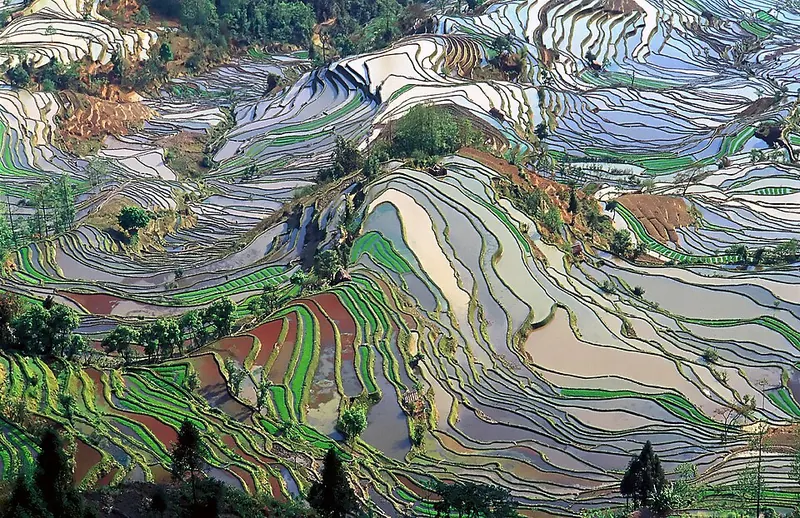
Full frame retained; proportionally resized and converted to WebP. No retouching or changes to the photographed subject. Card displays may crop the view.
Explore the region
About Honghe Hani Rice Terraces
Water channels connect these elements, making the scenery inseparable from the farming system. Duoyishu and Bada offer different views of the tightly layered fields. Their appearance changes with the agricultural season: water-filled terraces reflect the sky, while growing rice creates a more textured green surface. Look from managed viewpoints and village routes without entering cultivated plots.
The Hani have maintained this farming system for more than 1,300 years. The terraces became a Major Historical and Cultural Site Protected at the National Level (全国重点文物保护单位) on 5 March 2013. Their cultural landscape was inscribed on the World Heritage List on 22 June that year, with a heritage area of 16,603 hectares.
The protected landscape includes 82 villages, whose buildings are generally made from adobe and stone. Households typically cultivate one or two terrace plots and combine red-rice farming with cattle breeding. Conserved forests above 2,000 metres collect rainfall, while canals, ditches and sandstone water-storage features distribute it to the fields below.
What to look for
- Duoyishu reveals closely layered rice terraces that can reflect the sky when flooded.
- Bada provides another broad view of the terraces beneath villages and forest.
Background & history
The Honghe Hani Rice Terraces are the system of Hani rice-growing terraces located in Yuanyang County, Honghe Prefecture, Yunnan, China. The terraces' history spans around 1,200 years. The total area stretches across 1,000,000 acres and four counties: Yuanyang, Honghe, Jinpin and Lüchun, although the core area of the terraces is located in Yuanyang County. In 2013, 16,603 hectares of the Honghe Hani Rice Terraces were listed as a World Heritage Site, because of their outstanding resilient construction, unique social-ecological system, and importance to the Hani people.
Excerpt from Wikipedia: Honghe Hani Rice Terraces · Wikipedia contributors · CC BY-SA 4.0. Selected introductory sentences; formatting simplified. Background information, not current visitor-service advice.
Location & getting there
Getting to Honghe Hani Rice Terraces
Use Xinjie Town in Yuanyang as the highland access base, then arrange the road connection to Duoyishu or Bada. Yuanyang’s lower county seat, Nansha, is a different place; confirm whether your transport reaches Xinjie or requires an onward transfer.
Combine your visit
Suggested order for the visit:
-
Duoyishu viewpoint
Study the terrace pattern and seasonal surface.
-
Bada viewpoint
Compare another slope and its forest–village–field arrangement.
This is an editorial sequence of named spaces or places. It does not imply a verified walking connection or promise opening, ticket availability or a journey time.

Find Honghe Hani Rice Terraces
红河哈尼梯田 · 红河州
The pin marks the area, not the entrance.
More places nearby
Approximate straight-line distances between map pins, not travel distances.
Jianshui Confucian Temple 建水文庙
59 km awayJianshui Confucian Temple occupies a sequence of six courtyards in Lin’an town. The complex developed through successive periods, but its strongest visitor impression comes from the progression of open courts and formal halls…
View guide →Jianshui 建水
61 km awayJianshui’s old centre combines a city gate, scholarly buildings and traditional streets. Chaoyang Gate Tower marks the eastern approach, while the Confucian Temple opens into an unusually spacious setting around Xuehai, the Sea…
View guide →Tuanshan Village 团山村
61 km awayTuanshan preserves a concentration of courtyard houses west of Jianshui, where the settlement meets farmland and the Lujiang valley. Zhang Family Garden is the main architectural focus, with connected courts that reveal how a…
View guide →Sources & visit information
The sources below support the place-specific description and arrival information. Suggested combinations are editorial planning ideas; confirm current opening, entry arrangements and transport services for your date.
- Honghe Hani Rice Terraces ↗
- Wikivoyage: Yuanyang ↗
- Yuanyang government: terrace landscapes ↗
- Chinese Wikipedia: 红河哈尼梯田 (revision 93284838, 2026-07-02) ↗
- English Wikipedia: Honghe Hani Rice Terraces (revision 1366154370, 2026-07-26) ↗
Visitor information adapted and edited from Wikipedia contributors, “Honghe Hani Rice Terraces” · CC BY-SA 4.0. Source revision 1366154370.
Visitor information adapted and edited from Wikivoyage contributors, Yuanyang · CC BY-SA 4.0. Source revision 4929247.
Background paragraphs translated and condensed from Wikipedia contributors, "红河哈尼梯田", Chinese Wikipedia · CC BY-SA 4.0. Source revision 93284838.
Background paragraphs condensed from Wikipedia contributors, "Honghe Hani Rice Terraces", English Wikipedia · CC BY-SA 4.0. Source revision 1366154370.