

Entry & permits for Tibet (Xizang)
Foreign tourists need Tibet entry approval, commonly called a Tibet Travel Permit, and an organised visit arranged through a specialist travel agency in China. Confirm your approved route before booking transport. Requirements differ for Taiwan residents and for travellers using mainland or Hong Kong/Macao Chinese resident documents; check the document guide before you book.
Check the travel-document requirements →Policy scope verified: 2026-09-06. UK FCDO: China regional travel advice ↗ State Council Taiwan Affairs Office: Tibet entry approval ↗ Xizang Department of Culture and Tourism: Medog border permit notice ↗
Explore the region
Tap any red Chinese text to hear it in Mandarin.
Why this monastery matters
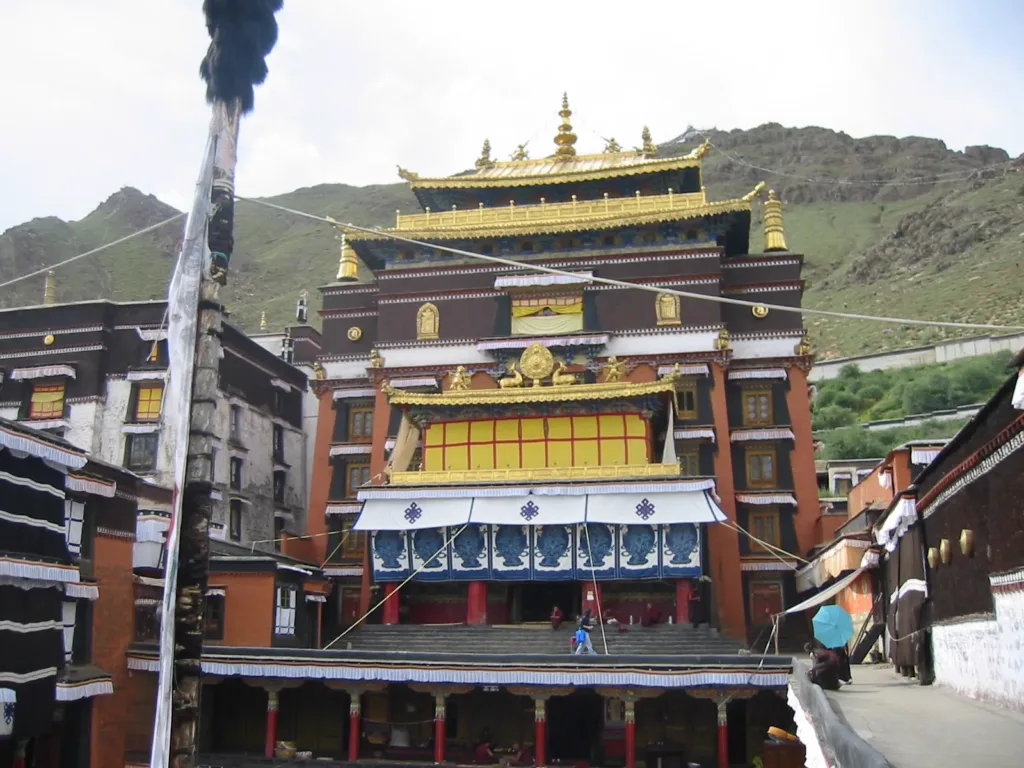
Tashilhunpo is part of Shigatse’s identity as the historic centre of the Tibetan region known as Ü-Tsang’s western heartland. Gendun Drub, later recognised as the First Dalai Lama, founded the monastery in 1447, and it became the traditional monastic seat of the Panchen Lamas. It was listed as a Major Historical and Cultural Site Protected at the National Level in 1961.
Read the complex as a hillside settlement, not a single façade. The lower part is dominated by low, white, flat-roofed buildings associated with residences and study spaces; taller red-walled, gilded-roof buildings rise behind them around chapels, scripture halls and stupa shrines. That change in height and colour is one of the clearest ways to understand how a working monastery is organised.
What to look for
Begin with the Maitreya Chapel, known locally as Qiang Kang (强康). The gilded copper Maitreya is about 26 metres high, so look at the relationship between the statue and the hall built around it rather than treating it as an isolated object. Details such as the lotus base, the height of the surrounding architecture and the devotional objects show the amount of craft and space required for the image.
Continue to the memorial-stupa halls associated with the Panchen Lamas. The stupa precincts connect the monastery’s present religious life with its institutional history; they are sacred interiors, not a staged museum display. Follow the guide’s instructions about which halls are open, where photography is permitted and when a service takes precedence over sightseeing.
If the day’s access allows, walk part of the lingkhor, the pilgrimage path outside the monastery walls. The route gives a different view of the red upper buildings, white residential blocks and the city below. Walk in the direction used by local pilgrims, keep clear of worshippers and do not assume that every hillside section or hall is included in a visitor ticket.
You may encounter chanting, prayer or philosophical debate, but these are activities of an active monastery rather than performances scheduled for visitors. Watch quietly from an allowed area, do not photograph people at close range without permission and let your guide explain any temporary boundary.
Getting there and returning
The listed visitor address is No. 1 Jijilangka Road, Sangzhuzi District, Shigatse, Tibet Autonomous Region (日喀则市桑珠孜区几吉朗卡路1号). In Amap/Gaode Maps, search 扎什伦布寺 Zhāshílúnbù Sì and keep the Chinese name available for the driver. A map pin is not a guarantee of the current admission gate, so meet your guide at the entrance used for that day’s admission.
For a rail approach from Lhasa, use the Lhasa–Shigatse railway to Shigatse Railway Station (日喀则火车站). A published station guide lists bus No. 8 from the railway station to Zhashi Square (扎什广场), the stop in front of Tashilhunpo Monastery. Bus operations and timetables were not independently confirmed for this draft, so an arranged vehicle or taxi is the safer plan, especially for visitors travelling under a fixed group itinerary.
For the return, arrange the pick-up point and departure time with your guide before entering. If you use bus No. 8, confirm the reverse direction at Zhashi Square rather than assuming that the next bus goes to the railway station. No reliable current reverse timetable, fare or exact journey time was found, so none is guessed here.
This visit sits at roughly 3,800 metres above sea level. Walk slowly, leave time for rests and tell your guide promptly if you feel unwell. Do not add a high-altitude or border-area extension on the assumption that the monastery visit covers it.
Foreign passport holders need more than a monastery ticket to reach Shigatse. The current travel guidance read for this draft says that foreign visitors must arrange a Tibet Travel Permit through a registered travel agency and travel on an organised itinerary; the permit may be checked before boarding a train or flight into Tibet. Confirm the approved route, document procedure and any additional permission needed before extending an itinerary towards Everest or another border-controlled area.
Current ticket prices, reservation rules, daily opening hours and access to individual halls should be confirmed with the venue or the authorised operator immediately before travel. The sources read here give conflicting ticket figures and do not provide a current venue notice, so older prices or a generic 09:00–17:00 listing should not be treated as guaranteed.
Combine your visit
Suggested order for this visit:
-
Main monastery courtyards
Orient yourself within the extensive monastic settlement.
-
Maitreya hall
Focus on the monumental image.
-
Memorial-stupa halls
Explore the monastery’s connection with the Panchen Lamas along the open visitor route.
This is an editorial sequence based on the features described in the sources. Confirm access locally; no walking time, shared admission or guaranteed interior access is implied.
Find Tashilhunpo Monastery
扎什伦布寺 · 日喀则
The pin marks the area, not the entrance.
More places nearby
Approximate straight-line distances between map pins, not travel distances.
Sources & visit information
Sources checked on 2 November 2026. Hours, tickets, reservations and transport can change; confirm with the operator before you go.
Image credits & notes (1)
- A richly decorated hall within Tashilhunpo Monastery, with red-and-gold upper buildings backed by Niseri Mountain. Photo: Mongol (Wikimedia Commons username; the file page states that the author is assumed from the copyright claims)Photo: CC BY-SA 3.0