

Entry & permits for Tibet (Xizang)
Foreign tourists need Tibet entry approval, commonly called a Tibet Travel Permit, and an organised visit arranged through a specialist travel agency in China. Confirm your approved route before booking transport. Requirements differ for Taiwan residents and for travellers using mainland or Hong Kong/Macao Chinese resident documents; check the document guide before you book.
Check the travel-document requirements →Policy scope verified: 2026-09-06. UK FCDO: China regional travel advice ↗ State Council Taiwan Affairs Office: Tibet entry approval ↗ Xizang Department of Culture and Tourism: Medog border permit notice ↗
Explore the region
Tap any red Chinese text to hear it in Mandarin.
Why visit
Sakya Monastery is the historic home of the Sakya school of Tibetan Buddhism, in Sakya County west of Shigatse. The site’s foundation is traced to 1073, while official regional descriptions date the present major monastery complex to 1268. Sakya’s importance is not only religious. Its collections and its links with the Sakya Pandita and Phagpa tradition place it in the history of Tibet’s relationship with the Yuan court.
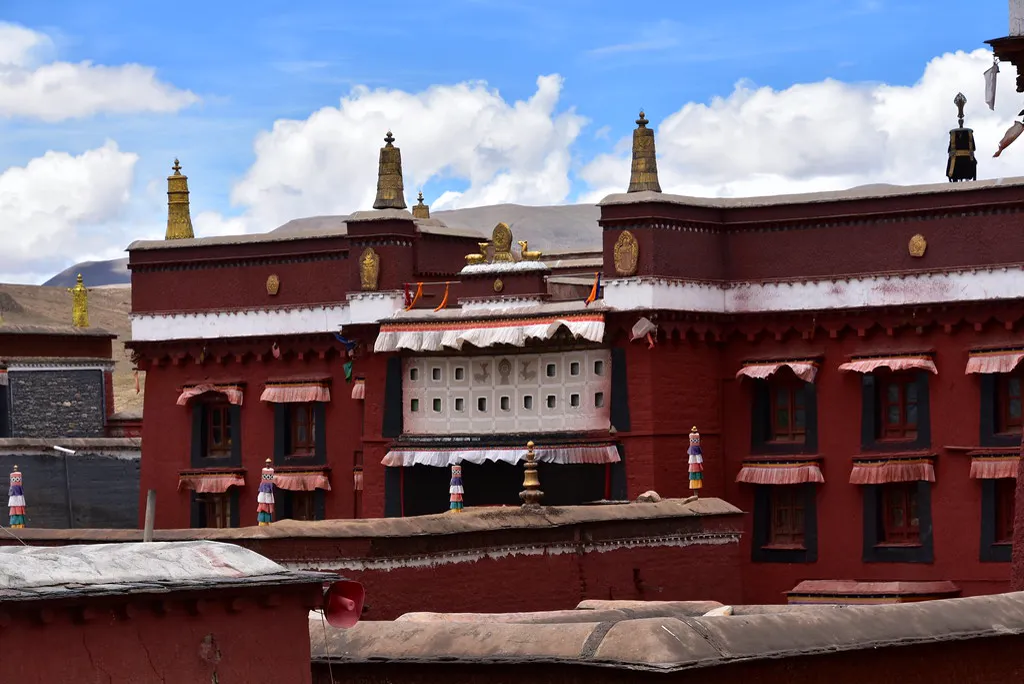
The strongest visit is a patient architectural and art walk rather than a quick photo stop. From outside, study the heavy enclosing walls and their red, white and blue bands, then notice how the courtyard and halls compress and release the view as you move inside. The official Shigatse description highlights the monastery’s rare manuscripts, murals and religious objects; if the library or mural rooms are open, make them the centre of the visit rather than trying to cover every hall.
What to look for
Begin with the southern monastery’s fortress-like exterior and main entrance. In the courtyard, look at the scale of the walls and the relationship between the open ground and the main hall. Inside, observe how painted surfaces, sculpture, timber details and devotional space work together. Ask before photographing, and do not assume that a room shown in an older guide will be open on your date.
The red, white and blue wall scheme is an unusually clear visual signature. The official city guide explains the colours through associations with Manjushri, Avalokiteshvara and Vajrapani; treat the bands as religious symbolism, not simply decoration.
Entry, altitude and practical limits
Foreign visitors to the Tibet Autonomous Region must obtain the required permit through a specialist travel agent in China and travel on an organised tour, according to the UK government’s current regional advice. Your agency should confirm that Sakya is on the approved route and whether any additional permission is needed if the itinerary continues towards a border or another restricted area. A passport and an ordinary attraction booking are not substitutes for the route approval.
The monastery stands at roughly 4,316 metres above sea level, a figure reported in an official account of its conservation work. Build acclimatisation into your Tibet itinerary, keep the first walk unhurried, and stop rather than pushing through serious altitude symptoms.
Current opening hours, ticketing, reservation rules and the list of rooms open to visitors were not confirmed in the official pages reviewed for this guide. Confirm them through your operator or the local site before setting out; a map listing is not proof that every hall is accessible.
Getting there and back
Sakya Monastery is in Sakya County, about 150 km from Shigatse according to the Shigatse government’s regional travel page. Arrange a road transfer from Shigatse rather than relying on an unverified walk-up coach plan. Give the driver the Chinese destination name 萨迦寺 Sàjiā Sì and confirm the visitor-facing complex; a public listing gives the useful last-mile description 日喀则市萨迦县八思巴路奔波山下 Rìkāzé Shì Sàjiā Xiàn Bāsībā Lù Bēnbōshān Xià, but the exact entrance should still be checked on the day.
For the return, reserve the same vehicle for a known pickup or have your agency verify a current coach back to Shigatse before you enter the monastery. The sources reviewed here do not establish a current public timetable, so do not plan around an assumed afternoon departure. There is no verified metro or rail station at the monastery, and no exact walking time from a transport stop is stated here.
Combine your visit
Suggested order for this visit:
-
Southern monastery walls and entrance
Begin with the fortress-like setting.
-
Main courtyard and hall
Move into the communal centre of the monastery.
-
Open library and mural areas
Focus the final part on manuscript culture and religious art.
This is an editorial sequence based on the features described in the sources. Confirm access locally; no walking time, shared admission or guaranteed interior access is implied.
Find Sakya Monastery
萨迦寺 · 日喀则
The pin marks the area, not the entrance.
Sources & visit information
Sources checked on 2 November 2026. Hours, tickets, reservations and transport can change; confirm with the operator before you go.
Image credits & notes (1)
- A red-walled hall at Sakya Monastery with gold roof finials and the high plateau behind it. Photo: Richard MortelPhoto: CC BY 2.0