

Entry & permits for Tibet (Xizang)
Foreign tourists need Tibet entry approval, commonly called a Tibet Travel Permit, and an organised visit arranged through a specialist travel agency in China. Confirm your approved route before booking transport. Requirements differ for Taiwan residents and for travellers using mainland or Hong Kong/Macao Chinese resident documents; check the document guide before you book.
Check the travel-document requirements →Policy scope verified: 2026-09-06. UK FCDO: China regional travel advice ↗ State Council Taiwan Affairs Office: Tibet entry approval ↗ Xizang Department of Culture and Tourism: Medog border permit notice ↗
Explore the region
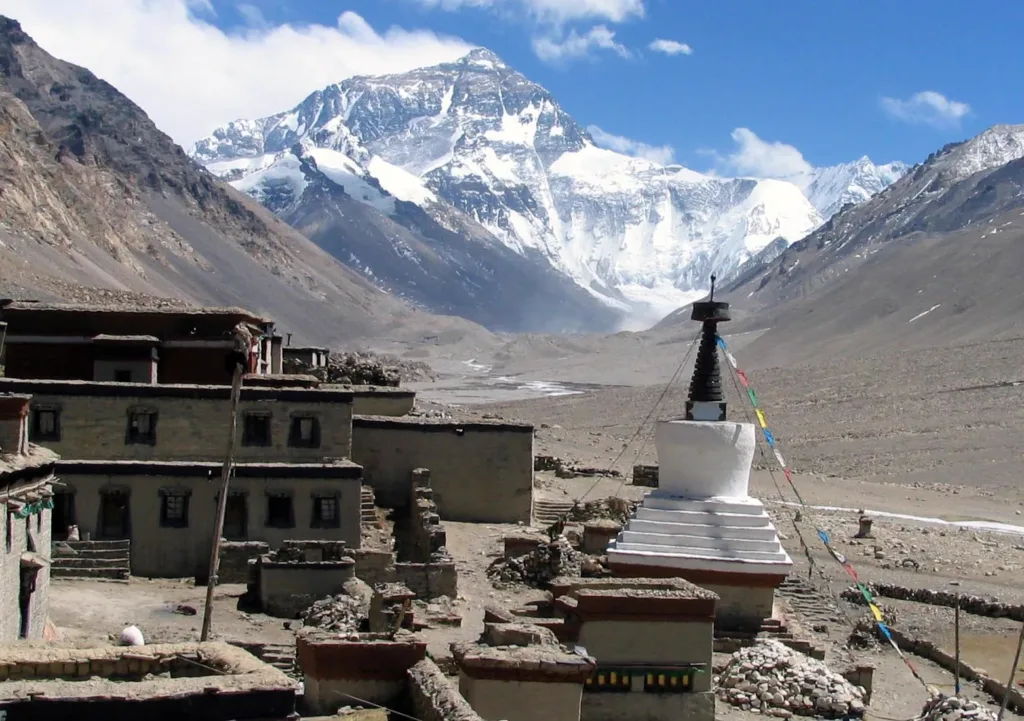
In brief: A high-altitude Nyingma monastery in Dingri County, where a terraced chorten, mani stones and a surviving religious settlement frame views toward the north face of Mount Everest when clouds allow. The visit is as much about observing a sacred Himalayan setting as entering a building.
Why this place matters
Rongbuk Monastery sits in the Everest valley of Dingri County at roughly 5,100 metres. It was founded in the early twentieth century in a landscape already used for meditation huts and caves; the monastery is associated with the Nyingma tradition of Tibetan Buddhism and has long been a religious settlement for both monks and nuns.
The memorable view is not just a mountain in the distance. Start with the large, terraced chorten in front of the monastery, then look for mani walls and carved stones along the paths and the small buildings climbing the slope. In clear weather, the valley opens toward the north face of Everest. Clouds and wind can close the view quickly, so the monastery’s low buildings, prayer landscape and high-altitude light are worth noticing even when the summit is hidden.
How to look and behave
Walk only in the areas the monastery and scenic-area staff make available. Observe the chorten, mani stones, rooflines and surrounding meditation landscape from the paths rather than climbing onto walls or entering caves and glacier terrain. This is a working Buddhist site, not a reconstruction for visitors. Ask before taking photographs inside a prayer hall or of people, and do not treat a ritual as a performance arranged for tourists.
The monastery’s ceremonial history includes masked-dance observances, but I did not find a current public calendar that would justify planning a trip around a particular date. Interior access, any active worship space and any temporary closure should be confirmed locally on arrival.
Entry, route and return
Rongbuk Monastery is in Quzong Village, Zaxizong Township, Dingri County, Shigatse, on the north side of the Everest region. The practical approach is an organised overland itinerary through Dingri County and the Everest scenic area. A 2018 official conservation notice described Provincial Road S515 as ending at Rongbuk and prohibited tourist travel above Rongbuk into the protected core area; that notice is useful as a warning not to assume that the Base Camp road or glacier area is freely walkable, but it is not a current timetable or a guarantee of today’s boundary.
The latest official scenic-area notice I found says ticket sales resumed at 09:00 on 26 September 2026 after snow and ice clearance. It also warned that some mountain roads and the Base Camp visitor area still had snow or ice, required vehicles to slow down, and told visitors to remain inside designated areas. Treat this as a time-stamped operating update, not a permanent opening schedule.
There is no verified rail station, regular public bus timetable or independent last-mile shuttle in the sources read for this entry. Arrange the road leg and the return before setting out; return by the same approved itinerary or the transport arranged by your tour operator, and do not assume that a vehicle will be waiting at the monastery. No exact walking minutes, ticket price, opening hours or current transfer arrangement is stated here because I could not confirm them.
Foreign visitors must obtain permission to travel to Tibet through a specialist travel agent in China and travel on an organised tour, according to the UK Foreign, Commonwealth & Development Office. Permit issuance and regional access can change without notice. A Tibet travel permit should not be treated as proof that every Everest-area road, monastery interior or protected-zone route is open: ask the operator to confirm the approved itinerary, the current scenic-area rules and any additional border or local-area permission for your passport before booking.
At about 5,100 metres, this is a high-altitude stop rather than a casual roadside stroll. Acclimatise before the visit, keep the schedule flexible, stay warm and follow your guide and local safety instructions. Leave the area if you feel unwell, and do not add an unsupervised climb above the designated visitor zone.
Combine your visit
Suggested order for this visit:
-
Monastery exterior
Begin with the compact buildings and their valley setting.
-
Terraced chorten
Look at the distinctive religious landmark in front of the monastery.
-
Permitted north-face viewpoint
Wait for a clear view without entering glacier or expedition areas.
This is an editorial sequence based on the features described in the sources. Confirm access locally; no walking time, shared admission or guaranteed interior access is implied.
Find Rongbuk Monastery
绒布寺 · 日喀则
The pin marks the area, not the entrance.
More places nearby
Approximate straight-line distances between map pins, not travel distances.
Sources & visit information
Sources checked on 2 November 2026. Hours, tickets, reservations and transport can change; confirm with the operator before you go.
Image credits & notes (1)
- Rongbuk Monastery buildings and a white chorten in the valley, with a snow-covered Himalayan peak behind them. Photo: Csearl (original uploader at English Wikipedia)Photo: CC BY-SA 3.0