

Explore the region
Tap any red Chinese text to hear it in Mandarin.
Why visit
The museum gives the tombs a historical and material context before you walk among the earthen remains. UNESCO describes the Xixia Imperial Tombs as a royal necropolis in the southern Helan foothills, with nine imperial mausoleums, 271 subordinate tombs, a northern architectural complex and flood-control works. The site reflects a Silk Road civilisation shaped by Tangut, Chinese and Buddhist traditions.
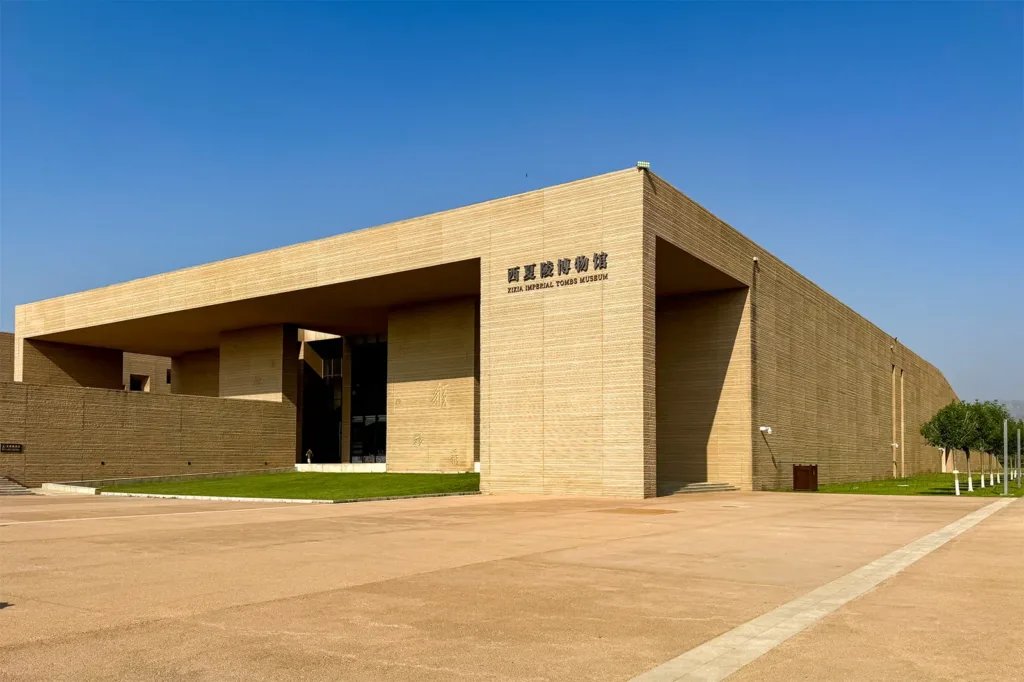
The new museum building opened in 2019. Its reported core themes cover Xixia history, culture, religious art, social and economic life, the imperial tombs, and conservation and transmission. The collections include architectural pieces, stone and brick objects, ceramics, coins, metalwork, paintings and sculptural figures.
What to look for
Start with the architectural fragments and ceramics: they make the tombs and their vanished buildings more legible than the outdoor earthworks alone. Coins, carved and inscribed objects, and religious sculpture extend the story beyond the cemetery. Models and reconstructed scenes are especially useful preparation for the tomb layouts outside.
Recent reporting on the museum describes interactive 720-degree cases for objects including a kalavinka figure (迦陵频伽), a green-glazed chiwen roof ornament (绿釉鸱吻), and a dragon-carved column. Displays and digital features can change, but these examples show the museum’s current effort to let visitors inspect details rather than only view objects behind glass.
If your visit includes the outdoor tombs, see the museum first and then follow the authorised visitor route. The museum and the mausoleum landscape are related parts of one heritage visit, not the same physical stop; allow time for the road transfer or any internal shuttle arrangement. A 2026 report says the visitor centre and museum display live shuttle waiting information, while the exact combination of admission, transport and experiences should be checked for your date.
Plan the visit
The museum is in Xixia District, south of Yinchuan’s southern ring expressway, east of National Highway G110 and west of Xiganqu. For a driver or ride-hailing car, give the Chinese destination 西夏陵博物馆 Xīxià Líng Bówùguǎn or 西夏陵国家考古遗址公园游客中心 Xīxià Líng Guójiā Kǎogǔ Yízhǐ Gōngyuán Yóukè Zhōngxīn and confirm the current visitor-centre drop-off. Search by the Chinese name as well as English: recent Chinese reporting uses 西夏陵博物馆 Xīxià Líng Bówùguǎn for the venue.
Plan for road transport rather than a metro transfer. Bus route 708 runs between 银川火车站东广场 (Yinchuan Railway Station East Square) and 闽宁商贸中心 (Minning Trade Center), with 西夏陵 (Xixia Tombs) listed as a stop. The stop serves the wider tombs visitor area, so follow on-site signs to the museum rather than assuming the bus terminates at the museum door. Check the live stop display and service hours before setting out.
Two visitor services are also described for the wider heritage site: 旅游专线一路 (Tourist Line 1) from 新月广场 (Xinyue Square) to 西夏陵国家考古遗址公园 Xīxià Líng Guójiā Kǎogǔ Yízhǐ Gōngyuán, and a Ningxia tourist through-bus from 银川火车站 (Yinchuan Railway Station) to 西夏陵 Xīxià Líng. Their departures vary by season. Confirm the first and last return before entering the museum or continuing to the outdoor tombs; do not assume that an outward tourist service runs late enough for your return.
A January 2026 local visitor notice listed 08:00–18:00 for the museum during the annual November–March low season. That dated notice does not establish the hours for every season or the hours on your chosen day. Current opening, combined-ticket arrangements, internal transport, and any passport-specific booking or admission procedure should be confirmed with the venue or its operator before travel.
Combine your visit
Choose from these complementary stops when planning your visit.
-
Western Xia history galleries西夏历史展厅
Begin with the state and its writing and material culture.
-
Tombs interpretation西夏陵展陈
Read the models before seeing the outdoor remains.
-
Western Xia imperial tombs西夏陵
Continue on the authorised visitor route if your ticket and timing allow.
This is a suggested combination, not a timed route; confirm the opening and transport arrangements for your date.
Find Western Xia Museum
西夏博物馆 · 银川
The pin marks the area, not the entrance.
More places nearby
Approximate straight-line distances between map pins, not travel distances.
Xixia Imperial Tombs 西夏陵
2 km awayThe Xixia Imperial Tombs preserve the royal cemetery of the Tangut dynasty at the foot of the Helan Mountains. Their surviving rammed-earth cores were once parts of more elaborate buildings. Walled enclosures and the position of…
View guide →Ningxia Science and Technology Museum 宁夏科技馆
19 km awayNingxia Science and Technology Museum offers hands-on exhibits in Yinchuan’s People’s Square museum area. Its programme connects general science with regional themes such as soil conservation and desertification, making the…
View guide →Ningxia Museum 宁夏博物馆
20 km awayNingxia Museum introduces the region through archaeology, art and local history. Notable collection pieces include carved tomb doors showing the whirling Hu dance, a gilded bronze ox and a stone support carved as a strongman…
View guide →Sources & visit information
Sources checked on 24 October 2026. Hours, tickets, reservations and transport can change; confirm with the operator before you go.
Image credits & notes (1)
- The current Xixia Imperial Tombs Museum building in Yinchuan's Xixia District, photographed from the forecourt. Photo: WindmemoriesPhoto: CC BY-SA 4.0