


Get to know Xixia District
- Administrative area
- District · 市辖区
- Part of
- Yinchuan
- Chinese name
- 西夏区
- Local areas
- District guide
Area & population
- Administrative seat
- Xihuayuan
Source: English Wikipedia, as of the dates shown.
Xixia is an administrative district rather than one compact sight. Its eastern side reaches the Baotou–Lanzhou Railway and its western boundary follows the Helan watershed, meeting Alxa Left Banner in Inner Mongolia. Between them, the district changes from a long-irrigated Yellow River plain to gravelly alluvial fans at the foot of the mountains. That transition is the key to the place: fields and city roads give way to dry gullies, bare rock and a high mountain wall.
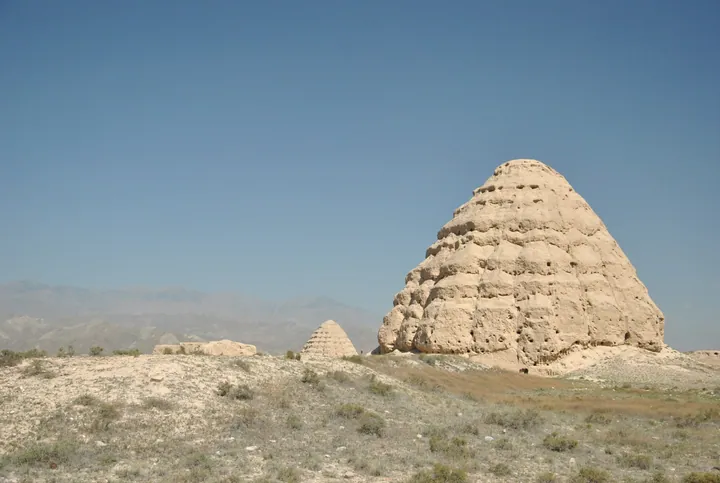
The clearest cultural stop is the Xixia Imperial Tombs (西夏陵). The necropolis is the imperial cemetery of the Xixia dynasty, founded by the Tanguts in the eleventh century and lasting until 1227. Its landscape includes nine imperial mausoleums, 271 subordinate tombs, a northern architectural complex and flood-control works, with the Helan Mountains still forming its visual backdrop. UNESCO inscribed the property as a World Heritage site in 2025.
Read the tombs as an archaeological landscape rather than as a single monumental building. The surviving earthen forms, their spacing and the mountain setting matter as much as any one mound. The official visitor facilities include the Western Xia Museum (西夏博物馆), whose permanent exhibition is arranged in eight parts, and a Western Xia script movable-type printing experience. The visitor centre also lists films and interpretation, giving a useful introduction before you look across the open site.
For a different kind of historical setting, go to Zhenbeibu Western Film Studio (镇北堡西部影城). The attraction uses two ruined Ming–Qing frontier forts and preserves the rough earthen walls and deliberately weathered look that made them useful to film-makers. The district’s official account links the site to films including Red Sorghum, A Chinese Odyssey and New Dragon Gate Inn, and says that more than 140 sets have been kept or reproduced. Look at how the walls, lanes and props turn a real frontier landscape into a film set; it is a managed cultural attraction, not an untouched fortress.
The eastern Helan foothills add a contemporary layer. Xixia’s tourism bureau describes the district as a core area of the Helan Mountain eastern-foot wine corridor and lists wineries including Changyu Longyu (张裕龙谕酒庄) and Zhihui Yuanshi (志辉源石酒庄). A winery visit is not a single district-wide attraction: choose the individual cellar, check its current opening and booking arrangements, and do not assume that a vineyard or tasting room accepts unannounced visitors. Helan inkstone (贺兰砚) is another local material tradition associated with the district; ask for the maker and provenance if you are buying a piece rather than treating every dark stone as a verified craft object.
Getting there and moving between the foothills
Use 银川站 (Yinchuan Railway Station) as a practical rail gateway, then plan the western foothill leg separately. China Railway’s station guide lists buses from the station, including routes to the city, and names 游一 for 西夏王陵 and 游二 for 滚钟口、苏峪口、贺兰山岩画.
A transport guide published on 30 September 2026 gives the most useful current route picture, but its departures and fares are date-sensitive. From 北门公交车场, 游1 runs toward 西夏陵, stopping at 银川火车站东广场 and 西夏广场公交首末站; the published outward departure is 09:30 and the return departure from 西夏陵 is 14:00, with a CNY 10 single fare.
For the mountain side, 游2 runs from 北门公交车场 via 银川火车站东广场, 文萃街朔方路口, 文萃街学院路口, 宁夏工商职业技术学院南门, 滚钟口, 拜寺口双塔 and 苏峪口 to 贺兰山岩画. The same guide lists 09:30 outward and 15:00 return departures, with a CNY 10–15 fare range. 游3 follows a similar western route but adds 镇北堡西部影城 before 苏峪口 and 贺兰山岩画; its published outward departure is 09:20 and return departure is 14:00.
The guide also lists two useful station shuttles: a 火车站东广场 service toward 贺兰山岩画, with 镇北堡影视城、漫葡小镇、苏峪口 and 贺兰山岩画 stops, departing during 08:30–11:30 and returning during 13:30–17:00; and a 火车站西广场 service to 西夏陵, departing from 08:00 according to passenger demand and returning from the scenic area at 19:00. These are published local transport arrangements, not a promise of a year-round timetable. Confirm the exact stop, payment method, operating day and return before setting out.
The tombs, film studio and mountain visitor areas are spread across a large district. If a scheduled bus does not fit your day, use the exact Chinese destination—西夏陵, 镇北堡西部影城 or 贺兰山国家森林公园苏峪口—when arranging a taxi or ride-hail, and confirm the return plan at the venue. Do not treat the three clusters as a walkable circuit. Sun protection and water are sensible on the exposed foothill routes; the transport guide specifically warns that the attractions are far apart.
Visiting notes
Opening hours, tickets, reservations and passport-holder arrangements belong to each venue, not to Xixia District as a whole. Check the current notice for the Xixia Imperial Tombs, Western Xia Museum, Zhenbeibu Western Film Studio or the individual winery before travelling. The heritage designation protects the site; it does not by itself confirm a particular exhibition, film, activity, entrance or transport service on your chosen date.
Explore Xixia District
Core places to explore, with English and Chinese names.
Places to explore around Xixia District
 A large earthen mound in the Xixia Imperial Tombs, with the Helan Mountains behind it. Photo: xiquinhosilva (Xiquinho Silva) · CC BY 2.0
Xixia Imperial Tombs西夏陵
Xixia Imperial Tombs is the Western Xia royal cemetery at the foot of the Helan Mountains, where nine imperial mausoleums, 271 subordinate tombs, a northern architectural complex and flood-control works form a planned funerary landscape. Its museum and open archaeological setting make the site a strong introduction to Tangut history, Buddhist and Chinese influences, and Silk Road exchange.
Read the place guide →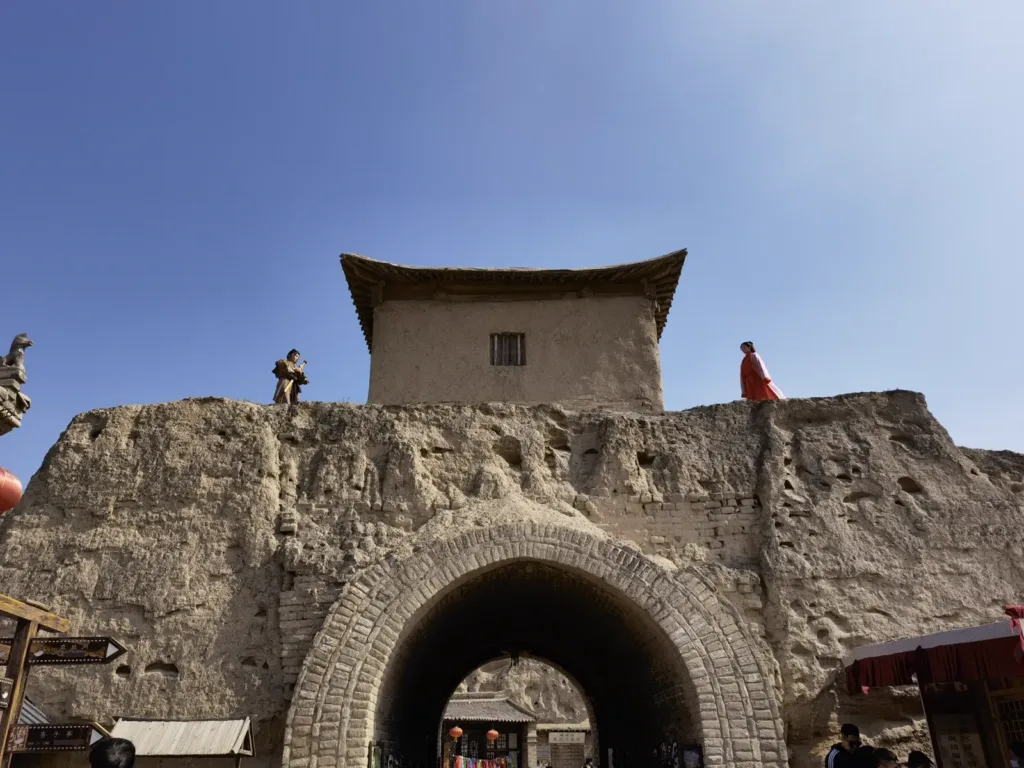 A rough earth-and-brick arched gate at Zhenbeibu Western Film Studio, with the weathered wall, a small tower and costumed visitors above it. Photo: Yanxutong1215 · CC BY-SA 4.0
Zhenbeibu Western Film Studio镇北堡西部影城
Zhenbeibu Western Film Studio is a film-tourism site built around old fort remains at the foot of the Helan Mountains. Its rough earth-walled streets, recreated northern-town scenes and recognisable locations from films such as Red Sorghum and A Chinese Odyssey make it a place to compare cinema with the physical sets rather than a preserved historic town.
Read the place guide → AI illustration · AI 示意图(仅供参考,非该地点实拍)
Gunzhongkou Scenic Area滚钟口
Gunzhongkou, also called Xiaokouzi (“Little Pass”), is a managed mountain visitor area on the eastern foothills of the Helan Mountains in Yinchuan’s Xixia District. Its three-sided valley, open eastern view and marked mountain walks make it a practical outing for seeing the Yinchuan Plain from the hills, while heritage records add a quieter archaeological layer.
Read the place guide →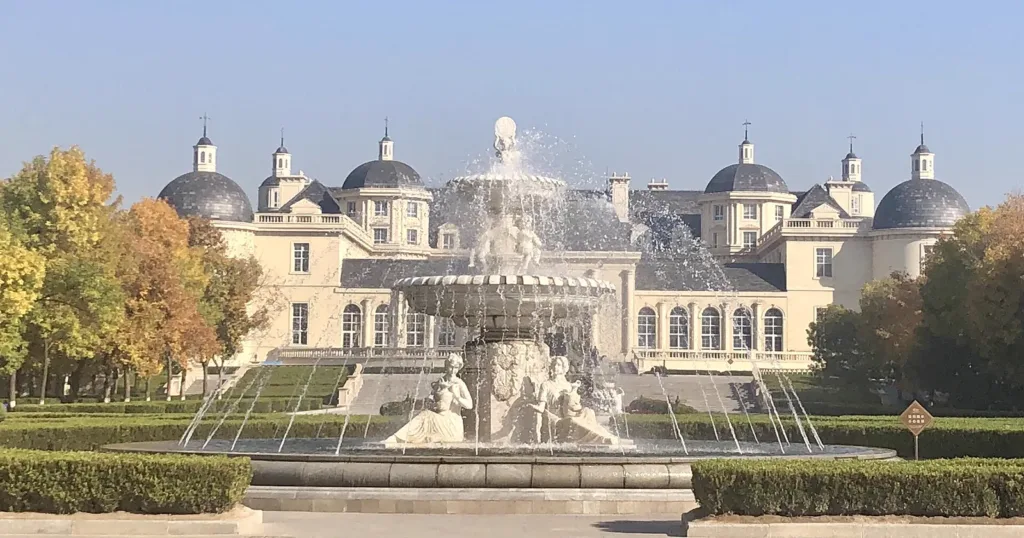 Château Changyu-Moser XV winery estate and fountain in Ningxia’s Helan Mountain foothill wine region, a named estate within the Yinchuan winery-visit landscape. Photo: Nicstricsmith · CC BY-SA 4.0
Winery Visits on the Eastern Helan Foothills贺兰山东麓酒庄参访
Winery visits on the eastern Helan foothills are a choose-your-estate experience around Yinchuan’s Xixia District, where vineyards sit against the Helan Mountains. Book a named winery to see the parts of the process that are actually offered—such as a vineyard, fermentation room, cellar or tasting hall—rather than expecting one shared gate or ticket.
Read the place guide →Plan your visit
Getting there
Xixia District is about 6 km (straight-line distance) from central Yinchuan. Search for 西夏区 in a map app to find stations and your accommodation.
Where to stay →Build your route
Xixia Imperial Tombs and Zhenbeibu Western Film Studio are about 20 km apart (straight-line distance). The linked place guides have entrance and visit details.
Continue with Yinchuan →More in Yinchuan
Sources & geographic information
Administrative names and parent areas: Official geographic directory (dmfw.mca.gov.cn) · Reference date 2026-09-06.
Background text adapted from Xixia, Yinchuan — Wikipedia contributors, under CC BY-SA 4.0. Text has been shortened and reorganized; source revision 1324791542.
Map data © OpenStreetMap contributors. Pins mark approximate centres, not entrances or boundaries.
Image credits & notes (1)
- Tomb towers of the Western Xia Imperial Tombs in Xixia District · 西夏区西夏陵一、二号陵塔Photo: Jayavarman · CC BY-SA 3.0 · taken 2013-08-29Resized for the web; the photo itself has not been edited. Thumbnails may show a cropped view.
