

Photo adjustments
Full-frame source proportionally resized and converted to WebP for display. No subject alteration. Source-supplied marks and edits remain; cards may crop the view.
Explore the region
About Beipu
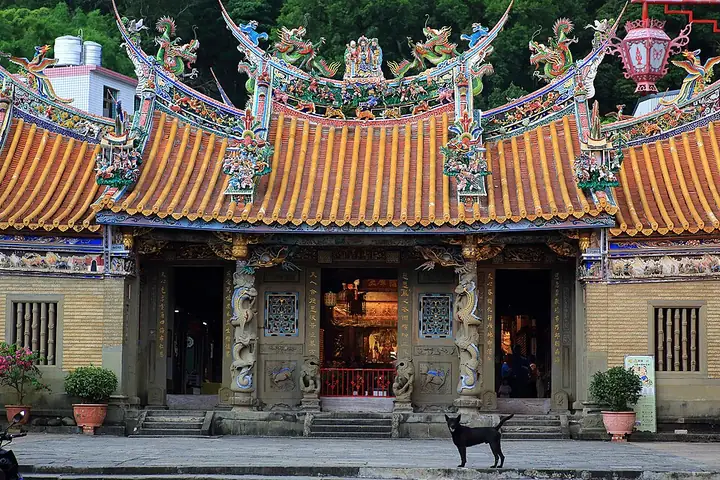
Citian Temple anchors the old-town streets, where traditional snacks, lei cha and small shops make a natural pause between buildings. The area retains red-brick lanes and several prominent historic residences.
Jinguangfu Hall, Tianshui Hall and the Jiang A-xin mansion show different chapters of the settlement’s history. Plan around the visitor arrangements for each property: some buildings are appreciated mainly from outside, and an open street does not mean every residence is open. Beipu Cold Spring lies outside this old-street circuit.
Before the Qing administration period, the area was home to the Saisiyat and other Pingpu indigenous peoples. In 1835 the Danshui sub-prefecture ordered the Hakka Jiang Xiuluan (姜秀銮) and the Hoklo Lin Dexiu (林德修) and Zhou Bangzheng (周邦正) to jointly fund the Jinguangfu Reclamation Company (金广福垦号), an armed Hakka-Hoklo venture that opened the Da'ai area covering today's Beipu, Baoshan and Emei townships. Hakka settlers who followed now make up about 95 percent of Beipu's population.
Beipu lies in southwestern Hsinchu County, bordered by Emei, Baoshan, Zhudong, Wufeng township and Miaoli County's Nanzhuang, covering about 50.667 square kilometres. The terrain is mostly hills and mountains, higher in the south, with the Beipu basin at an elevation of about 90 to 150 metres; its flat, fertile land and ample irrigation made it the area's early rice-growing centre, while the surrounding hills, at 90 to 200 metres, are planted with tea and fruit orchards.
Jinguangfu Guildhall (金广福公馆), built in 1835, is Hsinchu County's only national historic site (国定古迹), formerly ranked a first-grade national historic site, and served as the command and administrative office of the Jinguangfu reclamation venture. It has a two-section, one-courtyard quadrangle layout (四合院) with two side wings; the right wing was rebuilt in Japanese style after the 1935 earthquake, while the left retains its original Qing-era form.
What to look for
- Citian Temple forms the religious and spatial centre of the old streets.
- Jinguangfu Hall and Tianshui Hall preserve the settlement’s older architecture.
- The Jiang A-xin mansion and local tea shops add another layer to the walk.
Location & getting there
Getting to Beipu
For the historic settlement, go to Beipu Street around Citian Temple in Beipu Township, Hsinchu County. Specify the old street when arranging transport; Beipu Cold Spring is a different destination outside the centre.
Combine your visit
Build the visit around these complementary stops.
-
Citian Temple慈天宮
Begin at the temple and its forecourt.
-
Jinguangfu and Tianshui halls金廣福公館與天水堂
Follow the historic buildings, respecting their access rules.
-
Jiang A-xin mansion area姜阿新洋樓周邊
Add the later mansion and a tea stop in the lanes.
Use the current visitor programme and local conditions to choose which stops to include.
Find Beipu
北埔 · 新竹市/縣
The pin marks the area, not the entrance.
More places nearby
Approximate straight-line distances between map pins, not travel distances.
Daxi Old Street 大溪老街
33 km awayDaxi’s old streets grew around a prosperous inland port on the Dahan River. The surviving shop houses combine ornate Baroque-style facades with local decorative traditions. Look above the modern signs to see the shaped parapets…
View guide →Shengxing railway station 勝興車站
42 km awayShengxing is a small wooden station in the hills above Sanyi, associated with the old mountain railway. The station building, trackside setting and settlement around it make a coherent heritage stop. Its scale is modest, so the…
View guide →Taoyuan International Airport 桃園國際機場
48 km awayTaoyuan International Airport is a major arrival point for trips around Taiwan, connected to the metropolitan rail network by the Airport MRT. Its terminal facilities include places to eat, shop and rest while waiting for a…
View guide →Sources & visit information
The sources below support the place-specific description and arrival information. Suggested combinations are editorial planning ideas; confirm current opening, entry arrangements and transport services for your date.
- Tourism Administration: 北埔老街 — attraction record Attraction_376440000A_000221 ↗
- Chinese Wikipedia: 北埔鄉 (revision 94238219, 2026-09-08) ↗
Selected visitor facts translated and adapted from Tourism Administration and contributing local tourism authorities, 2026 Tourism Information Database v2.1 — 北埔老街 (Attraction_376440000A_000221) · Open Government Data License 1.0.
Background paragraphs translated and condensed from Wikipedia contributors, "北埔鄉", Chinese Wikipedia · CC BY-SA 4.0. Source revision 94238219.