


Photo adjustments
Full-frame source proportionally resized and converted to WebP for display. No subject alteration. Source-supplied marks and edits remain; cards may crop the view.
Explore the region
About Beigang Chaotian Temple
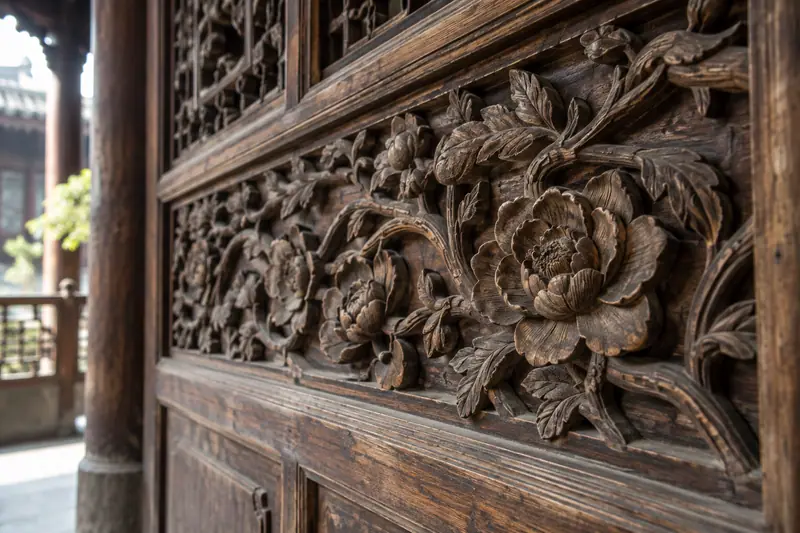
The front Sanchuan Hall and the Dragon and Tiger Gates concentrate much of the decorative work. Carved brackets and complex octagonal timber ceilings reward looking upwards as well as towards the altars.
The temple’s different halls reflect work by craftsmen from several periods. Begin with the entrance architecture, then follow the worshippers’ circulation towards the Mazu hall. Festival visits have a very different rhythm from an ordinary day; leave room around processions and devotional activity.
The temple was founded in 1694 (康熙三十三年) when the monk Shubi (树璧) brought a Mazu statue from the Chaotian Temple in her hometown of Meizhou, Fujian, to Beigang. In 1700 Chen Li-Shum donated land and funds to build Beigang's own Chaotian Temple, which was expanded in 1730 and rebuilt after 1770 when it was judged too simple. A further project begun in 1854 enlarged the temple into a palace-type complex of several wings.
The Shengmu Hall (圣母殿) enshrines Mazu, flanked by Zhongtan Yuanshuai (中坛元帅) and Hu Ye (虎爷), with the generals Qianliyan (千里眼) and Shunfeng'er (顺风耳) at her sides. A separate hall enshrines Guanyin (观音菩萨) with the Eighteen Luohan, and another enshrines the Three Treasure Buddhas (三宝佛) – Shakyamuni, Amitabha and Bhaisajyaguru – with images of Guanyin and Mazu placed before them.
The temple's original monastic lineage under the Linji school (临济宗), begun by founder Shubi, ran for seventeen generations before a management committee took over administration, though a Linji-school monk still serves as abbot. The temple also runs a cultural hall for concerts and other events and sponsors the Beigang International Music Festival. Since 2020 it has held a Buddhist Shuilu Fahui ceremony inviting deities from temples across Taiwan to pray for the pandemic's end.
What to look for
- Sanchuan Hall contains elaborate carved timber brackets.
- The Dragon and Tiger Gates have complex octagonal coffered ceilings.
- Mazu worship and pilgrimage traditions explain the temple’s place in Beigang life.
Location & getting there
Getting to Beigang Chaotian Temple
The temple is at 178 Zhongshan Road in Beigang Township, Yunlin County. Use the temple’s Zhongshan Road frontage as the arrival anchor, and check local traffic arrangements during major pilgrimage events.
Combine your visit
Build the visit around these complementary stops.
-
Sanchuan Hall三川殿
Look at the carved entrance structure.
-
Dragon and Tiger Gates龍虎門
Observe the octagonal timber ceilings from permitted areas.
-
Mazu worship hall媽祖殿
Continue respectfully through the active religious spaces.
Use the current visitor programme and local conditions to choose which stops to include.
Find Beigang Chaotian Temple
北港朝天宮 · 雲林縣
The pin marks the area, not the entrance.
More places nearby
Approximate straight-line distances between map pins, not travel distances.
Southern Branch of the National Palace Museum 故宮南院
11 km awayThe National Palace Museum’s Southern Branch in Taibao focuses on Asian art and cultural exchange. Its contemporary building by Kris Yao draws on the movement of Chinese ink painting, with solid and open forms winding around…
View guide →Alishan Forest Recreation Area 阿里山森林遊樂區
51 km awayThis pin refers to Alishan Forest Recreation Area, the high forest visitor zone with giant red cypress trees, mountain railway branches and misty woodland paths. The giant-tree trails and Sisters Ponds bring the forest into…
View guide →Alishan Forest Railway 阿里山森林鐵路
51 km awayThe Alishan Forest Railway began as an industrial line carrying timber from the mountains. Its climb from Chiayi towards Alishan passes through changing forest zones and demonstrates the engineering needed for steep terrain…
View guide →Sources & visit information
The sources below support the place-specific description and arrival information. Suggested combinations are editorial planning ideas; confirm current opening, entry arrangements and transport services for your date.
- Tourism Administration: 北港朝天宮 — attraction record Attraction_376490000A_000002 ↗
- Beigang Chaotian Temple: architectural art ↗
- Ministry of the Interior: Beigang Chaotian Temple architecture and pilgrimage tradition ↗
- Chinese Wikipedia: 北港朝天宮 (revision 94245860, 2026-09-08) ↗
- English Wikipedia: Chaotian Temple (revision 1373096650, 2026-09-04) ↗
Selected visitor facts translated and adapted from Tourism Administration and contributing local tourism authorities, 2026 Tourism Information Database v2.1 — 北港朝天宮 (Attraction_376490000A_000002) · Open Government Data License 1.0.
Background paragraphs translated and condensed from Wikipedia contributors, "北港朝天宮", Chinese Wikipedia · CC BY-SA 4.0. Source revision 94245860.
Background paragraphs condensed from Wikipedia contributors, "Chaotian Temple", English Wikipedia · CC BY-SA 4.0. Source revision 1373096650.