

Explore the region
Tap any red Chinese text to hear it in Mandarin.
A Buddhist landscape built as a procession
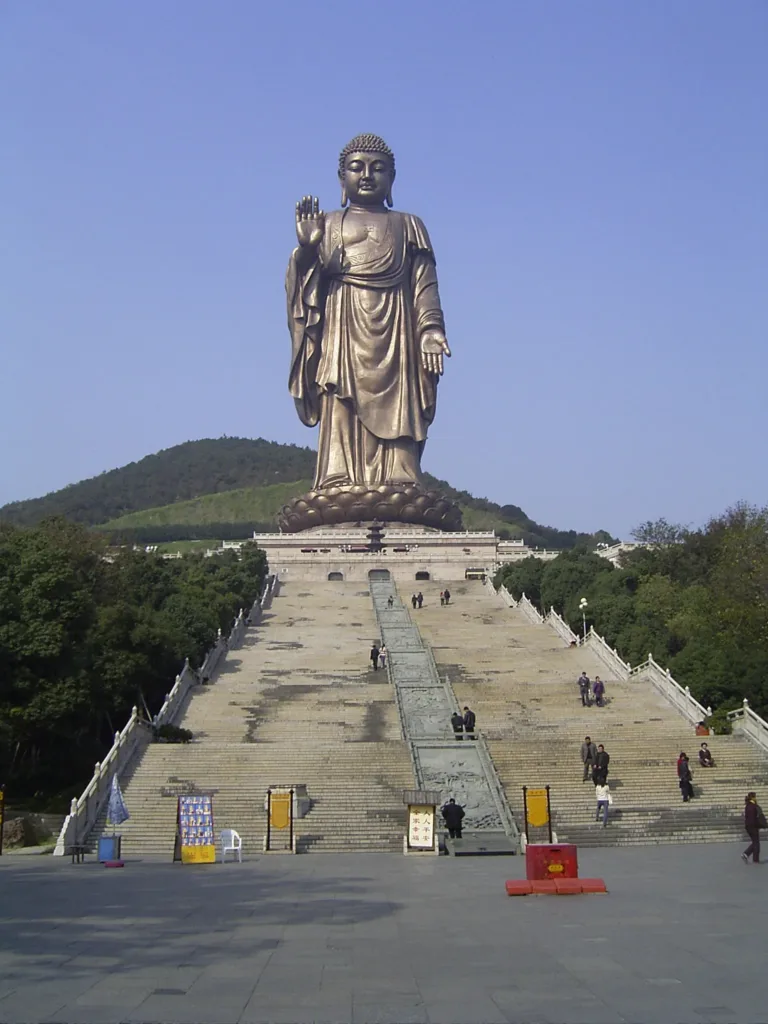
Lingshan is designed around a central axis that rises from the mountain gate toward the Grand Buddha, with halls and courtyards branching off it. The official Wuxi description identifies the Grand Buddha, Nine Dragons Bathing Shakyamuni and Brahma Palace as the three main wonders. The statue is 88 metres high and assembled from 725 tonnes of bronze; the scale becomes easier to understand when you see it at the end of the long approach rather than only from a distance.
Near the lower part of the axis, Nine Dragons Bathing Shakyamuni turns the Buddha’s birth story into a moving sculpture: a 7.2-metre gilded Prince Siddhartha rises from a lotus while nine dragon fountains spray water over it. Performance times are date-sensitive, so check the day’s notice rather than treating an old timetable as permanent.
Brahma Palace provides a very different experience from the open-air statue. Its large halls and decorated interiors bring together craft traditions including Dongyang woodcarving, Yangzhou lacquer and cloisonné; the result is a place to look closely at surfaces, ceilings and panels, not just take in the building’s exterior. Five Seals Mandala adds another enclosed cultural stop, while Xiangfu Temple and the surrounding grounds keep the visit connected to living Buddhist practice.
Planning the visit
For visits through 31 October, the current visitor notice lists scenic-area entry from 07:00 to 17:30. It lists Brahma Palace and Five Seals Mandala as open from 09:00 to 18:00, with some museums and halls keeping different hours; holiday or special-event adjustments can apply. A current listing also shows scheduled Nine Dragons performances and a separate Brahma Palace cultural programme, but times change by date. Leave enough time to walk the axis, see at least one interior and return before the final admission time.
Lingshan is a ticketed scenic area rather than a free Buddha overlook. Current booking pages show standard and foreign-visitor admission products, generally around CNY 150–160 depending on the date and product; treat the live booking page as the price source. Foreign visitors should carry the passport used for booking and the QR or reservation voucher: the ticket instructions require every visitor to present a passport when exchanging or checking the ticket. Admission products do not automatically include the internal sightseeing bus, meals or other paid experiences.
Getting there and back
The most useful public-transport option currently confirmed for a normal visit is Route 88 between Wuxi Coach Terminal 无锡汽车站 and Lingshan Shengjing 灵山胜境. A 2026 city transport notice lists service roughly from 05:30 to 19:00 and identifies the scenic area as the return terminus; check the same-day departure board before relying on the last bus. From Metro Line 2, use Meiyuan Kaiyuan Temple 梅园开原寺 station, then walk to the Meiyuan bus stop and transfer to Route 88. Seasonal LeYou services and holiday shuttles are added or withdrawn by date, so do not use a holiday-only timetable as a year-round route.
For a taxi or ride-hailing car, give the Chinese destination 灵山胜境检票口 Língshān Shèngjìng jiǎnpiàokǒu. The current ticket listing gives No. 1 Lingshan Road, Mashan Town, Binhu District, Wuxi City 无锡市滨湖区马山镇灵山路1号; a map listing uses another local road address, so keep the Chinese name and ask for the ticket entrance rather than relying on an English translation alone. Return by Route 88 from the 灵山胜境 Língshān Shèngjìng stop, or arrange a car pickup in advance if you plan to stay for a late performance.
Find Lingshan Grand Buddha Scenic Area
灵山胜境 · 滨湖区
The pin marks the area, not the entrance.
Sources & visit information
Sources checked on 24 October 2026. Hours, tickets, reservations and transport can change; confirm with the operator before you go.
Image credits & notes (1)
- The 88-metre Lingshan Grand Buddha rises above its long stairway in the Lingshan scenic area, Wuxi. Photo: Holger NaetherPhoto: CC BY-SA 3.0