

Explore the region
Tap any red Chinese text to hear it in Mandarin.
Why come
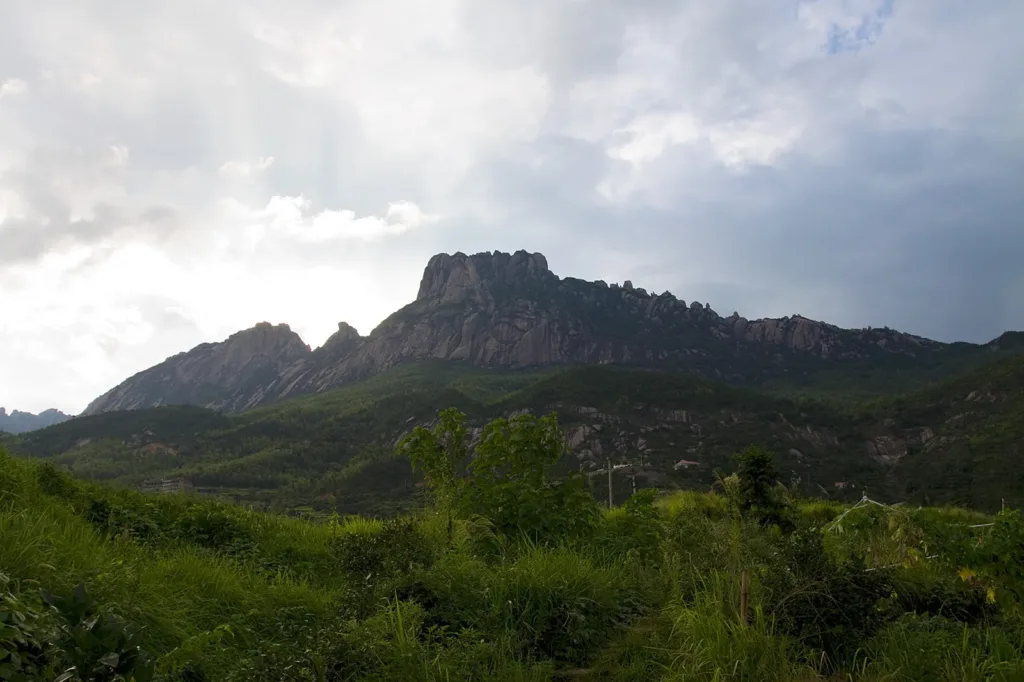
Lingshan is a mountain landscape to read in layers. The range lies in northern Guangxin District, Shangrao, and the scenic-area operator describes 72 peaks, with a main summit at 1,496 metres. Its granite ridges form a cluster of separate summits instead of a single cone. The view changes with distance: the ring-shaped peak forest is the geological subject, while the long skyline is compared locally to a woman lying asleep, the source of the “Sleeping Beauty” nickname.
The managed scenic area covers four named sections: Shuijing Mountain (水晶山), Shirendian (石人殿), Mingyang Lake (茗洋湖) and Tianti Peak (天梯峰). A recent Xinhua profile gives the planned area as 101.5 square kilometres and places the national scenic-area designation in December 2009 and the national 4A rating in December 2015. Treat these as a mountain region with different approaches and trail sections, not as four rooms reached from one compact plaza.
Lingshan also has a religious and literary identity. Shangrao’s scenic-area operator presents it as a Daoist and Buddhist sacred mountain and as the “thirty-third blessed land” of Daoist tradition. The range has been associated with writers including Wang Anshi and Xin Qiji. The strongest visit, however, is still physical: pause at the granite forms, compare near rock silhouettes with the wider ridgeline, and leave time for cloud and weather to alter what is visible.
What to see on the mountain
Use the 左溪游客中心 (Zuo Creek Visitor Centre) as the practical destination named in the current visitor guidance. The operator’s October 2026 guide groups the mountain walk around the 211 and 985 plankway sections, with viewpoints including 天空之境 (Sky Realm), 天梯峰, the glass walkway and 中华龙脊 (China’s Dragon Backbone). Its route suggestions range from shorter loops to a longer circuit, so choose by weather, leg strength and the time of the last return service rather than trying to collect every named rock.
The cableway can change the effort and sequence of a visit, but the current material does not establish a cableway price or guarantee that it is running on the day you travel. The same guide quotes the scenic-area admission as ¥95 per person; do not assume that this figure includes a cableway ticket. The official operator recorded a July 2026 temporary closure during typhoon weather and a delayed cableway maintenance schedule, a useful reminder that mountain access is operational and weather-sensitive.
Getting there and back
From Shangrao Station (上饶站), a direct “Didi Station Bus” service is described from the nearby Shangrao East Coach Station (上饶汽车东站) to Lingshan Scenic Area. The bus operator’s March 2024 release identifies the Shangrao high-speed-rail-station–Lingshan service as part of its tourism network, and a 2025 report describes the wider point-to-point network. The sources do not provide a dependable current timetable or last departure, so confirm the same-day booking and return before starting a long loop.
For a road transfer or taxi, use the exact Chinese destination 灵山左溪游客中心 Líng Shān Zuǒxī Yóukè Zhōngxīn. The recent visitor guide says this search name leads to the visitor centre; an exact street-number address is not stated in the accessible operator material. Do not give a driver only “灵山” or the name of a distant scenic sub-area. Before setting out, check the trail, cableway and closing status with the scenic-area operator at 0793-7985225, then keep enough daylight for the return.
Find Lingshan Mountains
灵山 · 广信区
The pin marks the area, not the entrance.
Sources & visit information
Sources checked on 1 November 2026. Hours, tickets, reservations and transport can change; confirm with the operator before you go.
Image credits & notes (1)
- A granite massif of Lingshan viewed from the foothills in Guangxin District, Shangrao, Jiangxi, photographed on 9 September 2010. Photo: ZhangzhugangPhoto: CC BY-SA 4.0