

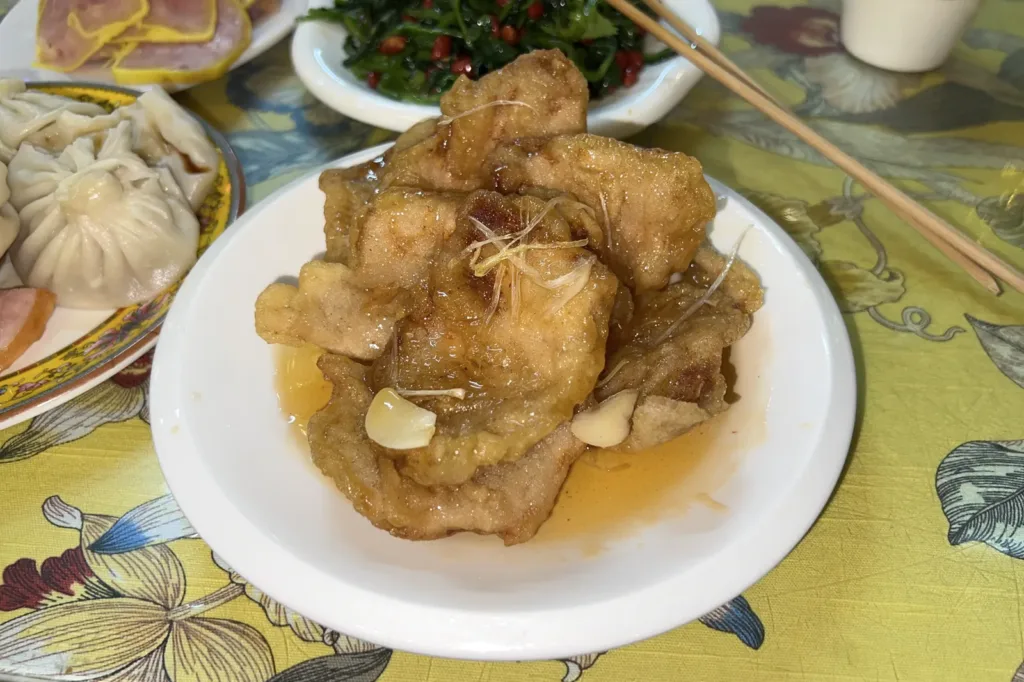
Guobaorou sweet-and-sour pork 锅包肉
Guobaorou (锅包肉) is a Harbin-associated northeastern Chinese pork dish: slices are coated in starch, fried until crisp, then quickly tossed with a sweet-and-sour sauce. It is best eaten hot, when the shell still crackles, and recipes vary between Harbin kitchens and elsewhere in Northeast China.
Tap any red Chinese text to hear it in Mandarin.
What makes it a Harbin dish
Harbin is strongly associated with guobaorou, but the dish is now a broader northeastern Chinese preparation rather than something found only in one city. Local culinary accounts place its early Harbin lineage in the kitchen of the former Daotai yamen, where chef Zheng Xingwen is said to have adapted a savoury fried pork dish for foreign guests. The older name is usually given as 锅爆肉 (guōbàoròu), while 锅包肉 (guōbāoròu) is the name you are most likely to see on a menu. Treat the yamen story and the explanation of the name as a local food tradition, not as a complete, independently documented recipe history.
The defining experience is contrast: a crisp, lightly coated pork slice, a tender centre, and a sharp-sweet glaze that is not meant to sit on the plate for long. A Harbin lineage described by Heilongjiang Daily uses pork, a thin water-and-starch coating, hot oil, aromatics and a sauce built around vinegar and sugar, with soy sauce and pepper water also appearing in the recorded old method. The fried pieces are returned to the hot wok for a quick 烹汁儿 Pēngzhīr finish, which drives off some of the vinegar’s harsh vapour while leaving a bright coating.
There is no single formula. Some kitchens fry twice to develop a drier, louder crunch before adding a thin glaze; a detailed English-language Dongbei recipe uses potato starch and a second short fry as one example. Other regional versions use more soy sauce, a different balance of vinegar and sugar, or a darker and thicker sauce. These are genuine variations, not proof that every red or soft sweet-and-sour pork dish is the Harbin style.
How to order it
Show the Chinese name 锅包肉 (Guōbāoròu) if you are ordering at a restaurant. Ask whether the dish is made to order, and start eating soon after it arrives: the sauce gradually softens the crust. A plate is easy to share, but tasting one piece before adding any extra condiment lets you notice the balance between vinegar, sweetness, aromatics and fried pork.
Pork is central to the dish. Starch forms the coating, but a particular kitchen may also use wheat flour, soy sauce, cooking wine, sesame oil or other seasonings. A recipe source illustrates pork loin, potato starch, soy sauce, Shaoxing wine, rice vinegar, aromatics and a quick final toss; it is useful for understanding one version, not for prescribing every local kitchen. If you have an allergy or dietary restriction, ask the restaurant about the meat, coating, sauce, oil and shared-fryer cross-contact. A menu name, colour or crisp coating cannot establish that a serving is halal, vegetarian, wheat-free or safe for your allergy.
Where to eat it
You can find Guobaorou all over Jilin, so there is no need to seek out one particular restaurant. To find one near you, search for “锅包肉” in Meituan (美团) or Amap (高德地图) and check recent reviews, distance and opening hours.
More dishes to compare
Explore related local specialties and compare their names, preparation notes and ordering guidance.
Pork belly, sour cabbage & glass noodles 酸菜白肉炖粉条 →
The cabbage is cut into narrow strips and simmered with pork and broth. The noodles are added so that they become tender without disappearing into the liquid. The balance of fresh pork, cooked pork and stock differs among households. Expect a clear sour note, soft cabbage and slippery noodles, with the pork providing richness. This is usually a broth-led dish rather than a thick sweet-and-sour sauce, and chilli can be added separately where offered.
Northeastern mixed vegetable & pork stew 东北乱炖 →
The meat and aromatics are started first where used, then the vegetables simmer together until tender. Cooks adjust the timing so denser potatoes and beans cook through while softer vegetables give body to the broth. The flavour is savoury and homely, with different vegetables contributing sweetness and texture. Corn can remain juicy, potato softens and aubergine absorbs the seasoning; the dish is about their combination rather than perfectly separate pieces.
Sources & reading
Recipes and servings vary between kitchens.
Image credits & notes (1)
- Guobaorou at Zhenbutong in Changchun, photographed 26 August 2022; a Northeast China regional example rather than a Harbin restaurant photograph. Photo: N509FZPhoto: CC BY-SA 4.0