

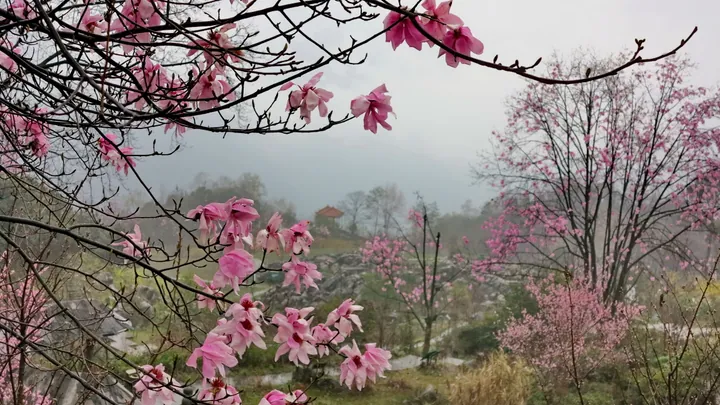
Photo adjustments
Full frame retained; proportionally resized and converted to WebP. No retouching or changes to the photographed subject. Card displays may crop the view.
Explore the region
About Medicine King Valley
The valley covers about fifteen square kilometres, with forest cover above ninety per cent and more than six thousand mu of that planted purely with medicinal species. More than a hundred and sixty commonly used medicinal herbs are produced here, and people living on the mountain have long made their living growing and digging them; the main products include gastrodia, eucommia, magnolia bark, xinyi magnolia buds, phellodendron, codonopsis and eleutherococcus, spread over more than ten thousand mu of continuous medicinal woodland. The two sources differ on height: the county chronicles office places the valley among mountains above 1,500 metres, while the People's Daily feature gives an average elevation of 1,400 metres. The chronicles office records dense vegetation, cool summers and 23,000 negative oxygen ions per cubic centimetre, along with karst caves and deep woodland.
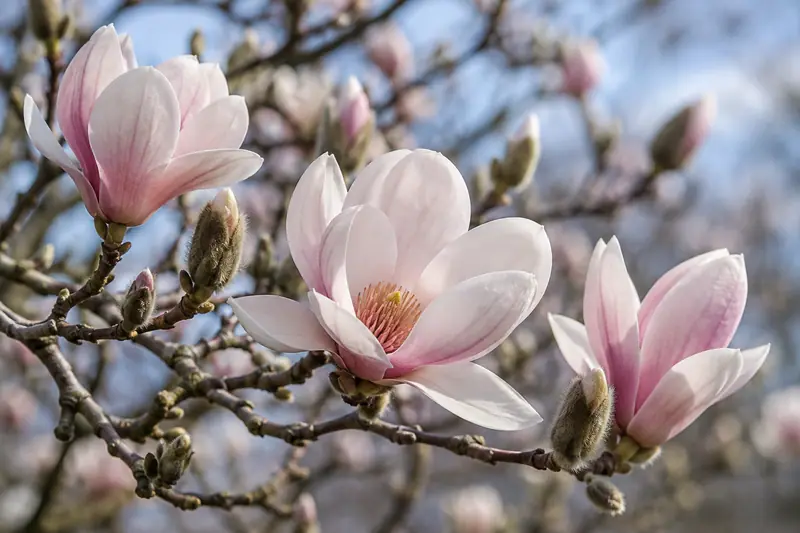
The stand that defines the place is old magnolia grown for xinyi, one of the medicinal materials the feature lists. More than 3,800 of these trees measure over thirty centimetres in trunk diameter, and nearly 1,800 are a century old, with trunks two people can just encircle and crowns spreading twenty to thirty metres. Every April the flowers open across the mountain, shading from white to purple. The site is run as a traditional-medicine wellness resort built on the principle of treating what has not yet become illness, and the chronicles office describes regimes there based on diet, breathing, consultation, bathing, pillows, movement and mind.
What to look for
- The old magnolia woodland grown for xinyi, in which more than 3,800 trees exceed thirty centimetres in trunk diameter.
- The century-old magnolias, nearly 1,800 of them, with trunks two people can just reach round and crowns twenty to thirty metres across.
- The April flowering, when the blossom runs from white to purple across the slopes.
- The medicinal crops themselves, including gastrodia, eucommia, magnolia bark, phellodendron, codonopsis and eleutherococcus among the more than 160 herbs grown here.
Location & getting there
Getting to Medicine King Valley
Check the open visitor route and follow the site’s rules on distance, food and photography. Conservation areas may limit access beyond designated paths.
- Search for 药王谷 with 绵阳市 and 北川羌族自治县.
Find Medicine King Valley
药王谷 · 北川羌族自治县
No reliable map pin yet: search by the Chinese name.
Sources & visit information
The linked sources support the identity and background described in this introduction. Opening hours, admission, activity availability and exact arrival arrangements have not been comprehensively checked. Confirm current visitor information with the venue; the original catalogue locality and editorial review flag are retained.