

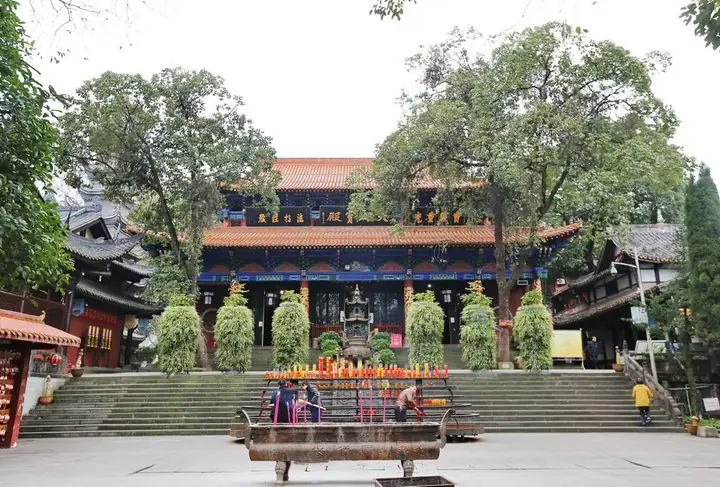
Photo adjustments
The exact downloaded source bytes are separately retained and hashed. Prepared JPEG is proportionally reduced to a maximum 720-pixel long edge; full frame retained, no subject alteration. Final website rendition: full frame retained, proportionally resized to at most 720 pixels and converted to WebP. No additional retouching or subject alteration. Card displays may crop the view.
Explore the region
About Guangde Temple
Originally named Shifo Temple, it was renamed successively across the dynasties: Baotang Temple in 767, Chanlin Temple in 778 (when founding abbot Wuzhu was given the posthumous title Keyou Chanshi), Shanji Temple in 780, Zaixing Chanlin Temple in 903, Guangli Chan Temple in 1011, and finally Guangde Temple in the Zhengde era (1513) of the Ming Wuzong emperor. The Suining tourism bureau's page records eleven imperial bestowals on the temple across the Tang, Song and Ming dynasties, and reports it is known as the "foremost Chan monastery from the west".
The complex covers about 28,350 square meters of building area and about 180,000 square meters of garden area, centered on the Mahavira Hall as its axis, with nine tiers of halls and 26 pavilions arranged from the base to the summit of the mountain, in a layout the tourism bureau describes as carrying Song-dynasty architectural characteristics.
The temple holds five named treasures: the Ming-dynasty Imperial Edict Archway, where monks once knelt to receive imperial edicts; the Song-dynasty Shanji Pagoda, the burial pagoda of founding abbot Keyou; a Song-dynasty Nine-Dragon Stele erected in 1174 recording the temple's imperial bestowals; a Burmese jade Buddha statue brought back via India by the monk Qingfu in 1910; and two jade seals kept at the temple, bestowed in 1011 and 1513.
What to look for
- the Ming-dynasty Imperial Edict Archway, where monks once knelt to receive imperial edicts
- the Song-dynasty Shanji Pagoda, burial pagoda of founding abbot Keyou
- the Song-dynasty Nine-Dragon Stele of 1174, recording the temple's imperial bestowals
- the Burmese jade Buddha statue brought back by the monk Qingfu in 1910
- the two jade seals bestowed on the temple in 1011 and 1513
Location & getting there
Getting to Guangde Temple
Check which interiors and courtyards are accessible. Active places of worship and protected monuments may have different visitor rules.
- Search for 广德寺 with 遂宁市 and 船山区.
Find Guangde Temple
广德寺 · 船山区
No reliable map pin yet: search by the Chinese name.
Sources & visit information
The linked sources support the identity and background described in this introduction. Opening hours, admission, activity availability and exact arrival arrangements have not been comprehensively checked. Confirm current visitor information with the venue; the original catalogue locality and editorial review flag are retained.