

Photo adjustments
EXIF orientation normalized; resized without changing aspect ratio; converted to WebP. No subject edits.
Explore the region
About Xiangcheng White Tibetan House Villages
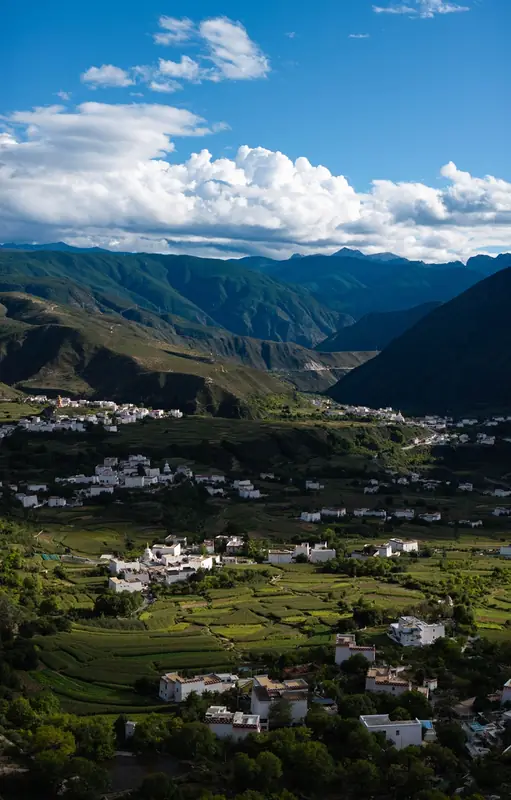
The catalogue name points to no single settlement but to this county-wide house type and the villages built of it. The Xiangcheng county local-chronicles office describes the houses as trapezoidal overall, with smooth flat walls whose outer face leans inward while the inner face stands vertical, and the interior framed with a dense array of wooden posts; the more posts a house has, the county notes, the larger it is. Doors and windows are finely carved and brightly painted, and red, yellow and green silks hang under the door and window eaves and on the central pillar for good fortune. Traditionally a house has five or six storeys: the lowest is a livestock shed, the second the main living floor with kitchen, sitting room, bedrooms and chapel, and the third, fourth and fifth mostly used for drying grain.
The walls are rammed from ordinary earth at a suitable dampness and can last upwards of a hundred years. About a month before the Monlam festival people mix a white earth peculiar to the mountains of Xiangcheng with water into a slurry, hold it in vessels such as teapots and pour it slowly down from the top of the wall until the earth wall turns white; the county local-chronicles item calls that earth agotu and the provincial housing department calls it saigaitu. The provincial department reports that the oldest surviving houses are more than 400 years old, that the waterproofing is poor and the slurry has to be poured again each year, and that in earlier years the buildings were disliked for it, some households fitting colour-steel tiles over them and others pulling them down for reinforced concrete, until about a third of the county's white houses had been damaged.
That report also records that in 2020 the China Folk Literature and Art Association investigated and Xiangcheng County was named the home of white Tibetan house culture in China, that in the same year the county issued measures on the management of urban and rural planning and building appearance requiring the main exterior colour of rural housing to be white rammed earth, and that more than 95 per cent of the houses kept their original appearance after those measures took effect; writing in April 2025 it adds that the Ministry of Housing and Urban-Rural Development had included the Xiangcheng experience in the second batch of its list of replicable experience in the protection and use of traditional villages the previous December. The prefecture government, reporting county work in December 2024, records 4.9 million yuan spent that year repairing 245 white Tibetan houses in Zhongde, Mucha and Xiaba villages in the Qingde area, and 370 rural craftsmen trained across the whole building process, among them wall-rammers, carvers, clay sculptors, painters, thangka painters, stonemasons and blacksmiths.
What to look for
- The wall profile itself: the outer face leaning inward and the inner face standing vertical, in houses the county describes as trapezoidal overall.
- The dense array of interior wooden posts, by which the county measures a house's size.
- The carved and painted doors and windows, with red, yellow and green silks hung under the eaves and on the central pillar.
- The three villages of the Qingde area named in the 2024 repair programme, Zhongde, Mucha and Xiaba, where 245 houses were worked on.
- The white slurry finish, renewed about a month before the Monlam festival by pouring it from the top of the wall until the earth turns white.
Location & getting there
Getting to Xiangcheng White Tibetan House Villages
Identify the main visitor approach and any separately managed houses, museums or performances. Ask before entering residential spaces or photographing residents.
- Search for 乡城白藏房村落 with 甘孜藏族自治州 and 乡城县.
Find Xiangcheng White Tibetan House Villages
乡城白藏房村落 · 乡城县
No reliable map pin yet: search by the Chinese name.
Sources & visit information
The linked sources support the identity and background described in this introduction. Opening hours, admission, activity availability and exact arrival arrangements have not been comprehensively checked. Confirm current visitor information with the venue; the original catalogue locality and editorial review flag are retained.