

Photo adjustments
Full frame retained; proportionally resized and converted to WebP. No retouching or changes to the photographed subject. Card displays may crop the view.
Explore the region
About Ganzi Monastery
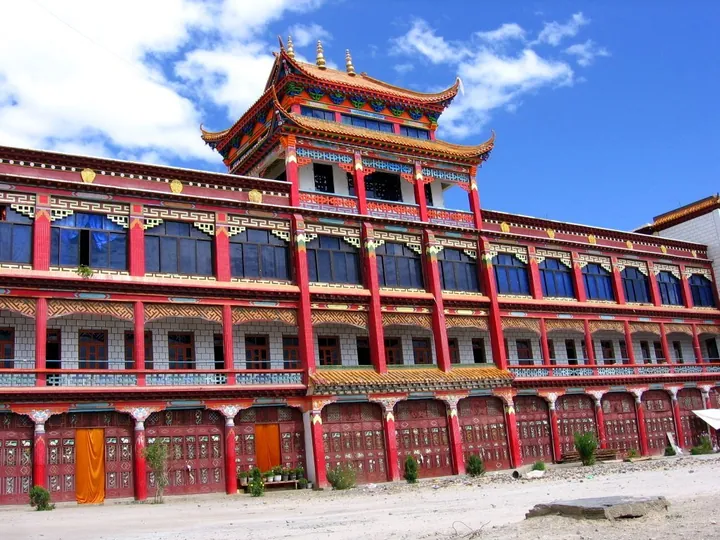
Ganzi Monastery (甘孜寺) is a Tibetan Buddhist monastery on a hilltop about 2 km north of Ganzi town (甘孜), in Ganzi County in Sichuan's Garzê Tibetan Autonomous Prefecture (甘孜藏族自治州). It is counted as the first of the Hor thirteen monasteries (霍尔十三寺) of northern Kham.
The monastery stands at about 3,400 m, built against the hill and facing south over the town and valley. Its founder, Hor Choje Ngawang Phuntsok (霍尔曲杰·昂旺彭措), was the son of a chief of the Hor family; taken at seven to Drepung Monastery (哲蚌寺) in Lhasa, he was ordained there before the Fifth Dalai Lama and vowed to him that he would build thirteen Gelug monasteries in northern Kham. The China Tibetology Research Center, citing a local history of Ganzi's holy sites, dates the founding to 1662; he later enlarged it with a nine-storey white palace and set its rules of study and discipline in his own charter. English Wikipedia instead gives about 1642 and ties the building to the Khoshut Mongols, whose castles of Mazur and Khangsar stood below; Chinese troops occupied the castles in the fighting of 1909 to 1918, and they are now ruins.
English Wikipedia says the monastery once housed 1,500 monks, which put it level with Chamdo as the largest in Kham, and that the pilgrims' circuit around it ran for nearly 8 km. It had nine reincarnate lamas. Rebuilding began in 1981, and on 1 June 2007 Sichuan listed it among its seventh batch of provincial protected sites.
A long stairway climbs to the main assembly hall, which has twelve great pillars and a golden roof topped by a Dharma wheel with deer. Inside, a gilded Shakyamuni sits at the centre, with a thousand gilded Shakyamuni figures on the east side and a thousand images of Tsongkhapa (宗喀巴) on the west.
What to look for
- The main assembly hall with its twelve pillars, golden roof and Dharma wheel with deer
- A gilded Kalachakra mandala upstairs in the three-storey building to the left of the main hall
- The central gilded Shakyamuni, with a thousand gilded Shakyamuni figures to the east and a thousand Tsongkhapa images to the west
- Sets of the Kangyur (甘珠尔) and Tengyur (丹珠尔) and the collected works of Tsongkhapa and his two chief disciples
- The Maitreya Hall, with a large Maitreya (Jampa) image
- The old hall and the monastery's collection of thangkas
- A rebuilt white stupa on a hill northeast of the monastery
Location & getting there
Getting to Ganzi Monastery
- Search for 甘孜寺 with 甘孜藏族自治州 and 甘孜县.
Find Ganzi Monastery
甘孜寺 · 甘孜县
No reliable map pin yet: search by the Chinese name.
Sources & visit information
Written from the linked sources and checked sentence by sentence against quoted extracts by a separate reviewer on 2026-09-23. Opening hours, admission and access arrangements are not covered; confirm current visitor information with the site.
- 【调研路上】阿音娜 | 霍尔(ཧོར་)人的历史遗产:甘孜霍尔十三寺 ↗
- Kandze Monastery - Wikipedia ↗
- 甘孜寺 - 维基百科,自由的百科全书 ↗
- 康北“霍尔” 及霍尔十三座寺院 ↗
Some facts checked against Wikipedia contributors, "Kandze Monastery" · CC BY-SA 4.0.
Some facts checked against Wikipedia contributors, "甘孜寺" · CC BY-SA 4.0.