

Entry & permits for Tibet (Xizang)
Foreign tourists need Tibet entry approval, commonly called a Tibet Travel Permit, and an organised visit arranged through a specialist travel agency in China. Confirm your approved route before booking transport. Requirements differ for Taiwan residents and for travellers using mainland or Hong Kong/Macao Chinese resident documents; check the document guide before you book.
Check the travel-document requirements →Policy scope verified: 2026-09-06. UK FCDO: China regional travel advice ↗ State Council Taiwan Affairs Office: Tibet entry approval ↗ Xizang Department of Culture and Tourism: Medog border permit notice ↗
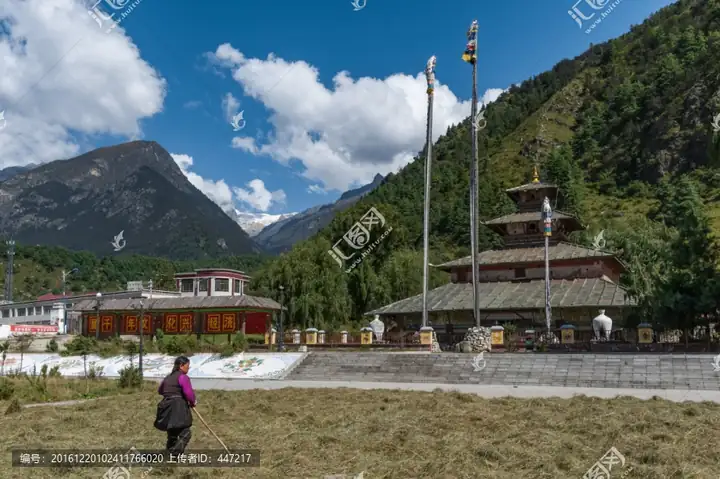
Photo adjustments
EXIF orientation normalized; resized without changing aspect ratio; converted to WebP. No subject edits.
Explore the region
About Phagpa Monastery
Phagpa Monastery (帕巴寺) is a Gelug (格鲁派) Buddhist temple in the form of a four-storey stone and timber tower, on the east side of Gyirong town (吉隆镇) in Gyirong County (吉隆县), Shigatse (日喀则), Tibet.
The temple stands at 2,850 m. The Shigatse city government dates it to about 637 and tells how the Nepalese princess Bhrikuti (赤尊公主), walking through Mangyul (芒域, the Gyirong area) on her way to Lhasa, carried three statues of Shakyamuni and left one, the Wati Zangpo (瓦帝桑布之尊), at Gyirong, building Phagpa to house it. Another tradition, recorded by Chinese Wikipedia, has Songtsen Gampo (松赞干布) found it at her suggestion as a temple guarding the frontier. Though repaired over the centuries, the main building keeps its old form and a strongly South Asian, Nepalese style.
In 1789 representatives of the Qing dynasty and of the Gorkhas (廓尔喀) of present-day Nepal held peace talks near the temple, and the Qing side signed an unequal treaty under armed pressure from the invading Gorkha army. The temple was wrecked in the Cultural Revolution; the Gyirong county government approved its restoration in the 1980s, and in 2013 it became a national key cultural relics protection unit. When a strong earthquake struck Nepal on 25 April 2015, most of the temple's buildings developed visible cracks.
Each storey of the tower steps in and carries its own eaves and small windows, and a ladder climbs to the top. Flame-shaped copper sleeves cap the eave corners of the lower two storeys, the upper two have upturned brass eaves, and a copper finial crowns a copper roof; small Buddhas are painted around the doorway niches of the third and fourth storeys. The ground floor holds a porch and a square shrine hall of 14 pillars, ringed by inner and outer walkways for circling the shrine. Its old statues, including a sandalwood Shakyamuni, were destroyed in the Cultural Revolution, but most of the murals survive. The finest are in the outer walkway, where a 9 m panorama shows the Potala Palace (布达拉宫) and the Ganden (甘丹寺), Drepung (哲蚌寺) and Sera (色拉寺) monasteries, and older layers include the Tibetan king Trisong Detsen (墀松德赞).
What to look for
- The four-storey tower with copper and brass eaves and a copper finial
- Small Buddhas painted around the doorway niches of the upper two storeys
- The inner and outer walkways around the square ground-floor shrine hall
- A 9 m mural panorama of the Potala Palace and the Ganden, Drepung and Sera monasteries in the outer walkway
- Early mural layers with a bodhisattva, a preaching master and Trisong Detsen (墀松德赞) seated on a lotus
- Later mural scenes of court life, a head-shaving ordination and the Buddha's nirvana
- Porch murals of Padmasambhava (莲花生) and the eleven-headed, eight-armed Avalokiteshvara
Location & getting there
Getting to Phagpa Monastery
- Search for 帕巴寺 with 日喀则市 and 吉隆县.
Find Phagpa Monastery
帕巴寺 · 吉隆县
No reliable map pin yet: search by the Chinese name.
Sources & visit information
Written from the linked sources and checked sentence by sentence against quoted extracts by a separate reviewer on 2026-09-23. Opening hours, admission and access arrangements are not covered; confirm current visitor information with the site.
Some facts checked against Wikipedia contributors, "帕巴寺" · CC BY-SA 4.0.