

Explore the region
About Fuzhou Ancient City
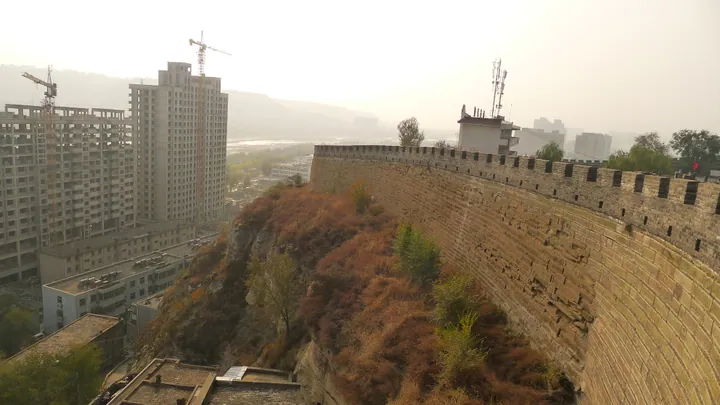
What the town is. The county government's own page describes Fuzhou old city as first built in the Five Dynasties period, the most completely preserved stone city in northern China and a national key cultural relic protection unit, standing against the hill and above the river in an imposing arrangement. A visitor item credited to the Yulin study platform gives the position as one kilometre east of Fugu county town and the date as more than a thousand years ago, and uses the same phrase for the stone city. The portal's county special feature gives the founding as the Five Dynasties and Ten Kingdoms period and describes the city as the most completely preserved Song city in northern China, as well as a national key cultural relic protection unit.
The sights inside the walls. The county government's page lists a cave, Ronghe academy, Wenxing pavilion, the Confucian temple, the city god temple, the south gate barbican and the water gate, among others. The visitor item gives the bell tower, the Confucian temple, the cave, Ronghe academy, Wenxing pavilion, the city god temple and the water gate, among others.
Ronghe academy. The visitor item records that the academy stands below the city's greater south gate and was first built in the thirty-fourth year of the Qianlong reign of the Qing, which it dates to 1769, laid out in three successive courtyards, upper, middle and lower, covering 3,500 square metres with 660 square metres of building; it was formerly the highest school in Fugu for students preparing for the imperial examinations, and it is now a national key cultural relic protection unit. The portal's feature places it south of the barbican of the old city's south gate, facing the Yellow River to the south, with a long bridge like a rainbow and the Kuixing tower standing tall, and records that 'listening to the waves at Ronghe' is one of the fine sights of Fugu.
The cave. The portal's feature places the Thousand Buddha cave in the east rock cliff inside the Kongyuan gate outside the old county town's south gate. It describes a small crooked and very dark opening leading through, which after a few steps opens out, with railings outside and a cloister within, from which the Yellow River is seen rolling below, and calls it a fine sight of the county; it was listed as a county-level cultural relic protection unit in 1981.
The Confucian temple. The portal's feature describes the temple inside Fuzhou city as the best-preserved Confucian temple in northern Shaanxi, first built in the fourteenth year of the Hongwu era of the Ming, which it dates to 1381, and, after several repairs, an axially symmetrical group centred on the Dacheng hall, with a nine-ridge hip roof, upturned eaves and glazed tiles.
Visiting. The visitor item gives the address as one kilometre east of Fugu county town in Yulin.
The sources differ in one phrase about what survives. The county government's page and the visitor item call the town the most completely preserved stone city in northern China; the portal's feature calls it the most completely preserved Song city in northern China. The difference is not resolved here, and the county government's page also prints the cave's name with a different second character from the other two sources, which call it the Thousand Buddha cave.
What to look for
- The city wall and the surviving stone town, which the county government's page calls the most completely preserved stone city in northern China.
- Ronghe academy, built in 1769 below the greater south gate, with three successive courtyards and the Kuixing tower, and the 'listening to the waves at Ronghe' sight.
- The Thousand Buddha cave in the east rock cliff inside the Kongyuan gate, reached through a small dark opening and giving onto a cloister above the Yellow River.
- The Confucian temple inside the walls, dated by the portal's feature to 1381 and described as the best-preserved Confucian temple in northern Shaanxi, centred on the Dacheng hall.
- The bell tower, Wenxing pavilion, the city god temple, the south gate barbican and the water gate, named among the sights inside the walls.
- The position itself, with the town standing against the hill above the Yellow River.
Location & getting there
Getting to Fuzhou Ancient City
Identify the main visitor approach and any separately managed houses, museums or performances. Ask before entering residential spaces or photographing residents.
- Search for 府州古城 with 榆林市 and 府谷县.

Find Fuzhou Ancient City
府州古城 · 府谷县
No reliable map pin yet: search by the Chinese name.
Sources & visit information
The linked sources support the identity and background described in this introduction. Opening hours, admission, activity availability and exact arrival arrangements have not been comprehensively checked. Confirm current visitor information with the venue; the original catalogue locality and editorial review flag are retained.
Image credits & notes (1)
- The crenellated south wall of Fuzhou ancient city in Fugu County, overlooking the modern town below · 府州古城南城墙,府谷县 Source-recorded photograph date: Taken on 2 November 2013.Photo: 鲍向阳 · CC BY-SA 3.0Resized for the web; the photo itself has not been edited. Thumbnails may show a cropped view.
