

Imperial Sturgeon Cartilage 御品鳇鱼骨
Imperial Sturgeon Cartilage is featured among the local specialties of Heilongjiang.
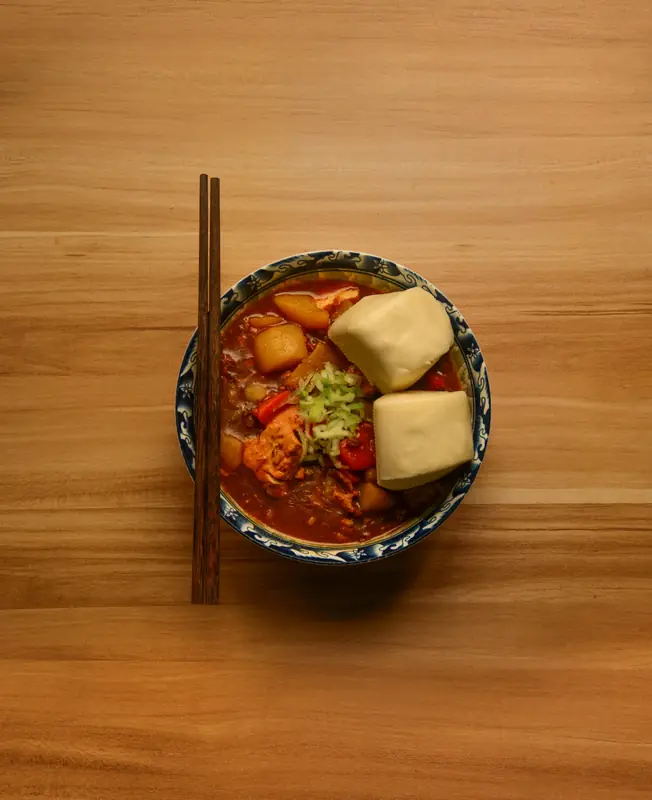
Image notes
Resized for the web; the photo itself has not been edited.
Imperial Sturgeon Cartilage (御品鳇鱼骨) is a Heilongjiang banquet dish made with the bone of the kaluga (鳇鱼), the giant sturgeon of the Heilongjiang (黑龙江) river basin. In 2018 the China Cuisine Association (中国烹饪协会) named it one of Heilongjiang's ten classic dishes in its "Chinese Cuisine" (中国菜) list.
Where it comes from
The dish comes from the northern half of the Manchu-Han Imperial Feast (满汉全席) as cooked at the Harbin Jinchun Hotel (哈尔滨金春大酒店). In 2019 Heilongjiang Daily reported that chef Zhang Jinchun (张金春) and his disciple Chen Jiming (陈继明) showed 12 dishes and 4 pastries from the feast's 54 northern-style dishes at a cookery contest held in Yichun (伊春) during a tourism development conference. Imperial Sturgeon Cartilage was among them, beside roast kaluga and a kaluga-sinew dish, Yutao Huangyujin (御桃鳇鱼筋). The hotel's catering director said these dishes are made with local natural ingredients and are the main dishes when Heilongjiang hosts Chinese and foreign guests.
Heilongjiang added the feast's northern-style dishes (北派菜) to its provincial intangible cultural heritage list in 2015, and a provincial local standard fixes the ingredients, seasonings and serving order of all 54. The Heilongjiang Department of Culture and Tourism says that feast dishes which once used rare animals now use other ingredients. The kaluga has a wider place in the province's cooking too: Heilongjiang Daily notes that a book by chef Meng Xianze (孟宪泽), Longcai Chuancheng (《龙菜传承》), records 200 Heilongjiang dishes, 18 of them with kaluga as the main ingredient.
Ingredients
Xinhua describes the kaluga (达氏鳇) as a fish found only in the Heilongjiang basin and a first-class state-protected animal; large ones reach several metres and more than a thousand jin. Its name is explained as "emperor among fish", and in the Qing dynasty it was sent to the court as tribute. As a cartilaginous fish it has no fine bones in its flesh. Its roe, nose, lips, bone and the cord called "fish dragon sinew" (鱼龙筋) are its most prized and best-tasting parts, while the meat mostly goes into stews with potato. According to Xinhua, all sturgeon and kaluga sold in markets and fish restaurants today are farmed, and old riverside dishes such as braised wild kaluga lips have left the table.
Flavour and texture
Guo Kaijun (郭凯军), head of a Harbin caviar company, told Heilongjiang Daily that sturgeon and kaluga meat is fresh and tasty and the bone crisp and fragrant, and named the intestines, lips, bone, swim bladder and roe as prime ingredients for well-known dishes. Writing about the Hezhen (赫哲族) dish talaha (塔拉哈), Banyuetan notes that young sturgeon and kaluga have bones that are entirely edible crunchy cartilage.
Sources & reading
Written from the linked sources and fact-checked against them on 2026-09-24. Recipes and servings vary between kitchens.