

Explore the region
About Tiantang Monastery
Tiantang Monastery (天堂寺) is a Gelug (格鲁派) Tibetan Buddhist monastery in Tiantang Town (天堂镇), Bairi Tibetan Autonomous County (天祝藏族自治县), also called Tianzhu, in Wuwei (武威), Gansu.
A Bon (苯教) temple stood here in the reign of the Tang emperor Xianzong (806–821). Tradition holds that in 1360 the Karmapa Rolpe Dorje (噶玛巴·若贝多杰), summoned to Beijing, stopped here and raised 108 stupas to subdue a troublesome dragon, and the spot took a Tibetan name meaning 'stupa plain', later shortened in Chinese to Tiantang. A Karma Kagyu (噶玛噶举派) temple followed. In the late Ming, as the Karma Kagyu house declined, the Gelug monk Danma Cicheng Jiacuo (丹玛次成嘉措) built meditation cells for himself and his disciples; in 1647 the fourth Dongke Living Buddha (东科活佛), Duoju Jiacuo (多居嘉措), made them into a college of study and named it Tiantang Si. In 1652 the fifth Dalai Lama passed the monastery on his journey to Beijing and gave it a Tibetan name glossed as 'auspicious flourishing land of the stupa plain'.
The monastery was counted among the five great old monasteries north of the Yellow River. In its prime it kept more than 800 resident monks, remembered in the phrase 'Tiantang's eight hundred monks', and at most over 1,000. Changkya Rolpe Dorje (章嘉·若必多吉), state preceptor under the Qianlong emperor, and Thuken Chokyi Nyima (土观·却吉尼玛) both began their education here. When the county's Chinese name was coined in 1936, it joined the first syllables of Tiantang and Zhugong (祝贡寺), its two largest monasteries.
Between the late 1950s and the 1970s the monastery was reduced to ruins. It was allowed to reopen in 1981 and has been rebuilt step by step since then. It is a Gansu provincial heritage site, classed as a Qing-period ancient building.
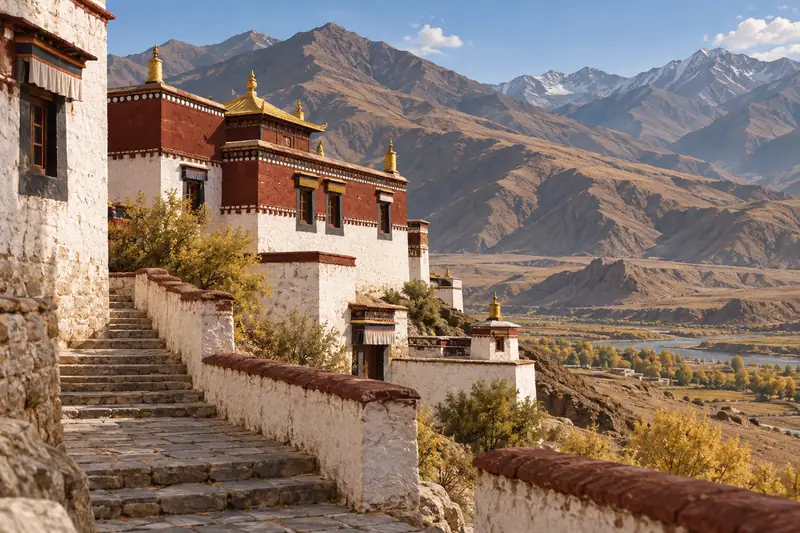
Mountains enclose the monastery on every side. The Tsongkhapa Hall (宗喀巴大殿), known too as the Thousand Buddha Hall, went up in 2002 under Duoshi Rinpoche (多识仁波切); inside are a gilded carved-wood Tsongkhapa 23 m high and 9.52 m wide, 4,000 bronze Buddhas and 21 wooden figures. The Kalachakra College (时轮学院), founded by the ninth Dongke Living Buddha in 1840, holds a Kalachakra assembly in the middle of the third lunar month.
What to look for
- Tsongkhapa Hall (宗喀巴大殿), built in 2002, with a gilded carved-wood Tsongkhapa 23 m high
- The hall's 4,000 bronze Buddhas and 21 wooden figures
- Kalachakra College (时轮学院), founded in 1840, where a Kalachakra assembly is held in mid-third lunar month
- Shakyamuni Hall (释迦牟尼殿), first built in the early 18th century, with a gilded scented-clay Shakyamuni more than 5 m tall
- A 40.9-tonne granite boulder shaped like a turtle carrying a bowl, found in the Datong River (大通河) near the monastery in April 2007 and hauled to the monastery
Location & getting there
Getting to Tiantang Monastery
- Search for 天堂寺 with 武威市 and 天祝藏族自治县.
Find Tiantang Monastery
天堂寺 · 天祝藏族自治县
No reliable map pin yet: search by the Chinese name.
Sources & visit information
Written from the linked sources and fact-checked against them on 2026-09-23. Opening hours, admission and access arrangements are not covered; confirm current visitor information with the site.
Some facts checked against Wikipedia contributors, "天堂寺" · CC BY-SA 4.0.
Some facts checked against Wikipedia contributors, "Bairi Tibetan Autonomous County" · CC BY-SA 4.0.