

Explore the region
About Kizilgaha Beacon Tower
Kizilgaha Beacon Tower (克孜尔尕哈烽燧) is an ancient rammed-earth signal tower on an alluvial terrace at the mouth of the Yanshui Gully (盐水沟), at the southern foot of the Qoltag Mountains (却勒塔格山), 13 km northwest of the city of Kuqa (库车) in Aksu Prefecture, Xinjiang. Minzu University of China glosses the name Kizilgaha as "red sentry post".
Kuqa was the ancient kingdom of Kucha (龟兹), a Silk Road town on the route between northern and southern Xinjiang, and successive Chinese dynasties fortified it; beacon towers were among the most important of these works. Beacons passed warnings with fire at night and smoke by day. According to the Aksu Daily, the Kizilgaha tower was first built under Emperor Xuan of the Han (汉宣帝), more than 2,000 years ago, and it is the oldest and best-preserved beacon on the northern route of the Silk Road. Of the 22 ancient beacon sites recorded in Kuqa, the paper calls it the earliest built and the most representative.
The State Council listed the tower as a national key cultural relics protection site in 2001 (fifth batch, classed as a Han-dynasty ancient site). The National Cultural Heritage Administration recognised it as part of China's Great Wall resources in 2012, and in 2014 UNESCO inscribed it on the World Heritage List as a component of "Silk Roads: the Routes Network of Chang'an-Tianshan Corridor". In November 2020 it was named in the first national list of key Great Wall sections, where it appears as a Tang-dynasty beacon.
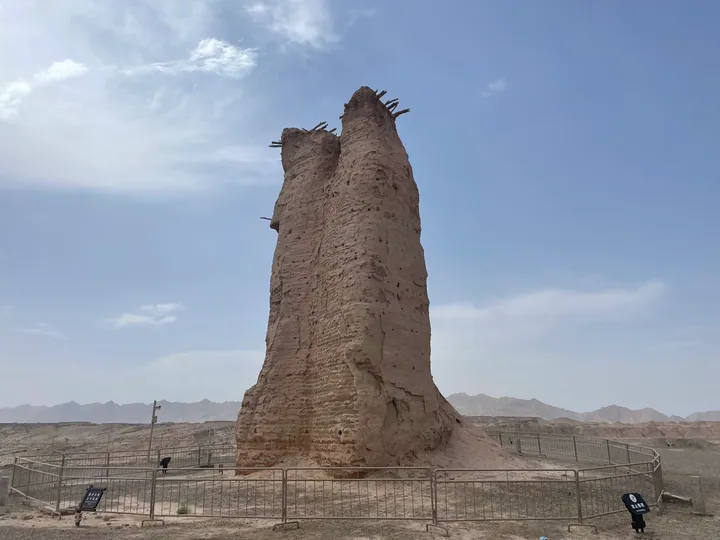
The tower is rectangular in plan and tapers from its base, a trapezoid in profile. It was tamped in layers roughly 10 to 20 cm deep, with courses of tamarisk and reed between the earth, and timbers stick out near the top. Chinese Wikipedia gives a surviving height of 16 m on a base 6 m by 4.5 m, with mud bricks at the top and timber posts framing the upper part; weathering has left a notch in the summit so that it looks like two towers. The Aksu Daily puts the height at about 13.5 m. Traces of old buildings survive on the north side.
What to look for
- The notched summit, split by weathering so that the tower looks like a pair of beacons
- Rammed-earth courses laid with alternating tamarisk and reed
- Timbers exposed near the top of the tower
- Remains of ancient buildings on the north side
- The setting on a terrace at the mouth of the Yanshui Gully below the Qoltag Mountains
- The Kizilgaha Caves (克孜尔尕哈石窟), close to the tower
Location & getting there
Getting to Kizilgaha Beacon Tower
- Search for 克孜尔尕哈烽燧 with 阿克苏地区 and 库车市.

Find Kizilgaha Beacon Tower
克孜尔尕哈烽燧 · 库车市
No reliable map pin yet: search by the Chinese name.
Sources & visit information
Written from the linked sources and fact-checked against them on 2026-09-23. Opening hours, admission and access arrangements are not covered; confirm current visitor information with the site.
Some facts checked against Wikipedia contributors, "克孜尔尕哈烽燧" · CC BY-SA 4.0.
Image credits & notes (1)
- The eroded earthen Kizilgaha Beacon Tower near Kuqa, Aksu Prefecture · 阿克苏地区库车市克孜尔尕哈烽燧Photo: Este Momento · CC BY-SA 4.0 · taken 2022-06-10Resized for the web; the photo itself has not been edited. Thumbnails may show a cropped view.
.png)