

Explore the region
Read the precinct as three different visits
Olympic Green lies in Chaoyang District at the northern end of Beijing’s extended central axis. The 2008 Olympic and Paralympic precinct combines public landscape, sports venues and Olympic Forest Park, so a map pin or a single subway stop does not describe the whole experience. Think of it in three broad parts: the forest park to the north, the main stadium-and-aquatics-centre zone, and other sports facilities farther south.
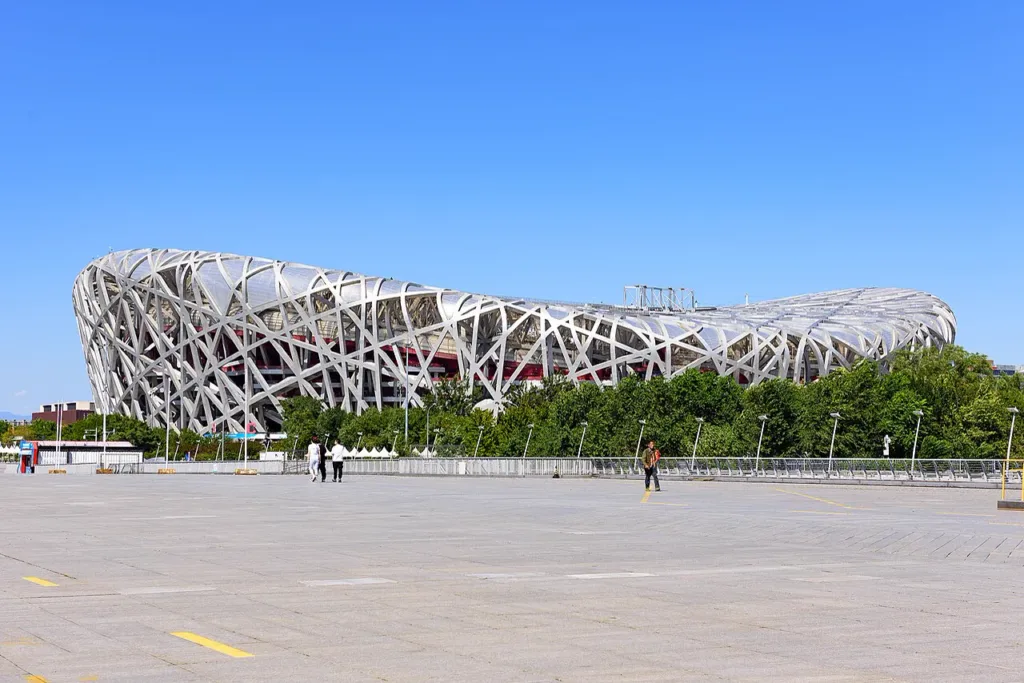
The easiest architectural comparison is between the National Stadium, usually called the Bird’s Nest, and the National Aquatics Center, or Water Cube. The Bird’s Nest is an interwoven steel structure whose irregular outer frame remains visible around the seating bowl. The Water Cube’s square outline and blue, bubble-like exterior give the neighboring building a distinctly different texture and light. Together they make the central open space worth walking even if you do not go inside.
The stadium’s designers describe it as a venue placed at the centre of the Olympic complex and intended to remain a functioning urban site after the Games. Its open form also reflects the operator’s stated goals of using natural ventilation and daylight. The Water Cube’s designers used a soap-bubble geometry for a repeatable but organic-looking pattern, clad in translucent ETFE panels. Read the two buildings as contrasting approaches to structure and enclosure, rather than simply as matching Olympic landmarks.
A quieter design detail is the sunken garden beneath the central venue area. The municipal tourism description identifies seven linked courtyards over a roughly 700-metre stretch, set about nine metres below ground. Traditional courtyard, gate and garden motifs are translated into a modern public passage. Treat it as part of the central-area walk, not as a separate ticketed museum; follow signs and any event-day closures on site.
Choose a route before setting out
Central Olympic promenade — editorial 2–3 hours outdoors. Start at Olympic Park station and walk the open central plaza between the Bird’s Nest and Water Cube. Pause to compare the steel frame with the aquatics center’s cellular façade, then look for the sunken-courtyard route if it is open. Add a venue interior only after checking that venue’s own hours, events and ticket arrangements. The estimate is an editorial pace for the outdoor visit, not a venue promise.
Forest-park visit — editorial half day. Use Forest Park South Gate station as the approach to the southern entrance of Olympic Forest Park. The south park is organized around the constructed hill Yangshan and the lake-and-water landscape of Aohai; farther north, the scenery shifts toward smaller streams, flower areas and woodland. The Fifth Ring Road separates the south and north sections, which are linked by a planted ecological bridge, so choose a gate and a shorter loop rather than assuming the park is a compact extension of the stadium plaza.
Yangshan and Aohai are more than names on a map. Yangshan is the park’s main hill, placed on the northward axis that answers Jingshan in the historic city; Aohai is the broad lake at its southern foot and forms part of the park’s winding water system. From higher viewpoints, the park landscape opens toward the Olympic venues and, on clear days, the distant Yan Mountains. These are landscape-design views, not a guaranteed visibility forecast.
For a combined outing, visit the central venues first and reserve a separate block of time for the forest park. A longer walk may be pleasant, but the area’s scale makes it unhelpful to treat the two zones as adjoining exhibits with a short, fixed transfer. Route and pacing suggestions here are editorial; allow extra time for weather, crowds, mobility needs or event controls.
Admission and opening arrangements
Olympic Forest Park’s operator lists free admission and seasonal opening hours: 05:00–22:00 from 15 March through 15 November, and 06:00–21:00 from 16 November through 14 March. Those are the operator’s posted park hours, not a promise that every facility inside the park operates for the full period.
The Bird’s Nest and Water Cube are separate venues. The National Stadium’s official site lists visitor opening as 10:00–22:00, with last entry at 21:00; its event notices show that concerts and other bookings can shorten or suspend sightseeing hours. Check the live “巢票” ticketing mini-program or call the stadium’s official service line 400-600-2008 before travelling.
A National Aquatics Center notice dated 2 September 2026 gives seasonal sightseeing hours of 10:30–21:00, with on-site ticket sales ending at 19:50, entry ending at 20:00, and clearing from 20:30. The same notice listed “Water Light” show sessions, but show times and venue access can change with programming. Check the Water Cube’s own ticket service or call 400-620-2022 for the date you plan to visit.
The official operator material consulted here did not establish a single current admission price for either stadium interior. Do not use old guidebook prices for today’s visit: check the official venue booking screen for the date, ticket type and any event restrictions. The forest park is a separate free-admission visit.
Getting there without confusing the zones
For the central stadium-and-aquatics-center area, take subway Line 8 or Line 15 to Olympic Park station and follow signs toward the venue plaza. For the south entrance of Olympic Forest Park, use Line 8 to Forest Park South Gate station. These are different starting points for different parts of Olympic Green; choose the station that matches the place you want to see first. No station exit letter or fixed walking time is needed to make the distinction.
Forest Park is entered through park gates rather than through the central venue plaza. If you plan to cross between the south and north sections, use the current on-site map and gate notices; the planted bridge across the Fifth Ring Road is the connection between them. For a stadium event, crowd-control barriers and temporary transport arrangements may supersede the ordinary pedestrian route.
Combine your visit
Suggested order within this visit:
-
National Stadium国家体育场鸟巢
Start with the exposed steel structure of the Bird’s Nest.
-
National Aquatics Center国家游泳中心水立方
Compare the neighboring Water Cube’s different structural expression.
-
Venue promenade
Finish with wider views across the Olympic ensemble.
This sequence is an editorial suggestion based on the features described in the sources. Access to individual buildings or areas should be checked locally; no travel time or shared admission is implied.
Find Olympic Green
奥林匹克公园 · 朝阳区
The pin marks the area, not the entrance.
More places nearby
Approximate straight-line distances between map pins, not travel distances.
China Science and Technology Museum 中国科学技术馆
Less than 1 km awayChina Science and Technology Museum uses interactive exhibits to connect scientific principles with inventions and everyday life. Its permanent themes include The Glory of China, Exploration and Discovery, Science and Technology…
View guide →National Aquatics Center 国家游泳中心水立方
1 km awayThe National Aquatics Center, widely called the Water Cube, is the bubble-clad venue beside the Bird's Nest in Beijing's Olympic Green. Its square outline and translucent cushions create a deliberate visual contrast with the…
View guide →Beijing National Stadium 国家体育场鸟巢
1 km awayBeijing National Stadium, known as the Bird’s Nest, is defined by the interwoven steel frame around its seating bowl. Designed for the 2008 Olympic Games and used again for the 2022 ceremonies, it is one of the central buildings…
View guide →Sources & visit information
Sources checked on 21 October 2026. Hours, tickets, reservations and transport can change; confirm with the operator before you go.
- Beijing Olympic Park overview ↗
- Beijing Olympic Park visitor profile ↗
- Bird’s Nest, Water Cube and Olympic Forest Park itinerary ↗
- National Stadium official visitor information ↗
- National Aquatics Center visitor-hours notice, 2 September 2026 ↗
- Olympic Forest Park operator visitor information ↗
- Chaoyang District Olympic Forest Park profile, 9 September 2024 ↗
- Herzog and de Meuron National Stadium project ↗
- Arup National Aquatics Center project ↗
Image credits & notes (1)
- The National Stadium as seen from the central axis, Beijing. Photo: N509FZPhoto: CC BY-SA 4.0