

Explore the region
A mountain park with three different characters
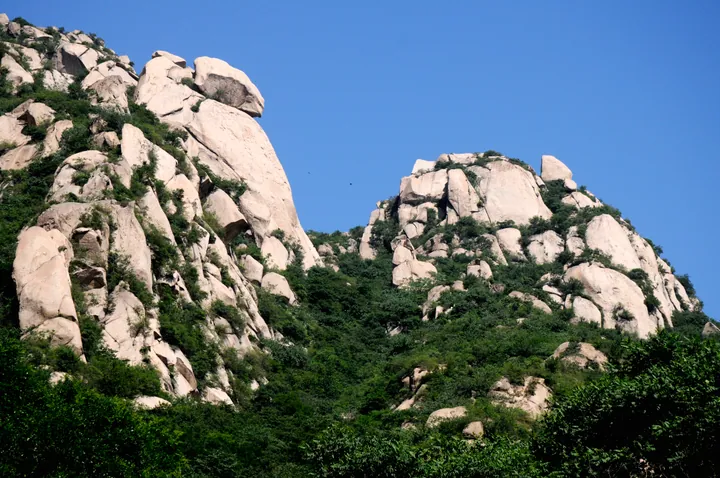
Fenghuangling lies in Sujiatuo Town in northwestern Haidian District. The park is a substantial mountain landscape rather than a single viewpoint: its trails move among weathered rock formations, forested slopes, springs and cliff carvings, with temples, caves and small pagodas along the way. Haidian District classifies it as a mountain-type natural scenic area and gives its address as 19 Fenghuangling Road.
Think of the north, central and south lines as distinct outings, not as a guaranteed all-in-one loop. Select the route for the kind of walk you want, check the park’s current map and trail notices at the entrance, and return by the signed open path. The operator prohibits climbing unmanaged hills or entering undeveloped areas; barriers and closures take precedence over any guidebook route.
North line: caves, springs and a steep finish
Choose the north route for the densest mix of mountain features and heritage. The operator lists the Li’ergang sea-cliff landform, Geyi Nunnery, Shangfang Temple and Linglong Pagoda, several other stone towers, caves including Guanyin Cave and Ancient Ape Cave, and springs and pools. These are not interchangeable stops: the route shifts from exposed rock and narrow cave passages to water features and surviving religious structures.
The high point is the small Flying Stone Pagoda, a seven-tier stone tower rebuilt in 1998 on a large rock outcrop at about 748 metres above sea level. Another striking landmark is the Cliff Pagoda, carved directly into a rock face and dated by the park to the Liao period. The route’s “Sky Ladder” is a steep section, so this is the line to choose only if you are comfortable with sustained climbing and uneven stone steps. Treat the listed high points as route goals, not an invitation to scramble off trail.
Central line: Longquan Temple and rock-cut practice sites
The central route begins at Longquan Temple, a Buddhist monastery whose earliest foundation the park dates to 951, in the Liao dynasty. The name refers to the spring pool south of the temple. Look for the old stone bridge behind the main gate hall and the pair of ancient ginkgo trees in the grounds; the temple’s siting and surviving features make more sense when read as part of a mountain religious landscape, not as a stand-alone city temple.
Beyond the temple, the route links natural granite shelters and carved sites including Three Buddhas Cave, Xuanyuan Cave and the so-called Immortal’s Chair. The park describes the cave carvings and sculpted stone furniture as traces of Liao- and Jin-period practices of cultivation and self-discipline. On the way, look for the large “Fenghuangling” cliff inscription, cut into the rock in the 1930s. The route offers a quieter alternative to the north line’s more rugged ascent, while still involving uphill walking.
South line: religious remains and the old pilgrimage landscape
The south line combines thicker vegetation and natural scenery with a group of religious and archaeological sites near Cheerying Village. The park identifies Huangpu Courtyard—later known as Miaojue Chan Temple—alongside Guandi Temple and Lüzu Cave as a cultural cluster. Nearby are the Northern Wei stone Buddha, the Jingangshi Pagoda and traces of the old northern approach used by pilgrims travelling toward Miaofeng Mountain.
The park’s route page also describes walnut groves around the village. This gives the south line a different feel from the exposed rock and tower sequence in the north: the walk is as much about the landscape around a historic village and religious sites as it is about reaching a summit. Individual ruins may be weathered or inaccessible; follow current barriers and do not enter a closed structure.
Arrival, entry and practical planning
The park address is 19 Fenghuangling Road, Sujiatuo Town, Haidian District. Recent 2026 visitor information lists two public-transport approaches: take bus 346 from Xiyuan Hub to its Fenghuangling terminus, or take Metro Line 16 to Beianhe and transfer to bus Zhuan 16 for Fenghuangling. These are transfers to a mountain-side destination, not subway stations at the trailheads; check current bus departures before setting out.
The operator currently lists park hours as 07:00–17:00, with admission stopping at 17:00. Longquan Temple has a separate schedule reported as 08:30–16:00 on weekdays and 08:30–16:30 on public holidays. Weather and safety notices can temporarily close a mountain park, so check the operator’s latest notice or call +86 10 6245 5933 before travelling, especially after heavy rain.
For holiday visits, the operator advises advance planning through its official “北京凤凰岭” WeChat account and notes that visitor flow may be limited or staggered. Haidian District’s current attraction listing directs visitors to that account for ticket-price details rather than publishing a fare on the listing. Confirm the live price, booking requirement, open routes and any temple access before departure; do not rely on older third-party fare tables. Online tickets are checked by QR code, while the operator’s visitor guidance directs cash purchasers to the traditional ticket channel.
Editorial planning suggestion: allow a half day for one route, with extra time for a strenuous north-line climb or a slow temple visit. A combined visit to more than one route is better treated as a longer day, not an assumed circuit. Carry water, wear shoes suitable for steps and rough stone, and keep to signed paths. The park prohibits pets, smoking and outdoor fires, and visitors must not pick plants or feed wildlife.
Find Fenghuangling Nature Park in Haidian
凤凰岭 · 海淀区
The pin marks the area, not the entrance.
Sources & visit information
Sources checked on 21 October 2026. Hours, tickets, reservations and transport can change; confirm with the operator before you go.
- Haidian District culture and tourism listing for Fenghuangling ↗
- Fenghuangling operator page for the north route ↗
- Fenghuangling operator page for the central route ↗
- Fenghuangling operator page for the south route ↗
- Fenghuangling operator visitor information ↗
- Fenghuangling operator booking and notices ↗
- 2026 Fenghuangling National Day visitor information and transit ↗
- Beijing Daily News 2026 Fenghuangling visitor notice ↗
- Beijing Phoenix Ridge Nature Park — official English overview ↗
- Phoenix Ridge Nature Scenic Area — Haidian District government profile ↗
- Phoenix Ridge Scenic Area tickets — official ticket page ↗
- Phoenix Ridge visitor instructions — official page ↗
- Phoenix Ridge scenic features — official operator ↗
- 2026 Phoenix Ridge National Day event and visitor guide ↗
- Phoenix Ridge temporary closure notice, 25 August 2026 ↗
Image credits & notes (1)
- Rocky granite peaks and ridgelines at Fenghuangling Nature Park, Haidian District · 海淀区凤凰岭自然风景区的花岗岩峰峦 Source-recorded photograph date: Taken on 30 May 2013.Photo: mayanming · CC BY-SA 3.0Resized for the web; the photo itself has not been edited. Thumbnails may show a cropped view.
