

Explore the region
Tap any red Chinese text to hear it in Mandarin.
Visitor facts checked: 21 October 2026
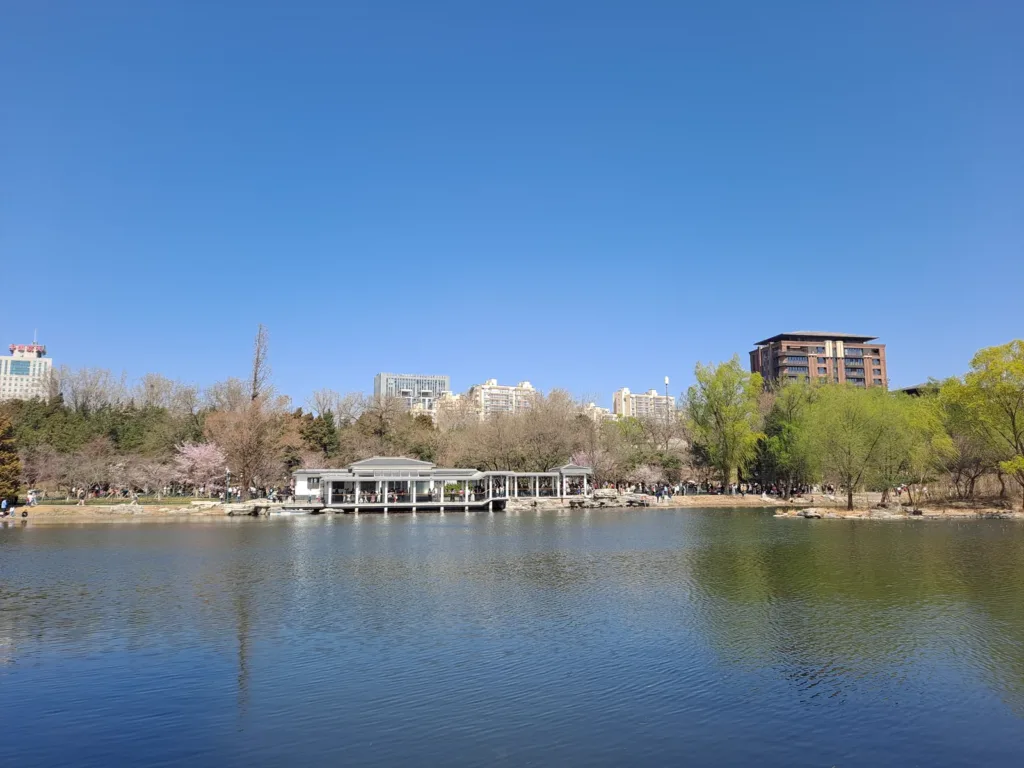
A city park organized around water
At No. 10 West Third Ring Middle Road in Haidian District, Yuyuantan sits beside Diaoyutai State Guesthouse and the China Millennium Monument. The municipal park inventory records 132.38 hectares in total, including 59.72 hectares of water. Its scale matters when planning a visit: east, south, north and west gates lead to different parts of a broad park, not interchangeable entrances around a single compact attraction.
Water has shaped the place for centuries. The park’s history records that a watercourse was brought from the Xiangshan area in 1772 and that the lake was excavated and regulated the following year. In 1774 the Qianlong court restored the old Diaoyutai site and built a garden residence nearby. A separate lake dug south of the main water in connection with Yongding River diversion works was named Bayi Lake in 1956; the municipal government formally named the public park in 1960. These layers explain why the experience is more about water, gardens and city recreation than a preserved palace interior.
The park’s official guide describes four broad landscape themes: cherry groves, wetlands, recreation and cultural displays. Among its named places are the Cherry Blossom Garden, Wetland Garden, Wanshu Hall and Yuyuan Chunqiu. Treat them as different stops within a park rather than as a short list of buildings; paths, shorelines and open lake views are part of what connects them.
Cherry groves: a seasonal landscape, not a year-round display
The Cherry Blossom Garden is the park’s signature area. Beijing’s municipal park register describes it as a roughly 25-hectare specialist garden with more than 2,000 cherry trees; the park says its collection includes more than 20 varieties. The first major planting in the park dates to 1973. Different cultivars flower in succession, so the scene changes from early blossoms to fuller pink-and-white canopies and then falling petals.
The park’s visitor information places the usual first blossoms in late March, the main display from early to mid-April, and some flowering into late April. Weather moves those dates from year to year. If blossom timing is the point of the trip, check the current park notice rather than treating a calendar window as a forecast. Spring also brings far heavier visitor demand than an ordinary lake walk.
A practical spring route is to enter from the south gate, head to Cherry Valley on the northwest side of that entrance, then continue west to the planted slopes at South Hill View of Cherry Blossoms. This links two distinct settings: a varied grove and a more open, layered hillside view. From the north gate, walk southwest toward the Cherry Blossom Garden. The west gate is the direct choice when the western blossom area is the priority.
For a quieter-feeling contrast, enter at the east gate, cross Dongmen Bridge, and climb at Yuyuan Chunqiu for a view over East Lake. That route makes the water legible from above instead of treating the park as only a flower destination. These gate-to-area sequences follow the official guide; they are not timed itineraries, and construction barriers or crowd controls may change the walk on the day.
How to plan the visit
The city government’s visitor guide lists these regular hours: 6:00–21:30, last entry 21:00, from January 1 to May 31 and September 1 to December 31; and 6:00–22:30, last entry 21:30, from June 1 to August 31. Its listed regular admission is CNY 2 full fare and CNY 1 half fare. During the 2026 Cherry Blossom Cultural Festival, the park announced CNY 10 full fare and CNY 5 half fare, with the normal price restored during the May Day holiday. That spring event is past; check the live official ticket page for any later seasonal change, ticket eligibility and actual availability.
The park’s official 2026 festival notice names the 畅游公园 Chàngyóu Gōngyuán and “玉渊潭公园5G” mini-programs as its booking platforms. The city visitor guide says foreign visitors may book by real-name passport details one to seven days ahead through the park’s 5G mini-program. For a crowded blossom date, check the official booking entry in advance and follow the live instructions; do not assume that an old seasonal ticket rule still applies.
Choose a gate around your intended walk. The government guide pairs Muxidi Station on Line 1 with the east gate, Military Museum Station on Line 1 with the south gate, Baiduizi Station on Line 9 with the north gate, and Gongzhufen Station on Line 1 with the southwest gate. These are arrival starting points, not claims about a particular station exit or walking time. Use the station-to-gate pair that fits your chosen area and confirm the surface approach in a current map.
Two current notices affect planning. Yuyuantan Park says its improvement project is scheduled from September 2026 to October 2029 and warns visitors of construction-related inconvenience; the announcement does not specify a full-park closure or a detailed set of blocked paths. Separately, a notice dated 17 September 2026 suspends reservations for wetland guided tours until further notice. It concerns the guided-tour reservation service; it does not say that the whole wetland or park is closed. Follow on-site barriers and check for later notices.
For an editorial visit, allow about 1.5–2 hours for one gate-to-lake-to-grove section, or 2.5–3 hours if adding a second landscape area. These are planning estimates, not official durations. A full circuit can take longer because the park is large, and seasonal crowds, closures, mobility needs and time spent by the water all change the pace.
Combine your visit
Suggested order within this visit:
-
Eastern lakeside approach
Begin with orientation beside the water.
-
Cherry-tree areas
Include the characteristic planting without assuming blossoms are present.
-
Open lake viewpoints
Finish with the water-and-skyline composition.
This sequence is an editorial suggestion based on the features described in the sources. Access to individual buildings or areas should be checked locally; no travel time or shared admission is implied.
Find Yuyuantan Park
玉渊潭公园 · 海淀区
The pin marks the area, not the entrance.
More places nearby
Approximate straight-line distances between map pins, not travel distances.
Military Museum of the Chinese People's Revolution 中国人民革命军事博物馆
1 km awayThe Military Museum of the Chinese People’s Revolution combines large equipment displays with galleries interpreting Chinese military history. Aircraft and missiles occupy the expanded central hall, while the wider weapons…
View guide →Capital Museum 首都博物馆
3 km awayThe Capital Museum presents Beijing’s history and art through collections that include porcelain, bronze, jade, calligraphy, painting, and Buddhist sculpture. Many objects come from discoveries in Beijing, making the museum a…
View guide →Purple Bamboo Park 紫竹院公园
3 km awayPurple Bamboo Park, also known as Zizhuyuan, is a water-and-bamboo garden in Haidian. Three connected lakes, islands, small hills, and bridges create changing viewpoints through extensive bamboo planting. The park’s design uses…
View guide →Sources & visit information
Sources checked on 21 October 2026. Hours, tickets, reservations and transport can change; confirm with the operator before you go.
- Beijing historical-garden inventory: Yuyuantan Park ↗
- Beijing municipal visitor guide: Yuyuantan Park ↗
- Yuyuantan Park official attraction descriptions ↗
- Yuyuantan Park official history ↗
- 2026 Yuyuantan Cherry Blossom Cultural Festival and ticket notice ↗
- Yuyuantan Park improvement project notice ↗
- Yuyuantan Park wetland guided-tour reservation notice ↗
- Beijing Metro Line 1 station information ↗
Image credits & notes (1)
- A lake and waterside pavilion at Yuyuantan Park, photographed on 22 March 2025. Photo: H2v5o68zPhoto: CC0 1.0