

Explore the region
A mountain shaped by its two peaks
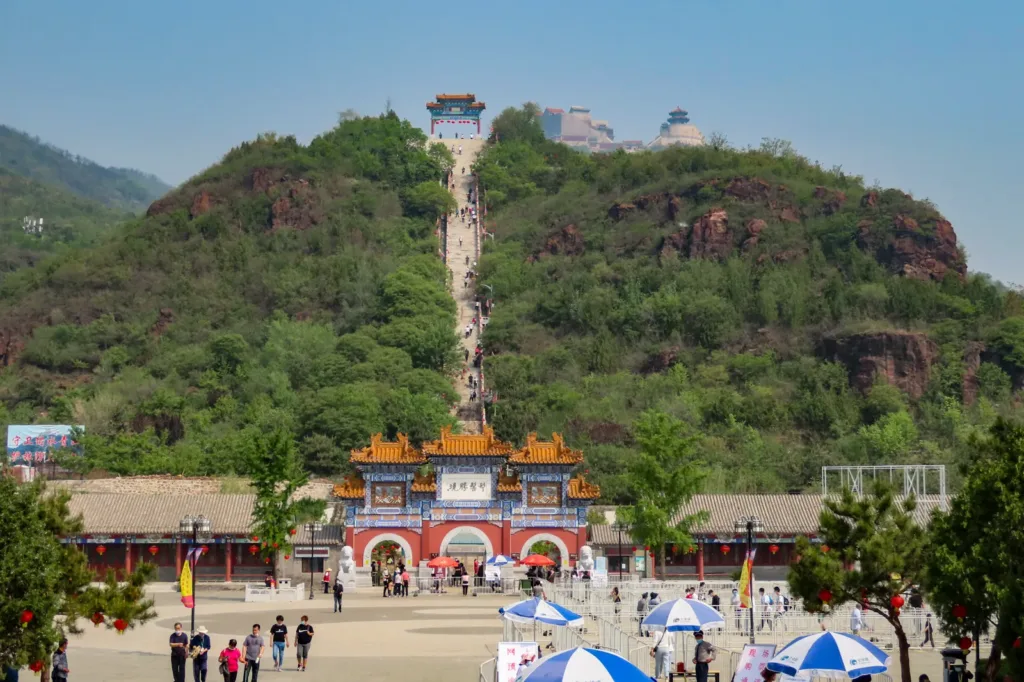
Yaji Mountain takes its name from the twin high points, said to resemble a young girl’s paired hair buns. The landscape and its religious architecture are experienced together: temples and pavilions occupy the foothills, middle slopes and cliff-edge summit sites rather than forming a single level complex. The municipal attraction listing describes a cluster of 19 historic buildings, including the Bixia Yuanjun Temple, Jade Emperor Pavilion and Medicine King Hall above, with Zixiao Palace, Dongyue Temple and other halls lower down.
The mountain’s Taoist tradition is traced to the Tang period in Beijing’s tourism account. Its Bixia Yuanjun Temple site is separately recorded by the Beijing Municipal Cultural Heritage Bureau as a Qing-period relic and a sixth-batch municipal protected heritage site. These are not competing dates: the first refers to the tradition and temple history, while the official heritage listing dates the protected surviving site.
The western summit’s Bixia Yuanjun Temple is the principal sanctuary associated with Bixia Yuanjun, a widely venerated Taoist goddess. On the eastern summit, the Jade Emperor Pavilion gives the second peak its own architectural focus. A 2023 Beijing Daily feature reports that the western shrine displays imperial plaques associated with Kangxi, Qianlong, Jiaqing and Daoguang, and describes the Jade Emperor Pavilion as a landmark building. Look for the contrast between the pair of elevated rooflines, the decorated temple compounds, and the steep route that links them; access to individual interiors depends on what is open on the day.
How to explore
Begin at the visitor entrance and take in the approach before climbing: a 2023 local-history feature identifies the prominent stairway as the 365-step “prayer road,” a symbolic count representing the days of a year. Continue through the lower temple area and mid-slope compounds, then climb toward the two summit sanctuaries if the stairs, weather and your energy allow. This order makes the change from entrance and devotional approach to smaller temple courts and exposed summit buildings easy to read. The 365-step account is a cultural explanation, not a promise that every visitor route or stair section is open.
Allow about three hours as a planning estimate for the climb and a visit to the main grounds; the Beijing tourism listing also recommends three hours. A slower visit, time for prayer or photography, steep steps, crowds, rain or temporary access restrictions can extend the outing. Follow the signs and staff instructions, and use the marked route back to the entrance rather than assuming there is a through-exit at the far summit.
Getting there and planning admission
The listed address is No. 39 Beijishan Street, Beijishan Village, Liujiadian Town, Pinggu District, Beijing. Use that full address as the navigation destination; the mountain is in rural Pinggu, not in central Beijing. A private car or pre-arranged car service is the simplest way to control the final approach. The tourism portal publishes a bus itinerary from Dongzhimen via Pinggu, but it names legacy route information and does not establish that those services remain current; check a live transit operator or map on the travel date before relying on public transport.
The Beijing municipal attraction listing published on 30 September 2024 gives an adult admission price of CNY 50 and a seasonal schedule of 08:00–16:00 from 1 April to 31 October and 08:00–15:30 from 1 November to 31 March. The Beijing tourism portal’s currently accessible attraction page also lists CNY 50, but gives different peak-season closing and last-entry times. Treat CNY 50 as the published reference price, not a guaranteed current offer, and phone the scenic area at +86 10 6197 2535 before setting out to confirm the day’s hours, last entry, ticket rules and any summit-area closures.
The city’s listing describes concessions for several groups, including children, older visitors, students and eligible service personnel, with proof required; confirm eligibility and accepted documents when buying. No current official online reservation channel was verified in the listings cited here, so do not assume that an online booking is mandatory or that walk-up entry is guaranteed.
Combine your visit
Suggested order within this visit:
-
Lower temple group
Begin with the religious setting at the mountain’s foot.
-
Middle-slope compounds
Read the transition between the lower courts and upper sanctuaries.
-
Twin-summit temples
Finish at the upper focus only if the climb and current access suit your group.
This sequence is an editorial suggestion based on the features described in the sources. Access to individual buildings or areas should be checked locally; no travel time or shared admission is implied.
Find Yaji Mountain
丫髻山 · 平谷区
The pin marks the area, not the entrance.
More places nearby
Approximate straight-line distances between map pins, not travel distances.
Jingdong Grand Canyon 京东大峡谷
16 km awayJingdong Grand Canyon in Pinggu joins a deep-canyon scenic area with the wooded Jingtai Mountain zone. Lakes and distinct pools occupy the lower landscape, while the higher area offers a different forest-and-viewpoint…
View guide →Shunyi Olympic Rowing-Canoeing Park 顺义奥林匹克水上公园
27 km awayShunyi Olympic Rowing-Canoeing Park preserves the water-sports setting built for Beijing’s 2008 Games. The long rowing water and the pumped slalom course were designed for very different kinds of competition, making their…
View guide →Yanqi Lake 雁栖湖
29 km awayYanqi Lake sits below the Yanshan Mountains in Huairou, with broad water views, a dam, and hillside paths around the conference-resort landscape. A useful visit can focus on the lake edge and the West Mountain trail rather than…
View guide →Sources & visit information
Visitor details checked on 21 October 2026. Opening and ticket details below are taken from published official listings; confirm them with the scenic area before travelling because the published seasonal schedules differ. Hours, tickets, reservations and transport can change; confirm with the operator before you go.
- Yaji Mountain Scenic Area — Beijing municipal attraction listing ↗
- Yaji Mountain — Beijing Municipal Bureau of Culture and Tourism attraction listing ↗
- Yaji Mountain Bixia Yuanjun Temple Site — Beijing Municipal Cultural Heritage Bureau ↗
- Yaji Mountain, a Blessed Land near the Capital — Beijing Daily, 12 August 2023 ↗
Image credits & notes (1)
- The entry gate and stair route rising toward Yaji Mountain's summit temples. Photo: N509FZPhoto: CC BY-SA 4.0