

Photo adjustments
Proportionally resized and converted to WebP without cropping, retouching or changing the photographed subject.
Explore the region
About Beijing Planetarium
Building A contains the historic Celestial Theater and exhibition halls, while Building B adds a digital space theater and other immersive formats. This makes the visit different from simply browsing a science gallery: the experience depends partly on a scheduled show and partly on the displays around it. Choose the screening that suits your interests and language needs, then use the exhibitions to develop the same topic, whether planetary motion, the solar system, or the wider universe.
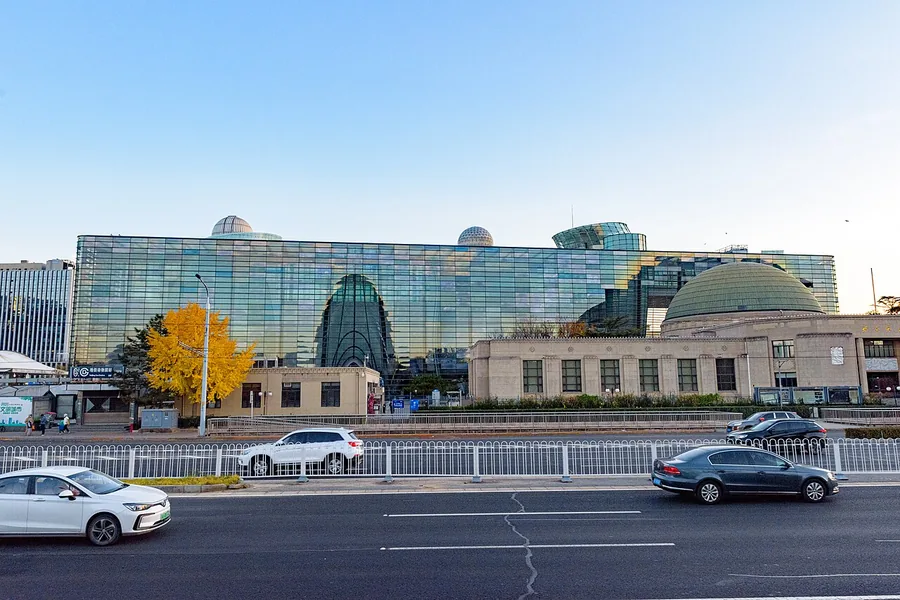
Beijing Planetarium is affiliated with the Beijing Academy of Science and Technology (北京市科学技术研究院) and also oversees the Beijing Ancient Observatory and several off-site science education bases. Its new building began construction south of the old building in 2001, one of sixty major municipal projects, and opened on 12 December 2004; the old building underwent renovation from November 2006 and reopened on 11 July 2008, restored to its appearance from when it was founded.
The new building rises five stories above ground and two below, with a floor area of 21,594 square meters; it was designed, around a 'relativity' concept, by the American architect Wang Nongji's office and the China Academy of Space Technology's architecture design institute, with its glass curtain wall built by Shenzhen Sanxin Special Glass Technology Co. The design won a design honor award from the Los Angeles chapter of the American Institute of Architects.
The renovated old building has a metal dome 23 meters in diameter and uses paired optical and digital projectors: a Zeiss Model 9 optical projector from Germany, and a digital system combining images from six Sony projectors at 7,800 by 7,800 pixels resolution, then the world's highest-resolution digital planetarium projector, plus four auxiliary laser projectors and a 13.1-channel surround-sound system; seating was reduced from 600 to 400.
What to look for
- Building A and the Celestial Theater setting: see the earlier generation of Beijing’s public astronomy institution.
- Building B’s digital presentation spaces: compare newer immersive methods with the traditional planetarium approach.
Location & getting there
Getting to Beijing Planetarium
The matched listing gives No. 138 Xizhimen Wai Dajie. The planetarium is across the street from the Beijing Zoo frontage.
- Confirm the building and theater named on your ticket so that you arrive at the correct part of the complex.
Combine your visit
Suggested order within this visit:
-
Astronomy exhibitions
Begin with the concepts related to your selected show.
-
Booked theater presentation
Use the dome or digital format to visualize the topic.
-
The second building’s public displays
Compare another presentation approach if access and time permit.
This sequence is an editorial suggestion based on the features described in the sources. Access to individual buildings or areas should be checked locally; no travel time or shared admission is implied.
Find Beijing Planetarium
北京天文馆 · 西城区
The pin marks the area, not the entrance.
More places nearby
Approximate straight-line distances between map pins, not travel distances.
Beijing Zoo 北京动物园
Less than 1 km awayBeijing Zoo occupies historic garden grounds in Xizhimen, where animal exhibits are interspersed with ponds, trees, and older buildings. The panda complex is a natural starting point for visitors focused on Chinese wildlife…
View guide →Five Pagoda Temple 五塔寺
1 km awayBeijing’s Five Pagoda Temple is Zhenjue Temple, whose surviving Diamond-Throne Tower combines a substantial stone-and-brick base with five smaller pagodas. Much of the former wooden temple has disappeared, making this compact…
View guide →Purple Bamboo Park 紫竹院公园
2 km awayPurple Bamboo Park, also known as Zizhuyuan, is a water-and-bamboo garden in Haidian. Three connected lakes, islands, small hills, and bridges create changing viewpoints through extensive bamboo planting. The park’s design uses…
View guide →Sources & visit information
The sources below support the place-specific description and arrival information. Suggested combinations are editorial planning ideas; confirm current opening, entry arrangements and transport services for your date.
- Wikipedia: Beijing Planetarium ↗
- Wikivoyage: Beijing/Xicheng ↗
- Chinese Wikipedia: 北京天文馆 (revision 92035488, 2026-03-25) ↗
Visitor information adapted and edited from Wikipedia contributors · CC BY-SA 4.0. Source revision 1353039521.
Visitor information adapted and edited from Wikivoyage contributors · CC BY-SA 4.0.
Background paragraphs translated and condensed from Wikipedia contributors, "北京天文馆", Chinese Wikipedia · CC BY-SA 4.0. Source revision 92035488.