

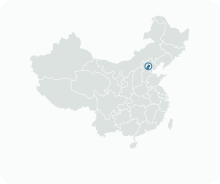
Get to know Xicheng District

Photo adjustments
Full frame retained; proportionally resized and converted to WebP. No retouching or changes to the photographed subject. Card displays may crop the view.
- Administrative area
- District · 市辖区
- Part of
- Beijing
- Chinese name
- 西城区
- Local areas
- District guide
Area & population
- Population · 2020 census
- 1,106,214
Source: cited geographic source, as of the dates shown.
History
Today's district was formed on 1 July 2010, when the old Xicheng and Xuanwu (宣武区) districts were merged. Xuanwu brought eight subdistricts, among them Dashilan (大栅栏), Tianqiao (天桥), Niujie (牛街) and Taoranting (陶然亭). Earlier, in September 1987, the Madian (马甸) area was moved in from Chaoyang.
What to see
Around Shichahai (什刹海), a route promoted by the district runs through Yandai Xiejie (烟袋斜街), a lane of small shops, paper-cutting and sugar-blowing stalls, over Yinding Bridge (银锭桥) and Desheng Bridge (德胜桥), and along Houhai to Prince Gong Mansion (恭王府), which it calls Beijing's grandest house. A cycling route links the Guo Shoujing Memorial Hall (郭守敬纪念馆), Wanning Bridge (万宁桥), the White Pagoda Temple (白塔寺), the Temple of the Moon (月坛), the Capital Museum (首都博物馆) and Tianning Temple (天宁寺) with its Liao pagoda. It passes the Jicheng Memorial Column (蓟城纪念柱) and the capital-founding memorial gate in Jinzhongdu Park (金中都公园) and ends at the Xiannongtan (先农坛) altar.
Other names in the district include Beihai Park (北海公园), Guangji Temple (广济寺), the White Cloud Temple (白云观), Financial Street (金融街) and Liulichang (琉璃厂), an antiques street. Wikipedia lists Fayuan Temple (法源寺) as the oldest surviving Buddhist temple inside the city.
Local products and crafts
The district government counts time-honoured brands (老字号) among its assets. Neiliansheng (内联升), founded in 1853, takes its name from the imperial court and from the wish that officials wearing its boots would rise in rank; its hand-stitched cloth shoes take close to a hundred steps and at least 2,100 stitches a pair, and the technique entered the national intangible heritage list in 2008. Ruifuxiang (瑞蚨祥), founded in 1862, sells silk and made-to-measure Chinese clothing; it supplied the cloth for the first national flag raised on 1 October 1949, and its hand tailoring has been on Beijing's intangible heritage list since 2007.
Highlights
- Prince Gong Mansion 恭王府: Qing mansion on the Shichahai walking route, called Beijing's grandest house by the district.
- Tianning Temple 天宁寺: Temple with a Liao pagoda on the district's cycling route.
- Capital Museum 首都博物馆: City museum on the same route, promoted with the line 'enter a museum, read a city'.
- Neiliansheng 内联升: Shoemaker founded in 1853; its cloth-shoe technique is national intangible heritage.
- Ruifuxiang 瑞蚨祥: Silk and tailoring house founded in 1862 that supplied the cloth for the first national flag.
Sources for this guide
骑行数十里,史越几千年 · Xicheng District People's Government, Beijing
什刹海致敬经典必选之旅 · Xicheng District People's Government, Beijing
西城区老字号概述 · Xicheng District People's Government, Beijing
内联升 · Xicheng District People's Government, Beijing
瑞蚨祥 · Xicheng District People's Government, Beijing
西城区 - 维基百科,自由的百科全书 · Wikipedia · CC BY-SA 4.0
Original English written from the listed sources and checked sentence by sentence against quoted extracts by a separate reviewer. Updated 2026-09-25.
Explore Xicheng District
Core places to explore, with English and Chinese names.
Beihai Park 北海公园
Jingshan Park 景山公园
Prince Gong Mansion 恭王府
Shichahai 什刹海
Gulou and Zhonglou 钟鼓楼
Capital Museum 首都博物馆
Beijing Zoo 北京动物园
Taoranting Park 陶然亭公园
National Centre for the Performing Arts 国家大剧院
Beijing Planetarium 北京天文馆
Paleozoological Museum of China · Beijing 中国古动物馆
Temple of Ancient Monarchs 历代帝王庙
White Pagoda Temple · Miaoying Temple 白塔寺
Places to explore around Xicheng District
 Beihai Park and its White Dagoba. The source contributor removed spots from the original photograph. Photo: 2013-08-29.
Beihai Park北海公园
Beihai Park is arranged around a large lake northwest of the Forbidden City. Jade Islet rises from the water with the White Dagoba above Yong’an Temple, while the northern shore holds a different group of pavilions, courtyards…
Read the place guide → Jingshan Park · 景山公园
Jingshan Park景山公园
Jingshan Park rises directly north of the Forbidden City. Its five hilltop pavilions turn the former imperial garden into a viewpoint over central Beijing, with Wanchun Pavilion at the middle summit overlooking the palace’s…
Read the place guide →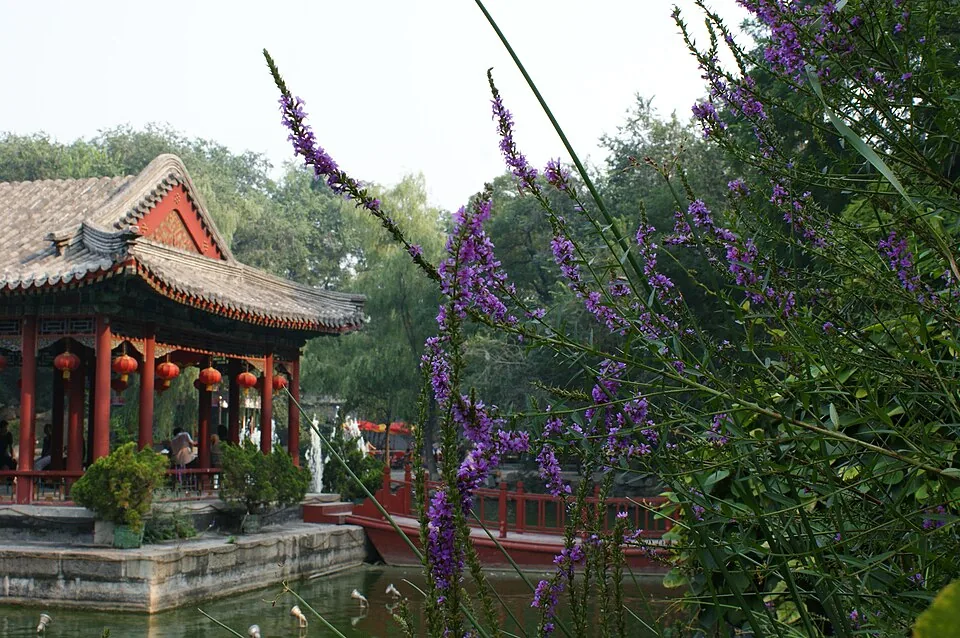 Prince Gong Mansion · 恭王府. Photo: 2008-08-03.
Prince Gong Mansion恭王府
Prince Gong Mansion combines a Qing aristocratic residence with a garden behind it in the Shichahai neighborhood. The southern residential portion is arranged through courtyards and substantial buildings; the northern garden…
Read the place guide → A lakeside promenade in Beijing’s Shichahai district, October 2008.
Shichahai什刹海
Shichahai is a historic lake district formed by Qianhai, Houhai, and Xihai, north of Beihai Park. Its waterside paths sit within an old neighborhood of temples, former mansions, and hutongs, recalling the area’s former role in…
Read the place guide → Beijing Drum Tower viewed from the Bell Tower; the Bell Tower is outside the frame. Photo: 2023-06.
Gulou and Zhonglou钟鼓楼
Beijing’s Drum and Bell Towers stand together at the northern end of the old inner-city central axis. They served the practical task of announcing time through the Yuan, Ming, and Qing periods, giving the surrounding streets a…
Read the place guide → Capital Museum in Beijing, China
Capital Museum首都博物馆
The Capital Museum presents Beijing’s history and art through collections that include porcelain, bronze, jade, calligraphy, painting, and Buddhist sculpture. Many objects come from discoveries in Beijing, making the museum a…
Read the place guide →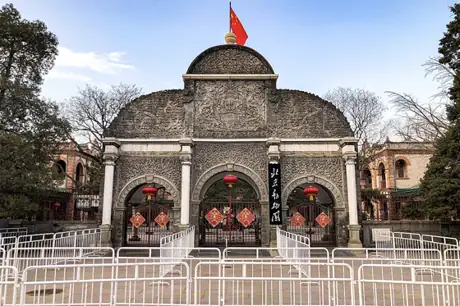 The old gate of Beijing Zoo · 北京动物园
Beijing Zoo北京动物园
Beijing Zoo occupies historic garden grounds in Xizhimen, where animal exhibits are interspersed with ponds, trees, and older buildings. The panda complex is a natural starting point for visitors focused on Chinese wildlife…
Read the place guide →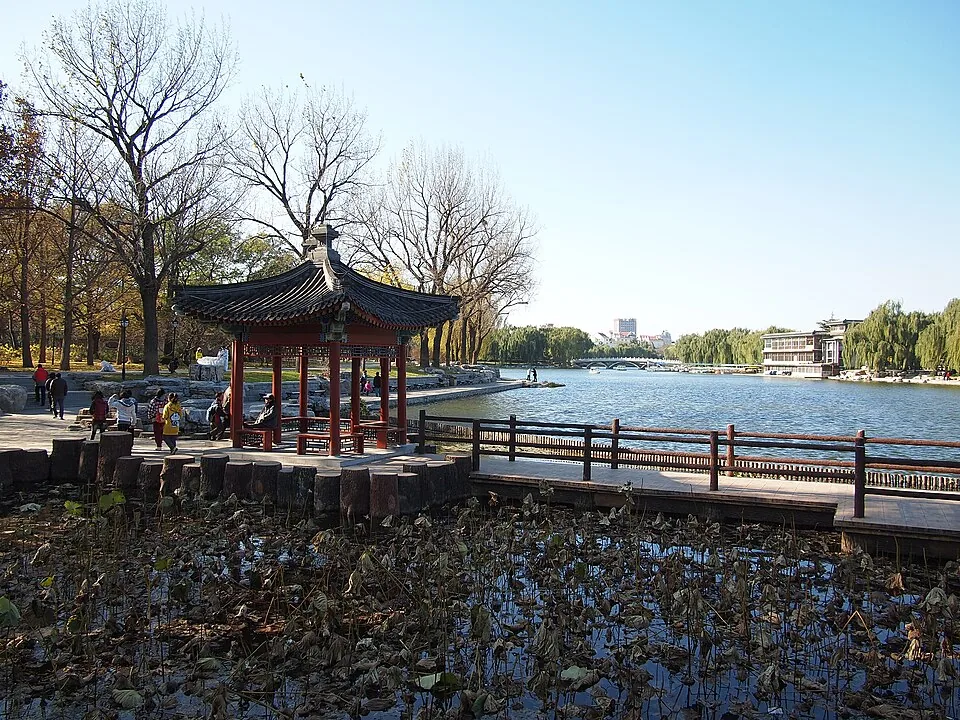 Taoranting Park · 陶然亭公园. Photo: Taken on 19 November 2011.
Taoranting Park陶然亭公园
Taoranting Park combines a lakeside public garden with an older literary and religious setting in southern Beijing. Its name comes from Taoran Pavilion, associated with gatherings of scholars and a poem by Bai Juyi, while Cibei…
Read the place guide →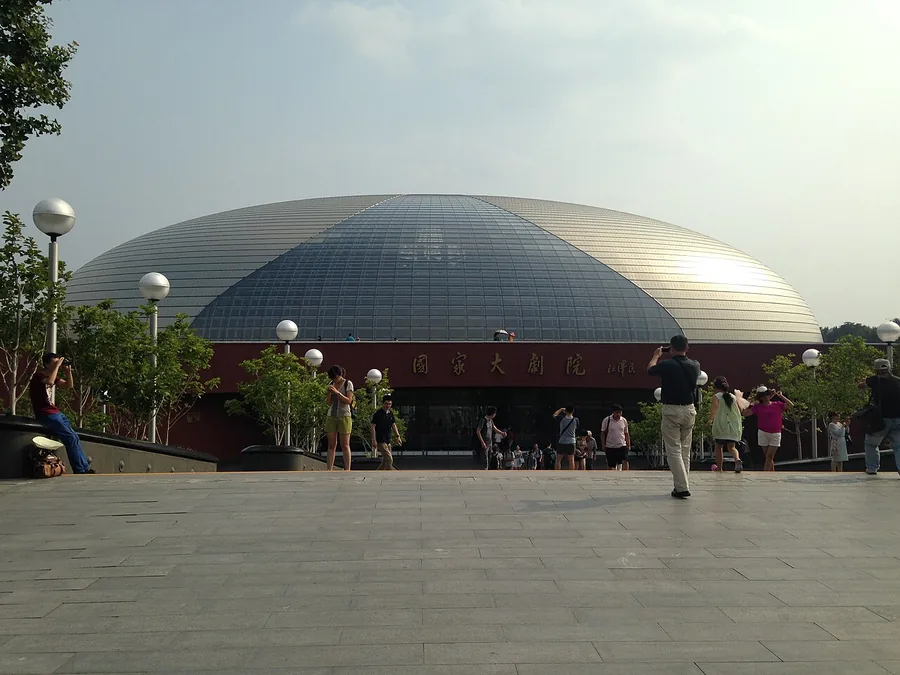 The domed National Centre for the Performing Arts in Beijing seen from its entrance approach.
National Centre for the Performing Arts国家大剧院
The National Centre for the Performing Arts brings opera, concerts, drama and smaller performances together immediately west of the Tiananmen area. Its operator identifies four principal auditoriums: the Opera House, Concert…
Read the place guide →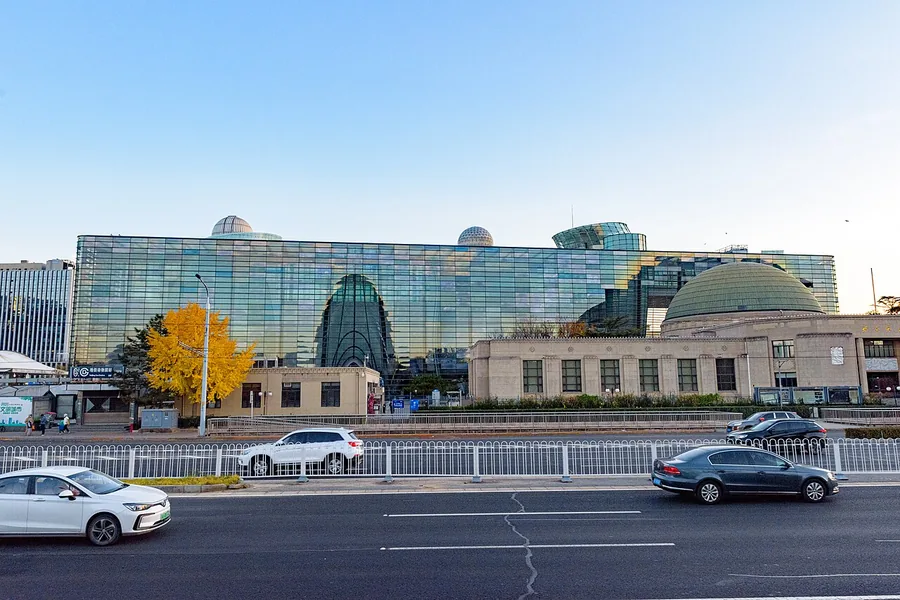 The old and new buildings of Beijing Planetarium, photographed from across the road.
Beijing Planetarium北京天文馆
Beijing Planetarium uses two generations of buildings to present astronomy through exhibitions and theater experiences. Building A contains the historic Celestial Theater and exhibition halls, while Building B adds a digital…
Read the place guide →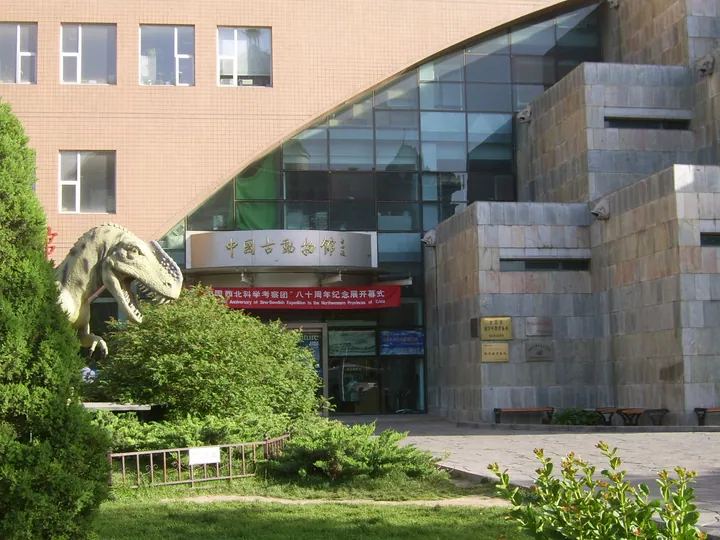 Entrance of the Paleozoological Museum of China in Xicheng District, Beijing, with its dinosaur statue · 中国古动物馆入口,西城区,北京,门前立恐龙塑像 Source-recorded photograph date: 2007.
Paleozoological Museum of China · Beijing中国古动物馆
The Paleozoological Museum of China (中国古动物馆) in Beijing is the fossil museum created by the Institute of Vertebrate Paleontology and Paleoanthropology.
Read the place guide → Main hall of the Temple of Ancient Monarchs, Xicheng District, Beijing · 北京市西城区历代帝王庙正殿 Source-recorded photograph date: Taken on 2 May 2016.
Temple of Ancient Monarchs历代帝王庙
The Temple of Ancient Monarchs (历代帝王庙) is a former imperial ritual complex on Fuchengmen Inner Street in Beijing's Xicheng District.
Read the place guide → The white bell-shaped dagoba of Miaoying Temple with its canopy top rising above grey hutong rooftops and a red-and-green traditional shopfront; a road junction with pedestrians, cars and a traffic light in the foreground and many overhead wires crossing a clear blue sky.
White Pagoda Temple · Miaoying Temple白塔寺
White Pagoda Temple (白塔寺), formally Miaoying Temple, stands on Fuchengmen Inner Street in Beijing's Xicheng District.
Read the place guide →Plan your visit
Getting there
Xicheng District is about 3 km in a straight line from central Beijing. Search for 西城区 in a map app to find stations and your accommodation.
Where to stay →Build your route
Beihai Park and Jingshan Park are less than 1 km apart. The linked place guides have entrance and visit details.
Continue with Beijing →More in Beijing
Sources & geographic information
Administrative names and parent areas: Official geographic directory · Reference date 2026-09-06.
Some facts checked against 西城区 — Wikipedia contributors, CC BY-SA 4.0.
Photo: Beihai Park · xiquinhosilva · CC BY 2.0. Converted to WebP and resized without changing the subject or cropping the source frame.

Photo: Jingshan Park · Charlie fong 冯成 · Public domain. Wikimedia thumbnail; fitted to the ranking-card frame.

Photo: Prince Gong Mansion · onion83 · CC BY-SA 2.0. Converted to WebP and resized without changing the subject or cropping the source frame.

Photo: Shichahai · FANG Chen · CC BY-SA 2.0. Proportionally resized and converted to WebP without cropping, retouching or changing the photographed subject.

Photo: Gulou and Zhonglou · Toadspike · CC BY-SA 4.0. Converted to WebP and resized without changing the subject or cropping the source frame.

Photo: Capital Museum · PENG Yanan (Neo-Jay/鸟甲) · CC BY-SA 3.0. Resized and WebP compressed; subject not altered.

Photo: Beijing Zoo · N509FZ · CC BY-SA 4.0. Resized and WebP compressed; subject not altered.
.jpg)
Photo: Taoranting Park · rheins · CC BY 3.0. Converted to WebP and resized without changing the subject or cropping the source frame.

Photo: National Centre for the Performing Arts · そらみみ (Soramimi) · CC BY-SA 4.0. Proportionally resized and converted to WebP without cropping, retouching or changing the photographed subject.
.JPG)
Photo: Beijing Planetarium · N509FZ · CC BY-SA 4.0. Proportionally resized and converted to WebP without cropping, retouching or changing the photographed subject.
.jpg)
Photo: Paleozoological Museum of China · Beijing · Shizhao · CC BY 3.0. Full frame retained; proportionally resized and converted to WebP. No retouching or changes to the photographed subject. Card displays may crop the view.

Photo: Temple of Ancient Monarchs · Aaron Zhu · CC BY-SA 3.0. Full frame retained; proportionally resized and converted to WebP. No retouching or changes to the photographed subject. Card displays may crop the view.

Photo: White Pagoda Temple · Miaoying Temple · shizhao · CC BY-SA 2.0. Full frame retained; proportionally resized and converted to WebP. No retouching or changes to the photographed subject. Card displays may crop the view.

Map data © OpenStreetMap contributors. Pins mark approximate centres, not entrances or boundaries.