

Explore the region
Read the temple as a curated history
Founded in Beijing in the Jiajing era of the Ming dynasty, the Temple of Ancient Monarchs was completed in 1532 as a place where Ming and Qing emperors performed state rites for earlier rulers and selected ministers and generals. It is the surviving imperial temple devoted to the Three Sovereigns and Five Emperors, successive rulers, and civil and military officials. The complex is a nationally protected historic site; it is not an imperial residence or burial ground.
The figures honored here were selected, not an exhaustive list of every ruler. By the Qianlong period, the main hall held memorial tablets for 188 emperors, while the eastern and western side halls honored 79 civil and military officials. The list changed over time as six Ming and Qing rulers shaped the ritual canon. It is worth reading the temple as an example of how a state organized its account of succession and political legitimacy, rather than as a neutral roll call of Chinese history.
Follow the architectural sequence
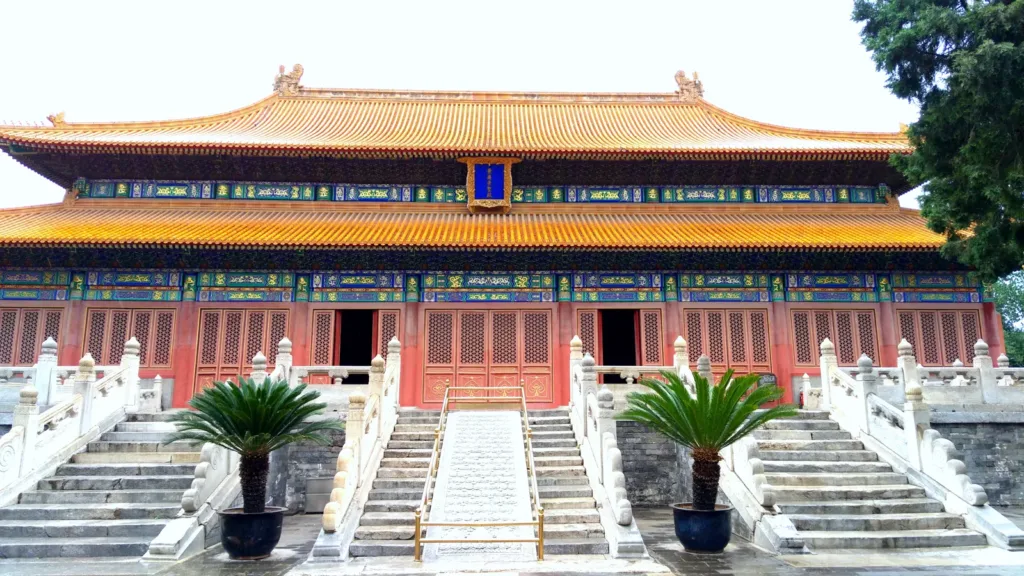
Begin at the street-facing visitor entrance at 131 Fuchengmen Inner Street and move inward from the spirit wall and main gate toward the bell tower and Jingde Gate. The main hall, Jingde Chongsheng Hall (景德崇圣殿), is the visual centre of the complex. Four imperial stele pavilions flank it, two on either side; the side halls and former service courtyards show that a major ritual site needed spaces beyond the principal altar hall. Follow the museum’s current signs for open rooms and the marked exit rather than assuming every gate or interior is accessible.
Pause in the courtyard before focusing on ornament. The hall has a double-eaved, four-slope roof and a nine-bay front; its breadth and elevated stone terrace make its rank legible even from outside. The expert account of the restoration records sixty columns in the hall and a major repair campaign from 1729 to 1733. If the interior is open, look upward: 707 ceiling panels with gold dragon painting date to that repair. If it is closed, treat the ceiling as part of the building’s history, not a promised interior view.
The surfaces also record changing imperial choices. In 1762, the roof’s earlier black and green glazed tiles were replaced with yellow tiles, and the exterior painting was raised to the highest imperial grade. These interventions turned the hall itself into an argument about ritual status. The four imperial stele pavilions, the main hall and the two side halls reward a slower circuit than a quick photograph at the central steps.
Inside the main hall, the arrangement of tablets expresses a shared ceremonial order across dynasties. The temple’s final roster included rulers associated with different ethnic and regional regimes, while the side halls placed civil and military officials in the same larger commemorative landscape. Look for the sequence from gate to hall, the spatial balance of the side courts, and inscriptions that explain why a figure was admitted to the ritual canon. Some interiors or displays may be restricted on the day.
Plan the visit
The municipal tourism service’s 18 May 2026 museum-day listing gives routine hours as Tuesday to Sunday, 09:00–17:00, with ticketing ending at 16:30; Monday is listed as the regular closure day except on statutory holidays. A separate city tourism directory gives a different weekly schedule, so treat the May listing as dated guidance and confirm the day’s hours with the museum before travelling.
The city tourism directory lists adult admission at CNY 20 and a half-price ticket at CNY 10. It does not establish a live ticket inventory or a current advance-booking requirement. Check the museum’s latest notice for ticket purchase, concession eligibility and holiday arrangements; a one-day free-admission event is not the regular price.
The official address is 131 Fuchengmen Inner Street, Xicheng District. The municipal tourism directory names the Baita Si (白塔寺) bus stop, but route numbers can change; use a live route planner to confirm service and walk from the stop to the street-address entrance. Do not navigate only to the nearby White Dagoba Temple, a separate site. The city heritage profile lists 010-66120186 as a contact number; because that profile is dated 2018, confirm that it remains in service before relying on it.
Allow about 60–90 minutes as an editorial planning estimate. The city tourism directory recommends about an hour, but time on site depends on which halls and displays are open and how closely you read the architectural details.
Find Temple of Ancient Monarchs
历代帝王庙 · 西城区
The pin marks the area, not the entrance.
Sources & visit information
Visitor details checked on 21 October 2026. Hours, tickets, reservations and transport can change; confirm with the operator before you go.
- Temple of Ancient Monarchs — Beijing Municipal Government ↗
- Temple of Ancient Monarchs — Beijing Municipal Cultural Heritage Bureau ↗
- Ming and Qing Emperors and the Temple of Ancient Monarchs — Beijing Daily ↗
- How the 188 Emperors at Beijing’s Temple of Ancient Monarchs Were Selected — National Ethnic Affairs Commission ↗
- Beijing Museums on International Museum Day, 2026 — Visit Beijing ↗
- Temple of Ancient Monarchs — Visit Beijing attraction directory ↗
- Exploring the Temple of Ancient Monarchs and its imperial ritual culture — Beijing Daily ↗
Image credits & notes (1)
- Jingde Chongsheng Hall, the principal hall of the Temple of Ancient Monarchs. Photo: Aaron ZhuPhoto: CC BY-SA 3.0