

Explore the region
Ride the city’s terrain
Chongqing Rail Transit is a network rather than a single kind of train. Lines 2 and 3 are straddle-beam monorails; other corridors include underground metro. On Line 2, the track climbs and crosses built-up slopes, making the ride itself a useful way to see the city’s topography. It remains ordinary public transport, not a sightseeing service.
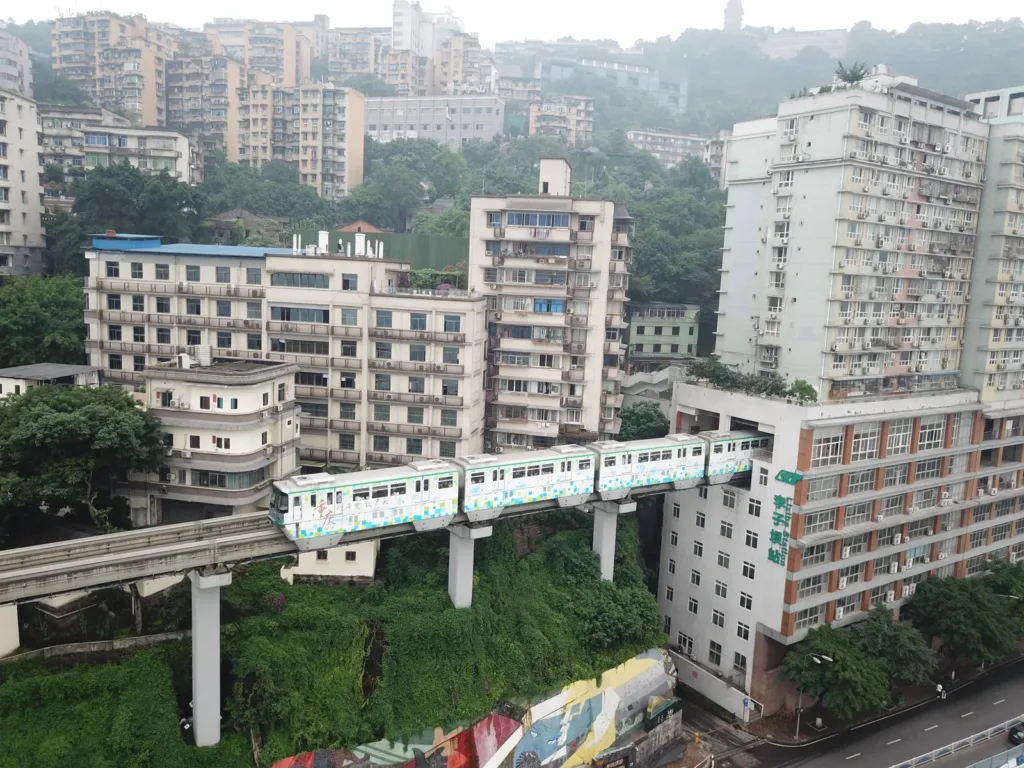
For a memorable stop, ride Line 2 to Liziba (李子坝). The station is known for a train passing through a residential building, and the operator built a designated viewing platform and visitor facilities at the station so people can watch from a managed public space rather than crowding the road. Follow station signs to that platform; the sources reviewed do not establish a numbered exit for it. Keep clear of residential entrances and other visitors’ way.
Line 1 is a practical way to reach Ciqikou (磁器口). Get off at Ciqikou Station (磁器口站) and use Exit 2; a local report describes a walk of about 100 metres to the pedestrian street. From there, explore the old lanes and newer riverside quarter on foot. The path includes uneven paving and steps, so allow time rather than treating the station-to-street walk as a level mall connection.
Choose the right line and terminal
The airport rail stops are terminal-specific. A current English network guide lists Jiangbei Airport T2 (江北机场T2航站楼) on Line 3, and Jiangbei Airport T3 (江北机场T3航站楼) on Line 10; it also shows Line 10 serving Chongqing North Railway Station (重庆北站). Check the terminal printed on your flight ticket before boarding: T2 and T3 are not interchangeable stops.
The network keeps changing, and planned lines are not necessarily passenger services. A Chongqing News report in April 2026 described Line 15’s opening as expected for late June; that was a forecast, not proof of service. Do not plan a trip around Line 15 unless it appears on the operator’s current network and service information. The official operator site publishes ticket-sale guidance and service notices, which are the better place to check before travel.
Practical trip planning
Use the station names on the current operator map to choose your route, then follow the signs inside each station for the correct line, transfer and exit. In Chongqing, a station may sit at a different street level from the road you can see; a short map distance can still involve stairs or a steep walk. Check the station’s current exit notices before setting out, especially if you need a lift or step-free route. Do not rely on a saved diagram for a recently opened extension or a temporary exit change.
Use the operator’s current ticket-sale instructions for payment options and the live service notice for operating times. This guide does not quote a fare or last-train time because they can change and vary by route. For the return journey, confirm the direction and last service from the station you will actually use rather than assuming all lines share one timetable.
The rail network has no single taxi address or universal curbside entrance. For a specific station or attraction, give the driver its Chinese name and verified address, and use only the legal passenger drop-off shown for that destination; do not ask a driver to stop on a station approach road. Long-distance coach terminals and river piers are separate destinations, not part of the urban rail system. If a trip continues by coach or boat, verify the named terminal or boarding pier and the return connection separately.

Find Chongqing Rail Transit
重庆轨道交通 · 重庆
No reliable map pin yet: search by the Chinese name.
Sources & visit information
Sources checked on 22 October 2026. Hours, tickets, reservations and transport can change; confirm with the operator before you go.
Image credits & notes (1)
- Line 2 train passing through a residential building at Liziba. Photo: David290Photo: CC BY-SA 4.0