

Explore the region
Tap any red Chinese text to hear it in Mandarin.
Huguang Guild Hall is a ticketed heritage complex in Yuzhong District, beside the Yangtze and the old Dongshuimen area. The visitor site is the compound of Yuwang Palace, Qi’an Guild Hall and Guangdong Guild Hall, not Dongshuimen Gate or Dongshuimen Bridge, which are separate nearby landmarks.
The halls grew out of Chongqing’s Qing-era trade and migration. As people from Huguang and other regions moved into Sichuan, hometown associations and merchant groups used guild halls as places to meet, conduct business and maintain shared traditions. The complex was rebuilt and expanded over time; the surviving architecture reflects several phases rather than a single construction date.
How to explore
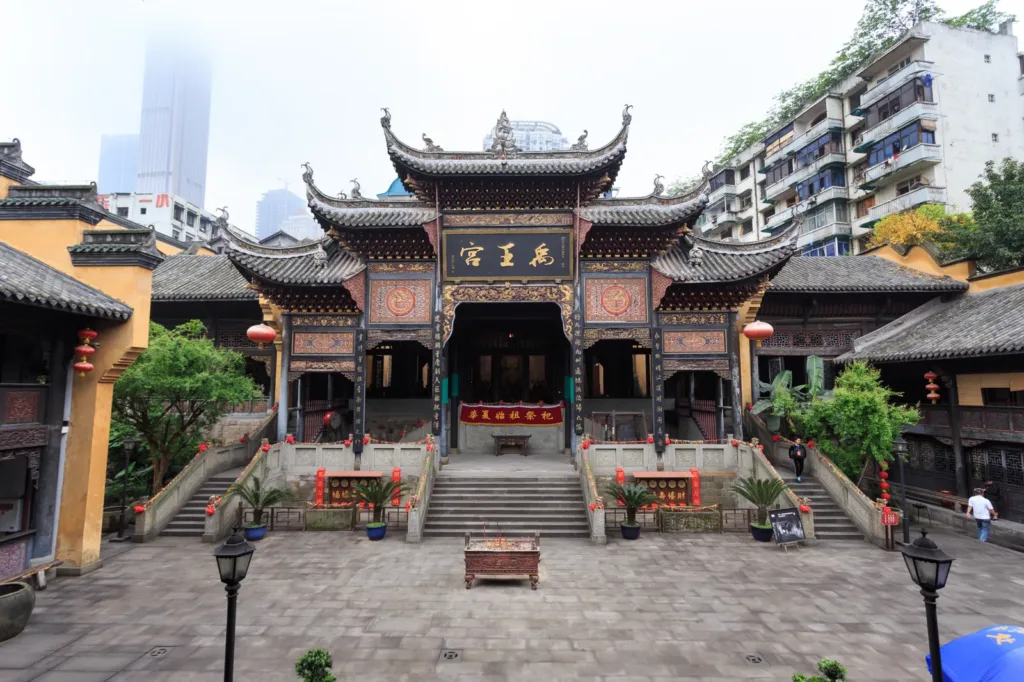
Allow time to move slowly through the stepped courtyards and halls. The compound follows a hillside with a substantial level change, so expect stairs and uneven changes in elevation; a step-free visitor route has not been confirmed. Start at Yuwang Palace and look for the layered roofs, carved brackets, painted and carved timber details, and the hall’s temple associations with Dayu, the legendary flood controller.
Continue to Qi’an Guild Hall, associated with migrants from Huangzhou in Hubei, then to Guangdong Guild Hall, also known as Nanhua Palace. Its theatre building and the other carved stages help show how a guild hall could serve as a community venue as well as a place of worship and business. Look closely at the wood, stone and brick carving: local descriptions identify familiar stories from Journey to the West, Romance of the Western Chamber, Investiture of the Gods and the Twenty-four Filial Exemplars.
The Huguang-to-Sichuan Migration Museum interprets the movement through exhibits on migration routes, daily life and the forces that drew people into Sichuan. Read the displays alongside the halls: the museum explains the journeys, while the architecture shows how migrants and merchant groups organized community life after reaching Chongqing. Temporary performances and activities may be offered, but schedules and access to individual rooms can change; do not assume a performance is included with admission.
Getting there
Metro: Take Chongqing Rail Transit Line 1 or Line 6 to Xiaoshizi (小什字). A local route guide published in 2026 recommends Exit 8, the 港渝广场 elevator to street level, then a short walk of about 150 metres to the venue. Exit numbering and street access can change; follow current station signs for 港渝广场 and 湖广会馆 rather than relying on an old exit number.
Bus: A 2026 local visitor guide lists routes 414, 440 and 553 to 湖广会馆站. Confirm the route and stop in a live transit service before boarding, since third-party route listings can lag behind service changes.
Taxi or ride-hail: Enter 重庆湖广会馆 Chóngqìng Húguǎng Huìguǎn, 重庆市渝中区长滨路芭蕉园1号. A recent Chongqing Daily report gives the nearby address as 渝中区东水门正街4号; use the venue name and follow signs to its main visitor gate. The exact legal curbside set-down point is not confirmed, so ask the driver to stop only at a lawful public curb and do not request entry into the stairways or pedestrian areas.
This is a central-city heritage attraction, not a pier or an outlying-municipality day trip; no onward rail, coach or boat transfer is needed. Opening information differs between local guides: one current visitor page lists 09:00–18:00 with last entry at 17:00, while a 2026 route article lists an earlier closing and cutoff. Check the venue’s current notice before setting out. Admission is ticketed; prices, advance-booking conditions and show packages should also be checked for the visit date.
References
Find Huguang Guild Hall
湖广会馆 · 渝中区
The pin marks the area, not the entrance.
Sources & visit information
Sources checked on 22 October 2026. Hours, tickets, reservations and transport can change; confirm with the operator before you go.
Image credits & notes (1)
- Entrance hall of Yuwang Palace at Chongqing Huguang Guild Hall, viewed from the courtyard. Photo: ZhangzhugangPhoto: CC BY-SA 3.0