


Get to know Fengdu County
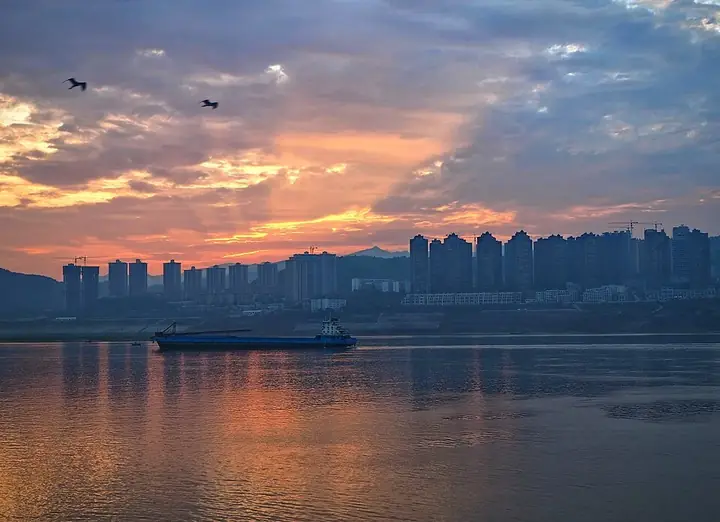
Photo adjustments
Full frame retained; resized proportionally to a maximum dimension of 960 pixels and converted to WebP quality 88. No crop, retouch, generated elements, or subject alteration. Final website rendition: full frame retained, proportionally resized to at most 720 pixels and converted to WebP. No additional retouching or subject alteration. Card displays may crop the view.
- Administrative area
- County · 县
- Part of
- Chongqing
- Chinese name
- 丰都县
- Local areas
- County guide
Area & population
- Area in the source
- 2,896.00 km²
- Population · 2020 census
- 557,374
Source: cited geographic source, as of the dates shown.
Setting and landscape
The county has 47 kilometres of Yangtze frontage. The old county town in Mingshan subdistrict was flooded by the Three Gorges Dam project, and the county seat moved to Sanhe subdistrict (三合街道). Its high-mountain attractions include an old salt-and-horse trail (盐马古道), and it has the Nantian Lake (南天湖) national tourist resort.
History
In AD 90 the Eastern Han created Pingdu County (平都县), named after Pingdu Mountain, today's Mingshan. A county called Fengdu was split off from Linjiang in 618, written with the character "酆" (feng) from 1380 and given back its present spelling in 1958. Chinese Wikipedia traces the underworld reputation to that character: the writer Tao Hongjing (陶弘景) described a Luofeng Mountain (罗酆山) where the dead go, and popular belief later merged the two.
The county government presents Fengdu as a 2,000-year county town and a 1,000-year ghost city. The "Bayu divine bird" (巴渝神鸟) found here is a prize piece of the Three Gorges Museum.
What to see
The Mingshan scenic area, on the north bank of the Yangtze, covers nearly 4 square kilometres and combines the ghost-city temples, Shuanggui Mountain National Forest Park (双桂山国家森林公园) and the old houses of Xiaoguanshan (小官山古民居). Its temples blend Taoist, Confucian and Buddhist folk belief; key buildings are the Naihe Bridge (奈何桥), the Ghost Gate Pass (鬼门关) and Tianzi Hall (天子殿). Tianzi Hall, the oldest and largest temple on the hill, was first built under the Western Jin; the present hall dates from a 1664 rebuilding and its bell and drum towers from 1901. The gateway arch carries the words "Famous Mountain under Heaven" (天下名山), taken from a poem by Su Shi (苏轼). Mingshan was on the first national list of key scenic and historic sites in 1982.
Xueyu Cave (雪玉洞), a karst cave 12 kilometres from the new county town, is a 4A area within the Three Gorges national scenic area.
Food and local products
Fengdu spicy chicken (丰都麻辣鸡) is free-range chicken dressed for a numbing, hot flavour, made by nearly 400 local businesses. It is traced to pork offal boiled with star anise and Sichuan pepper and tossed in chilli oil; local lore links the chopping of the bird to the Chicken-Foot God (鸡脚神) that stood at the temple gate on Mingshan.
Xianjia fermented tofu (仙家豆腐乳) comes with a local legend of two immortals on Pingdu Mountain. In 1915 the Shuxiangyuan (蔬香园) workshop in the county town was producing it in quantity, and in 1956 seven workshops merged into a works later renamed the state-run Fengdu brewery, which continued it.
Highlights
- Tianzi Hall 天子殿: Core temple of the ghost city, first built under the Western Jin and rebuilt in 1664.
- Xueyu Cave 雪玉洞: 4A-rated cave about 12 kilometres from the new county town.
- Fengdu spicy chicken 丰都麻辣鸡: Free-range chicken with a numbing, hot dressing, made by nearly 400 local businesses.
- Xianjia fermented tofu 仙家豆腐乳: Produced in quantity in the county town by 1915.
Sources for this guide
走进丰都_丰都县人民政府 · Fengdu County People's Government
丰都县 - 维基百科 · Chinese Wikipedia · CC BY-SA 4.0
丰都名山景区_丰都县人民政府 · Fengdu County People's Government
丰都麻辣鸡_丰都县人民政府 · Fengdu County People's Government
丰都仙家豆腐乳_丰都县人民政府 · Fengdu County People's Government
Original English written from the listed sources and checked sentence by sentence against quoted extracts by a separate reviewer. Updated 2026-09-25.
Explore Fengdu County
Core places to explore, with English and Chinese names.
Places to explore around Fengdu County
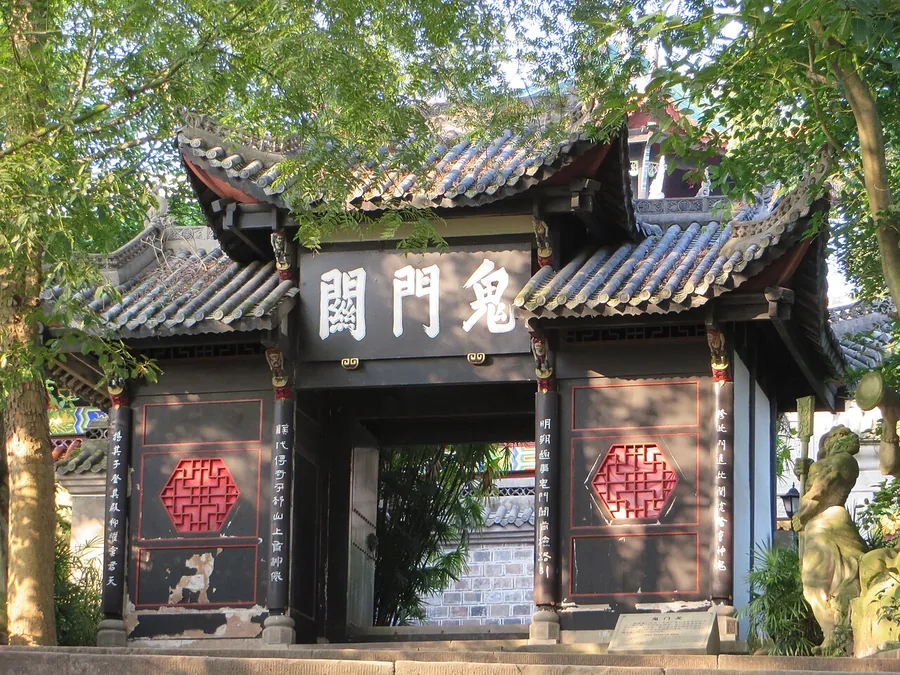 The Gates of Hell at Fengdu Ghost City, Chongqing; 14 September 2014.
Fengdu Ghost City丰都鬼城
Fengdu Ghost City climbs Ming Mountain through temples and sculptural scenes inspired by Chinese ideas of the afterlife. The three-arched Bridge of Helplessness, demon figures at Ghost-Torturing Pass and Tianzi Palace form a…
Read the place guide →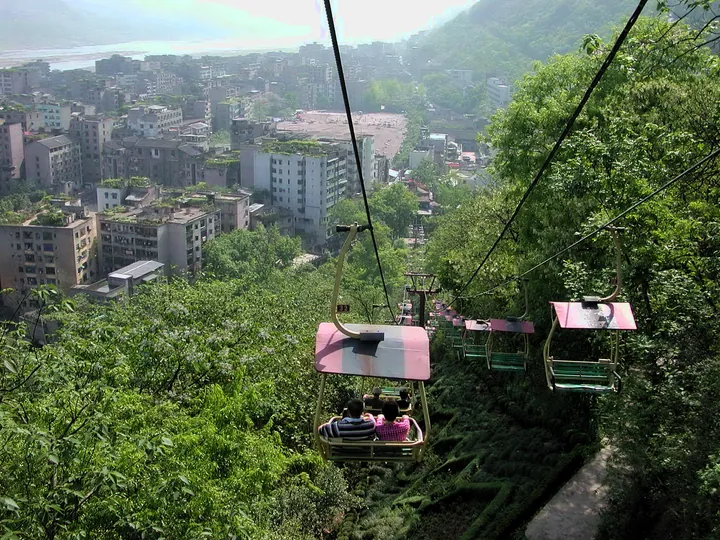 A view from a chairlift on a wooded hillside: a dense green forested slope with a footpath below, pink-roofed and green chairlift cars carrying passengers on cables crossing the frame, and a city of high-rise blocks along the Yangtze in the upper left.
Fengdu Ghost City Mingshan Scenic Area名山景区
Mingshan, known as Fengdu Ghost City, is a hill of 27 temples and underworld-themed attractions in Fengdu County, Chongqing, an ancient secondary capital of the state of Ba where a county was established nearly 2,000 years ago.
Read the place guide → Stalactite and stalagmite formations inside Snowy Jade Cave, Fengdu County, Chongqing · 重庆市丰都县雪玉洞内的钟乳石景观 Source-recorded photograph date: 2014-09-14 16:32:22.
Xueyu Cave雪玉洞
A still-growing karst cave in Fengdu, Chongqing, named for its white stalactites and known for a 4 m cave shield, a stone flag and a dense soda-straw forest.
Read the place guide →Local life & food
Fengdu County local specialties
丰都县特色美食 · 6 specialties to discover
 Fengdu Numbing-Spicy Chicken Pieces 丰都麻辣鸡块AI illustration · AI 示意图(仅供参考,非实拍)
Fengdu Numbing-Spicy Chicken Pieces (丰都麻辣鸡块), also called Fengdu mala chicken (丰都麻辣鸡), is chicken cut into pieces and tossed with chilli and Sichuan pepper, a traditional snack of Fengdu County (丰都县) in Chongqing.
Read the dish guide →Ghost City Numbing-Spicy Chicken 鬼城麻辣鸡AI illustration · AI 示意图(仅供参考,非实拍)
Ghost City Numbing-Spicy Chicken (鬼城麻辣鸡) is the numbing-and-hot poached chicken of Fengdu County (丰都县), Chongqing, whose Mount Ming (名山) is known as the 'ghost city'.
Read the dish guide → Fengdu Charred Chilli Noodles 丰都糊辣壳小面AI illustration · AI 示意图(仅供参考,非实拍)
Fengdu Charred Chilli Noodles (丰都糊辣壳小面) are noodles seasoned with hulake (糊辣壳), chilli darkened by heat and rubbed into small particles.
Read the dish guide → Fengdu Wontons 丰都抄手AI illustration · AI 示意图(仅供参考,非实拍)
Fengdu Wontons (丰都抄手) include a pungent local preparation served in hulake (糊辣壳) soup. In Fengdu (丰都), these small dumplings can also share a meal with noodles, a combination known as yuanyang mian (鸳鸯面).
Read the dish guide → Xianjia Fermented Bean Curd 仙家豆腐乳AI illustration · AI 示意图(仅供参考,非实拍)
Xianjia Fermented Bean Curd (仙家豆腐乳) is the fermented bean curd of Fengdu County (丰都县), Chongqing, which the county traces to a legend of Mount Pingdu (平都山) and the incense burned in its temples.
Read the dish guide → Fengdu Pickled Mustard Stem 丰都榨菜Reference photo of a similar dish · 同类菜品参考照片
Fengdu Pickled Mustard Stem (丰都榨菜) is made from qingcaitou (青菜头), the fleshy mustard stems processed into zhacai.
Read the dish guide →
Photo adjustments
Full frame retained; EXIF orientation normalized, proportionally resized to at most 800 pixels and converted to WebP. No generated pixels or subject changes. Cards may crop the display.
More dishes from across Chongqing are in the Chongqing food guide.
Plan your visit
Getting there
Fengdu County is about 120 km in a straight line from central Chongqing. Search for 丰都县 in a map app to find stations and your accommodation.
Where to stay →Build your route
Fengdu Ghost City and Fengdu Ghost City Mingshan Scenic Area are both listed here. The linked place guides have entrance and visit details.
Continue with Chongqing →More in Chongqing
Sources & geographic information
Administrative names and parent areas: Official geographic directory · Reference date 2026-09-06.
Some facts checked against 丰都县 — Wikipedia contributors, CC BY-SA 4.0.
Photo: Fengdu Ghost City · Jpbowen · CC BY-SA 4.0. Proportionally resized and converted to WebP without cropping, retouching or changing the photographed subject.

Photo: Fengdu Ghost City Mingshan Scenic Area · lienyuan lee · CC BY 3.0. Full frame retained; proportionally resized and converted to WebP. No retouching or changes to the photographed subject. Card displays may crop the view.

Photo: Xueyu Cave · Jpbowen · CC BY-SA 4.0. Full frame retained; proportionally resized and converted to WebP. No retouching or changes to the photographed subject. Card displays may crop the view.

Map data © OpenStreetMap contributors. Pins mark approximate centres, not entrances or boundaries.