


Get to know Hebei District

Photo adjustments
Proportionally resized and converted to WebP without cropping, retouching or changing the photographed subject.
- Administrative area
- District · 市辖区
- Part of
- Tianjin
- Chinese name
- 河北区
- Local areas
- District guide
Area & population
- Area in the source
- 29.14 km²
- Population · 2020 census
- 647,702
Source: cited geographic source, as of the dates shown.
Setting and landscape
The district government gives an area of 29.62 square kilometres, almost all of it below 4 metres above sea level. The Hai River and the North Canal (北运河) form its western edge, across which lie Heping (和平区), Nankai (南开区) and Hongqiao (红桥区); Hedong (河东区) is to the south, Dongli (东丽区) to the east and Beichen (北辰区) to the north. The government lists the Ziya (子牙河), Xinkai (新开河), Yueya (月牙河) and Beitang (北塘河) rivers among its waterways.
History
Chinese Wikipedia dates the Dabei Monastery (大悲禅院) to 1658–1659, when the Tianjin garrison commander Cao Bin (曹斌) paid for its construction. The Wanghailou (望海楼), a three-storey pavilion paid for by salt merchants, went up in 1773; the Catholic church of the same name was burned in the Tianjin Massacre of 1870. In 1902 Italy and Austria-Hungary took concessions here, and the same year the governor-general Yuan Shikai (袁世凯) began the Hebei New District on low marshland north of the river, planned around today's Zhongshan Road (中山路), with the Jingang Bridge (金钢桥) linking it to the old city. The Xinkaihe station of 1903 is today's Tianjin North railway station (天津北站). The Third District took the name Hebei in 1956.
What to see
The Italian Style Town (意式风情区) on the Hai River covers the former Italian concession of 1902: 137 period buildings, all designed by Italians, including houses, a consulate, town hall, barracks, schools, a hospital and a church. The district government calls it the only well-preserved group of Italian-style buildings in Asia; restoration with Italian technicians began at the end of 2002.
The Tianjin Eye (天津之眼) stands on the Yongle Bridge (永乐桥) at the Sancha River mouth (三岔河口). Built from 2003 and running since April 2009, it is 110 metres across, rises about 120 metres above the water and carries 48 cabins; a turn takes about 30 minutes. The Liang Qichao Memorial (梁启超纪念馆) at 44 and 46 Minzu Road (民族路) opened in 2003 as Tianjin's first museum in a notable person's former home; it combines his house with the Yinbingshi (饮冰室) study, and is a national key protected site. The district government also names the Awakening Society (觉悟社) site, Wanghailou Church (望海楼教堂) and the former homes of Li Shutong (李叔同) and Cao Yu (曹禺).
Getting oriented
Tianjin railway station (天津站) and Tianjin North station both lie in the district, which the government says has seven metro lines. The district government seat is on Shizilin Street (狮子林大街).
Highlights
- Italian Style Town 意式风情区: Former Italian concession with 137 period buildings designed by Italians.
- Tianjin Eye 天津之眼: 110-metre wheel built on the Yongle Bridge over the Hai River, running since 2009.
- Liang Qichao Memorial 梁启超纪念馆: Liang's former home and Yinbingshi study; national key protected site, opened 2003.
- Dabei Monastery 大悲禅院: Buddhist monastery founded in 1658–1659.
- Wanghailou Church 望海楼教堂: Catholic church burned in the Tianjin Massacre of 1870.
Sources for this guide
河北区 - 维基百科,自由的百科全书 · Chinese Wikipedia · CC BY-SA 4.0
区情简介 - 天津市河北区人民政府 · Hebei District People's Government, Tianjin
意式风情区 - 天津市河北区人民政府 · Hebei District People's Government, Tianjin
“天津之眼”摩天轮 - 天津市河北区人民政府 · Hebei District People's Government, Tianjin
梁启超纪念馆 - 天津市河北区人民政府 · Hebei District People's Government, Tianjin
Original English written from the listed sources and checked sentence by sentence against quoted extracts by a separate reviewer. Updated 2026-09-25.
Explore Hebei District
Core places to explore, with English and Chinese names.
Places to explore around Hebei District
 Tianjin Eye · 天津之眼
Tianjin Eye天津之眼
The Tianjin Eye is a giant observation wheel built over Yongle Bridge on the Haihe. Its most distinctive feature is the combination of transport structures: the circular wheel rises above a working river crossing, with the…
Read the place guide → The main entrance of Dabei Temple, the Temple of Great Compassion, Tianjin; 1 January 2013.
Dabei Temple大悲禅院
Dabei Temple, the Temple of Great Compassion, is a Buddhist monastery organized around older western and later eastern compounds. Its sculpture gives the visit a clear focus: the Sakyamuni figure in the main hall sits on a…
Read the place guide →Wanghailou Church beside the Haihe in Tianjin, photographed in January 2014.Wanghailou Church望海楼教堂
Wanghailou Church, dedicated to Our Lady of Victory, stands beside Shizilin Bridge on the Haihe's northern bank. Its history includes repeated destruction and rebuilding during the violence of 1870, the Boxer period and later…
Read the place guide → Italian Concession of Tianjin · 意式风情区
Italian Concession of Tianjin意式风情区
Tianjin's Italian-style district reuses streets and buildings from the former Italian concession as a dining and heritage neighborhood. Marco Polo Plaza forms its best-known center, while the surrounding grid retains villas…
Read the place guide →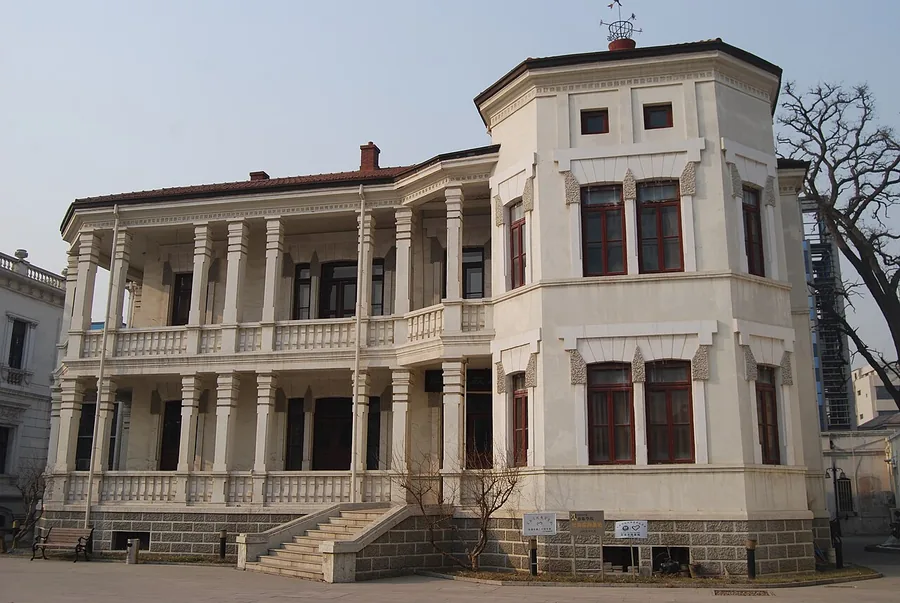 Liang Qichao's former residence in Tianjin, photographed in January 2011.
Liang Qichao Former Residence梁启超故居
Liang Qichao's Tianjin residence and the neighboring Yinbingshi study connect an Italian-style villa with one of modern China's influential reformers and scholars. The domestic building and study served different purposes…
Read the place guide → The decorated entrance arch of Zhongshan Park in Tianjin. Photographed on 29 January 2024.
Zhongshan Park天津中山公园
Tianjin's Zhongshan Park began as an early public park and exhibition ground in Hebei District. Its present identity includes memorials rather than a fully preserved version of the original gardens. A Sun Yat-sen statue and…
Read the place guide → The facade and courtyard entrance of Cao Yu’s former residence in Tianjin. Photographed on 5 January 2011.
Cao Yu Former Residence曹禺故居纪念馆
Cao Yu's former residence preserves two adjoining courtyard properties associated with the playwright's childhood and youth in Tianjin. Brick-and-timber houses contain restored living and study spaces, while photographs…
Read the place guide →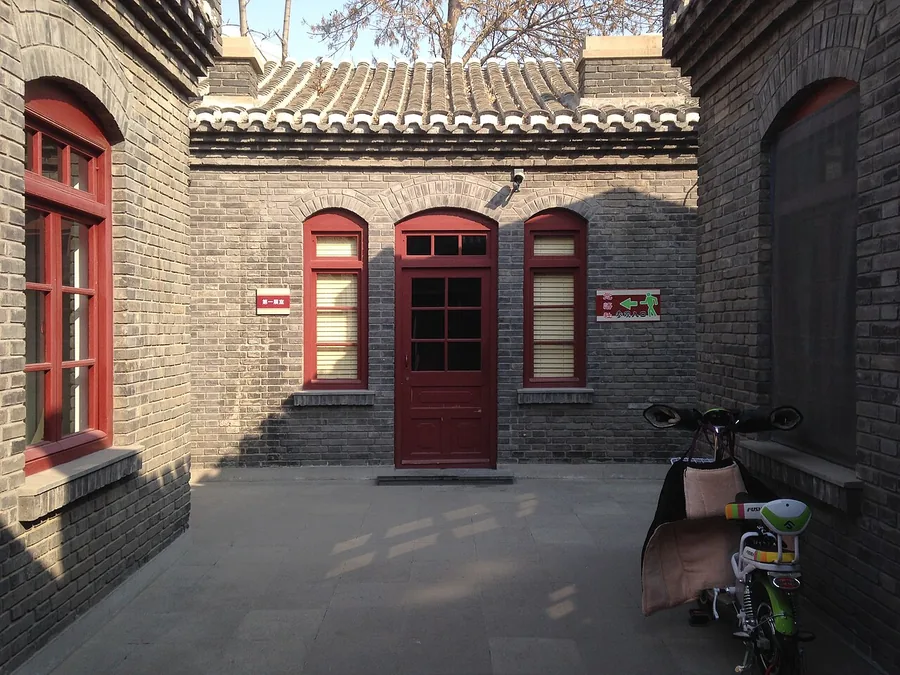 The grey-brick courtyard of the Awakening Society Memorial in Tianjin, before the 2026 renewal. Photographed on 22 January 2014.
Awakening Society Memorial觉悟社纪念馆
The Awakening Society Memorial occupies the small grey-brick courtyard where Zhou Enlai, Deng Yingchao, Ma Jun and fellow students formed their association in 1919. It reopened on 29 April 2026 after repairs and an exhibition…
Read the place guide → Liang Qichao Memorial Hall · 梁启超纪念馆
Liang Qichao Memorial Hall梁启超纪念馆
Liang Qichao Memorial Hall occupies the reformer and scholar’s former residence and Yinbingshi study in Tianjin’s Hebei District.
Read the place guide →Plan your visit
Getting there
Hebei District covers the centre of Tianjin. Search for 河北区 in a map app to find stations and your accommodation.
Where to stay →Build your route
Tianjin Eye and Dabei Temple are less than 1 km apart. The linked place guides have entrance and visit details.
Continue with Tianjin →More in Tianjin
Sources & geographic information
Administrative names and parent areas: Official geographic directory · Reference date 2026-09-06.
Some facts checked against 河北区 — Wikipedia contributors, CC BY-SA 4.0.
Photo: Tianjin Eye · KangTyngrwey · CC BY-SA 4.0. Wikimedia thumbnail; fitted to the ranking-card frame.

Photo: Dabei Temple · Regina800809 · CC BY-SA 3.0. Proportionally resized and converted to WebP without cropping, retouching or changing the photographed subject.

Photo: Wanghailou Church · Xrdtj · CC BY-SA 3.0. Proportionally resized and converted to WebP without cropping, retouching or changing the photographed subject.

Photo: Italian Concession of Tianjin · xiquinhosilva · CC BY 2.0. Wikimedia thumbnail; fitted to the ranking-card frame.
.jpg)
Photo: Liang Qichao Former Residence · TJArchi-Studio · CC BY-SA 2.0. Proportionally resized and converted to WebP without cropping, retouching or changing the photographed subject.

Photo: Zhongshan Park · KangTyngrwey · CC BY 4.0. Proportionally resized and converted to WebP without cropping, retouching or changing the photographed subject.

Photo: Cao Yu Former Residence · TJArchi-Studio · CC BY-SA 2.0. Proportionally resized and converted to WebP without cropping, retouching or changing the photographed subject.

Photo: Awakening Society Memorial · Xrdtj · CC BY-SA 3.0. Proportionally resized and converted to WebP without cropping, retouching or changing the photographed subject.

Photo: Liang Qichao Memorial Hall · Source photographer · License not provided. EXIF orientation normalized; resized without changing aspect ratio; converted to WebP. No subject edits.
Map data © OpenStreetMap contributors. Pins mark approximate centres, not entrances or boundaries.