

Baked samsa buns 烤包子
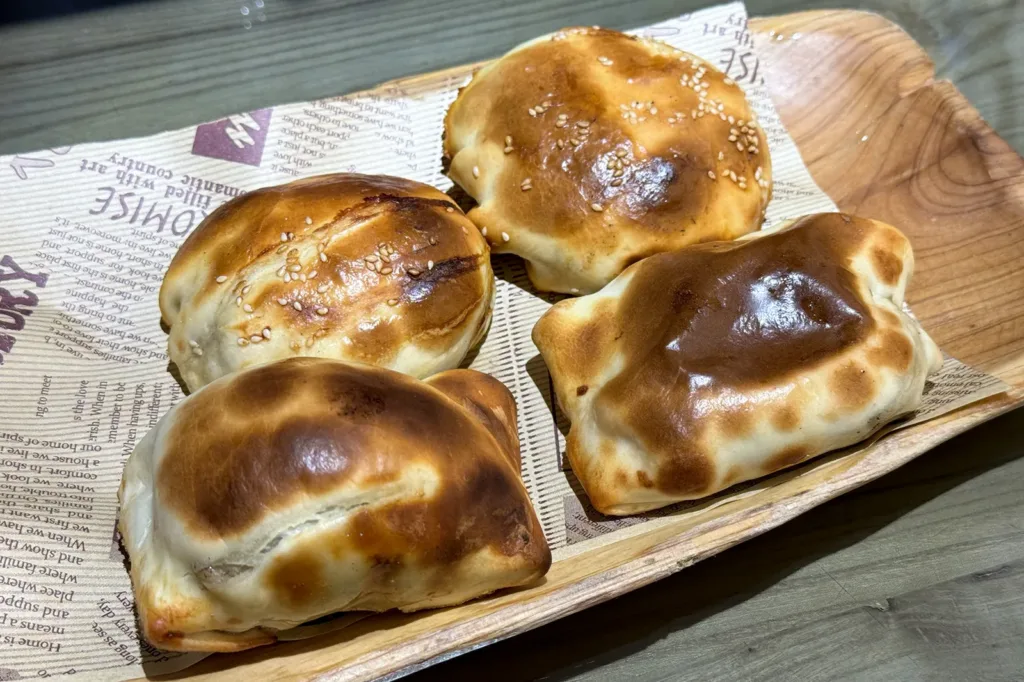
Baked samsa buns (烤包子), also called 撒木萨 in a Kashgar municipal food guide, are thin-wrapped lamb pastries baked against the wall of a nang pit. In Kashgar they are part of everyday food culture rather than a dish tied to one canonical shop: expect a crisp shell, juicy lamb, sweet onion and warm spice.
Tap any red Chinese text to hear it in Mandarin.
What you are ordering
烤包子 translates literally as “baked buns”, but the eating experience is closer to a filled baked pastry than to a steamed baozi. The Kashgar city guide describes a thin, unleavened wrapper rolled from dead dough, filled and folded into a square. A reliable English-language Xinjiang recipe also identifies 烤包子 as Kao Bao Zi and connects it with the Uyghur name samsa.
This is a Xinjiang-wide food style with a clear Kashgar association, not a dish that Kashgar can be said to have invented. The Kashgar municipal government places 烤包子 among its ten local foods to try, while a 2025 report describes it as part of ordinary food life in Kashgar and other southern Xinjiang places.
How it is made
The documented Kashgar version uses lamb cut into pieces, lamb-tail fat, onion, cumin, salt and pepper, with a little water mixed into the filling. The wrapper is folded over the filling and the raw parcels are stuck to the hot wall of a nang pit until the skin turns golden and the meat cooks. The same local account says some kitchens use an oven instead; a newspaper description likewise records thin dough, square folding, egg wash and sesame as common steps rather than a single mandatory formula.
For a visitor, the important contrast is with steamed baozi: there is no soft, yeasted cushion around the filling. High heat sets the thin wheat wrapper and renders the fat into the lamb and onion. Home-oven recipes can reproduce the idea, but their dough, temperature and timing are adaptations, not a rule that every Kashgar baker follows.
Flavour and texture
A well-baked bun gives you a firm, crisp edge first. Inside, the lamb stays juicy because the onion releases moisture and the small pieces of fat melt during baking. Cumin and pepper give the filling a warm savoury lift, while the onion brings sweetness. The result is richer and more aromatic than the plain word “bun” suggests.
Let a fresh bun cool briefly before opening it. Steam, hot meat juice and rendered fat can escape from the centre, so break it carefully rather than biting straight through the folded top. Keep 烤包子 Kǎo Bāozi handy when ordering; this is the Chinese name used by the Kashgar government guide.
Local variation and dietary notes
The lamb-and-onion version is the clearest Kashgar reference, but it is not a universal fixed recipe. The Xinjiang Daily report notes that southern versions may also use vegetables or tofu, while northern versions more often centre on lamb. A filling may therefore look familiar but still differ in meat, fat, spices or vegetables from one bakery to another.
The documented standard version contains lamb and often lamb fat, so it is not vegetarian. Ask what is in the day’s filling if you avoid meat, have an allergy or need a particular preparation. The sources establish a local food tradition, not a universal halal certification, allergen-free kitchen or single ingredient list.
Where to eat it
You can find Baked samsa buns all over Xinjiang, so there is no need to seek out one particular restaurant. To find one near you, search for “烤包子” in Meituan (美团) or Amap (高德地图) and check recent reviews, distance and opening hours.
More dishes to compare
Explore related local specialties and compare their names, preparation notes and ordering guidance.
Tacheng cheese buns 塔城奶酪包 →
The filled buns are baked until the dough sets around the softer cheese centre. The bread is soft against a richer dairy filling, which may be sweet or more savoury according to the style.
Grilled lamb skewers 烤羊肉串 →
Lamb chunks, often alternating lean meat and fat, are threaded onto skewers and grilled over strong heat. Cumin, chili and salt are familiar seasonings, with local and individual variations. Fat renders around browned edges, giving a juicy bite and a smoky, aromatic finish.
Sources & reading
Recipes and servings vary between kitchens.
Image credits & notes (1)
- Baked samsa served by Tianshan Qihao Samsa Restaurant in Aksu, Xinjiang; a regional reference image, not a photograph of a Kashgar venue. Photo: WindmemoriesPhoto: CC BY-SA 4.0