

Bean-filled sesame pastries 蛤蟆吐蜜
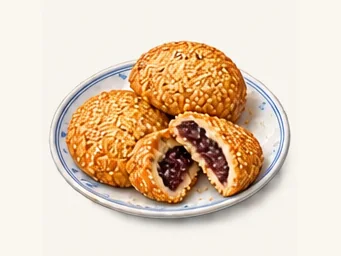
Hama Tu Mi (蛤蟆吐蜜) is a Beijing-associated baked wheat bun filled with sweet bean paste and sesame-coated around its edge. In the oven, the filling expands through a split in the crust—the “honey-spitting toad” image behind its name. Eat it warm for a fragrant, tender-crisp crust and a substantial, sweet bean centre.
A bun named for its filling
蛤蟆吐蜜 is also called 豆馅烧饼, or bean-filled baked bun. The name literally evokes a toad spitting honey, but the “honey” is the sweet bean filling; the pastry need not contain honey, and there is no animal ingredient. In the oven, the bean paste swells and pushes through a natural opening at the bun’s edge, where it remains visible like a little tongue of filling.
This is a baked wheat pastry, not a chewy glutinous-rice sesame ball. A typical version encloses sweet bean paste in a small piece of wheat dough, flattens it with the seam facing outward, and presses sesame seeds onto the dampened rim. The high heat opens the seam as the filling warms. Published recipes and kitchens vary, so a particular dough formula, filling ratio, or baking time is not a universal standard.
What it looks and tastes like
Look for a small, round, sesame-edged bun with a browned baked surface and a dark seam of bean paste showing at one side. The shell can be crisp at the rim and softer through the middle; the bean centre is dense and sweet rather than runny. Toasted sesame gives the first nutty aroma, followed by the warm, mellow scent of baked dough and beans. Beijing food coverage describes the contrast as a crisp, fragrant outside around a generous bean filling, while another Beijing account calls the bun soft and sweet. The exact balance depends on the baker.
It is best eaten warm, when the crust is more fragrant and the filling soft. Let a freshly baked bun cool briefly, since the centre can hold heat. Have it as a snack with tea, or split one to share if you want a smaller taste; the bean filling makes the pastry more substantial than its size suggests.
Its place in Beijing food culture
Beijing food and tourism sources identify Hama Tu Mi as a familiar local snack, and Beijing’s 2024 citywide snack festival included it among the traditional foods presented by the Nánláishùn restaurant brand. It is also described as a traditional snack of the wider Beijing–Tianjin area. These sources support its place in Beijing’s food culture, but not a claim that Beijing alone invented it; this article does not repeat contested origin legends as fact.
For a quick dietary check, the pastry is made with wheat dough and sesame, and its filling is sweet bean paste. Ask the seller about the particular filling and preparation if you need to avoid a specific ingredient; recipes and shop practices vary.
Where to eat it
You can find Hama Tu Mi all over Beijing, so there is no need to seek out one particular restaurant. To find one near you, search for “蛤蟆吐蜜” in Meituan (美团) or Amap (高德地图) and check recent reviews, distance and opening hours.
More dishes to compare
Explore related local specialties and compare their names, preparation notes and ordering guidance.
Honey-dipped ear pastries 糖耳朵 →
Thin pieces of sweetened dough are folded into ear-like shapes, fried and dipped in syrup. The syrup penetrates the folds rather than simply forming a dry sugar coating. Fresh pieces combine a lightly firm surface with a dense, chewy interior. Their lasting sweetness makes plain tea a useful accompaniment.
Jiaoquan 焦圈 →
Small rings of wheat dough are deep-fried until dry and golden, with very little soft dough remaining inside. They are normally served ready to eat rather than filled. A jiaoquan shatters with a brittle crunch and leaves a toasted, lightly oily finish.
Sources & reading
Recipes and servings vary between kitchens.
- “Old Beijing Thirteen Delicacies”: Hama Tu Mi, the Bean Filling Swells Like a Golden Toad Spitting Honey
- Beijing Snack: Bean-Filled Baked Bun Hama Tu Mi
- Fourth Beijing Snack and Food Culture Festival Opens
- Hama Tu Mi
- Hama Tu Mi: How Did a Beijing Specialty Become Tianjin Intangible Cultural Heritage?
- Local food reference