

Beef baked in a covered pot 罐焖牛肉
Harbin-style 罐焖牛肉 (guàn mèn niúròu) is a Russian-influenced beef stew slow-cooked in a covered clay or earthenware pot, often with potatoes and carrots; its rich sauce and local variations make it a useful introduction to the city’s old Russian-style dining tradition.
Tap any red Chinese text to hear it in Mandarin.
What you are eating
罐焖牛肉 (guàn mèn niúròu) is a Harbin menu name for beef cooked slowly in a covered pot. It belongs to the city’s Russian-style restaurant tradition, which took root as Harbin grew into a railway-era city and Russian and other immigrant foodways met local Manchu and Han cooking. That history makes the dish locally meaningful, but it does not make every version a single, fixed Russian recipe.
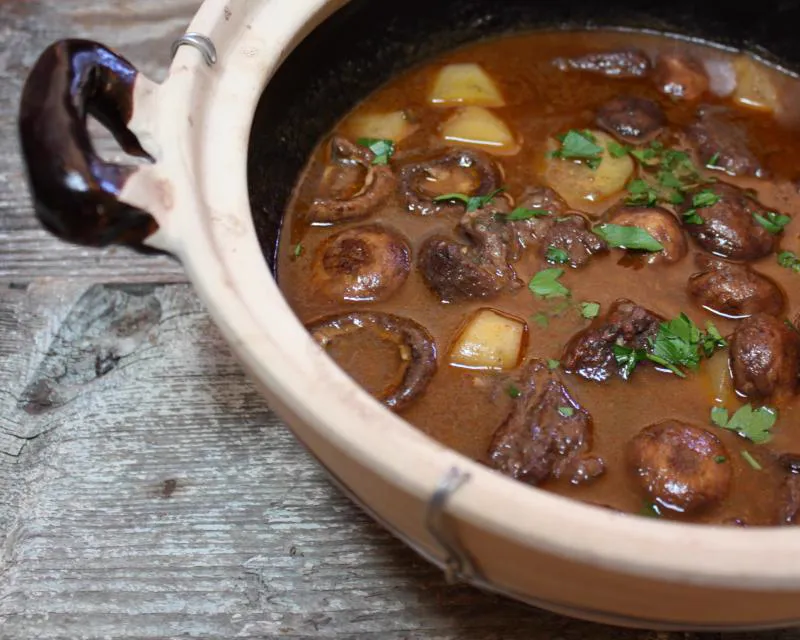
A reported Harbin preparation uses beef brisket in a clay casserole with potatoes and carrots. The long, covered cooking lets the meat juices season the vegetables, so the result is a moist braise rather than a crisp roast: expect tender beef, softened vegetables and a substantial savoury sauce. Treat this as a useful picture of one local preparation, not a guarantee that every kitchen uses the same cut, vegetables, seasoning or vessel.
The covered-pot idea also has a wider Russian cooking parallel: Russian beef stew is traditionally cooked in a clay pot in an oven, while the vegetables and the choice of serving potatoes can vary. That comparison helps explain the technique, but it is not evidence that a Harbin restaurant follows that recipe exactly.
How the Harbin versions differ
Restaurant recipes can be noticeably local or contemporary. One Harbin restaurant report describes a version packed with beef, tomatoes and potatoes and capped with a thin baked topping. The same report describes another restaurant’s 罐焖牛肉 as using red wine for flavour rather than the more traditional garlic emphasis. These are restaurant-specific variants, not ingredients to assume in every order.
The dish is also part of a recognised local Russian-style Western-food tradition. In 2025, a Heilongjiang government report described the Russian-style Western cooking techniques at Madier Hotel as being standardised, including the ingredients, process, colour and flavour of 罐焖牛肉. Standardisation at one established institution confirms the dish’s place in the tradition; it does not erase kitchen-to-kitchen variation.
How to order and eat it
Keep the Chinese name ready: 罐焖牛肉 Guànmèn Niúròu. You can show it to a server or ask, 请问有罐焖牛肉吗? (Qǐngwèn yǒu guànmèn niúròu ma?) Menus may shorten the name to 罐焖肉 Guànmèn Ròu, or use a restaurant’s own English translation, so the Chinese characters are more useful than an English label.
Ask what is in that day’s pot if you have dietary restrictions. The dish is beef-based, but the cooking liquid, thickener, wine, butter, dairy, stock and vegetables can vary. Its name or brown sauce does not prove that it is free of gluten, dairy or other allergens, and the dish is not vegetarian. If bread is offered, it can be used to collect the sauce; bread is not guaranteed as part of the serving.
Where to eat it
You can find Beef baked in a covered pot all over Heilongjiang, so there is no need to seek out one particular restaurant. To find one near you, search for “罐焖牛肉” in Meituan (美团) or Amap (高德地图) and check recent reviews, distance and opening hours.
More dishes to compare
Explore related local specialties and compare their names, preparation notes and ordering guidance.
Qiqihar barbecue 齐齐哈尔烤肉 →
Thin beef slices are seasoned and cooked on a hot tabletop grill, with vegetables and other cuts often added to the order. Marinades and dipping mixtures vary between Qiqihar restaurants. Browning gives the meat savory edges while thin slicing keeps the bite manageable. Onion, herbs or dry seasoning can add sharpness and spice.
Pork belly, sour cabbage & glass noodles 酸菜白肉炖粉条 →
The cabbage is cut into narrow strips and simmered with pork and broth. The noodles are added so that they become tender without disappearing into the liquid. The balance of fresh pork, cooked pork and stock differs among households. Expect a clear sour note, soft cabbage and slippery noodles, with the pork providing richness. This is usually a broth-led dish rather than a thick sweet-and-sour sauce, and chilli can be added separately where offered.
Sources & reading
Recipes and servings vary between kitchens.
- Xinhua, “追光|“尔滨”,太好吃了!”
- Heilongjiang Daily, “标准化助燃龙江旅游热”
- Economic Daily–China Economic Net, ““尔滨”的浪漫西餐”
- China News Service Jingwei, “哈尔滨俄式餐厅创新意,带动“俄餐”关注热度大涨226%”
- RusslandJournal.de, “Beef Stew Russian Style”
- Heilongjiang Provincial Department of Culture and Tourism, “行食四季|在哈尔滨来一场citywalk,邂逅不期而遇的惊喜”
- Local food reference
Image credits & notes (1)
- Claypot beef stew with potatoes and mushrooms; an illustrative comparison for Harbin-style 罐焖牛肉, not a photograph identified as a Harbin restaurant serving the dish. Photo: Andrea NguyenPhoto: CC BY 2.0