

Beijing braised oxtail 红烧牛尾
Hongshao niuwei (红烧牛尾), or braised oxtail, is a signature dish at Beijing’s Hongbinlou, a Hui-style restaurant that moved from Tianjin to Beijing in 1955. Its bone-in tail pieces are slowly cooked until the meat releases easily, then served with a rich, glossy, slightly sweet sauce. It is a well-documented Beijing restaurant specialty, not a dish claimed to have originated only in Beijing.
What the dish is
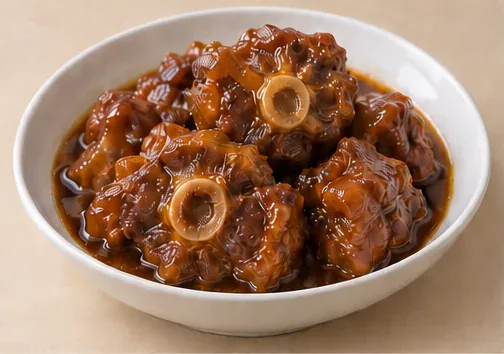
Hongshao niuwei means oxtail cooked in a braising sauce. At Hongbinlou, the dish is a prominent house specialty: reports describe carefully selected middle sections of the tail, cut through the joints and served with the bone still in each piece. This is a substantial, sauce-led meat dish rather than boneless slices of beef.
Hongbinlou began in Tianjin and moved to Beijing in 1955. Beijing tourism listings and local reporting identify 红烧牛尾 as one of its celebrated dishes. That gives the dish a strong and traceable Beijing association through a particular restaurant; it does not establish that braised oxtail was invented in Beijing or that every restaurant’s version is the same.
How Hongbinlou makes its version
A 2024 interview with Hongbinlou’s administrative head chef describes a painstaking method. The kitchen selects the more even middle joints of the tail, cleans them repeatedly, and simmers them with ginger, star anise and more than ten seasonings for four to five hours. The cook checks individual pieces as they soften, taking out the more tender ones while less-cooked pieces continue. The report describes a later steam of about an hour with chicken stock, followed by a finished, thickened sauce. This is the chef’s account of Hongbinlou’s practice, not a fixed recipe for every dish called 红烧牛尾.
The long, moist cooking softens the connective tissue around the tail bones. In braises generally, the resulting gelatin and a reduced cooking liquid help give the sauce body and shine; other Chinese home recipes use a different sequence of pressure-cooking and wok-braising, with soy sauce, wine and aromatics.
What to expect at the table
The Hongbinlou version is described as glossy red-brown, deeply savory and gently sweet. Its meat is tender enough to come away from the bone with a nudge of chopsticks, while the sauce is concentrated and substantial rather than a thin soup. Ginger and warm spices are part of the reported cooking, but no single spice blend or exact seasoning ratio should be assumed across restaurants.
Because the pieces contain bones, allow time to work around them and keep a small side plate for bones if one is provided. A spoon can help with the sauce; plain rice is a useful, optional accompaniment for catching it, though side dishes and service vary by restaurant.
Where to eat it
You can find Hongshao niuwei all over Beijing, so there is no need to seek out one particular restaurant. To find one near you, search for “红烧牛尾” in Meituan (美团) or Amap (高德地图) and check recent reviews, distance and opening hours.
More dishes to compare
Explore related local specialties and compare their names, preparation notes and ordering guidance.
Lamb hotpot 涮羊肉 →
Thin lamb slices cooked at the table, often paired with sesame sauce.
Beijing pork and pickled-cabbage casserole 砂锅白肉 →
Shaguo bairou (砂锅白肉) brings thin slices of cooked pork belly together with pickled cabbage and vermicelli in a casserole of clear meat broth. The pale meat and tangy cabbage distinguish it from a dark, sweet braise.
Sources & reading
Recipes and servings vary between kitchens.