

Fish Maw in Rich Yellow Broth 黄焖鱼肚
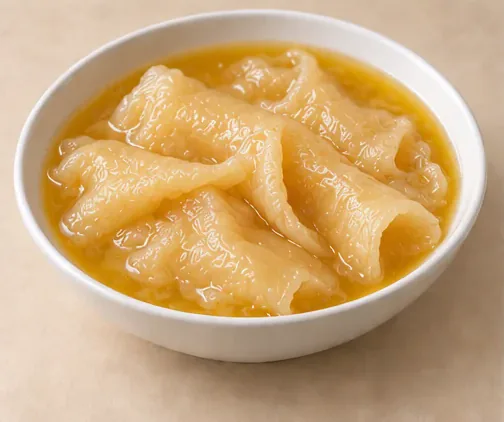
Fish Maw in Rich Yellow Broth (黄焖鱼肚) is a Beijing-associated Tan Family Cuisine braise: dried fish swim bladder is prepared until tender, then served in a glossy, golden, deeply savory stock. Its hallmark is the contrast between the soft, yielding maw and concentrated broth—not a piece of fish fillet. Recipes and fish-maw varieties differ, so ask what stock and seafood are in the serving.
Tap any red Chinese text to hear it in Mandarin.
What the name means
The “maw” is the fish’s swim bladder, usually sold dried as a seafood ingredient; it is not fish-belly meat, stomach, or shark fin. Depending on species and grade, a dried piece can be thick and substantial or thin and delicate. Rehydration changes its size and tenderness, and the texture varies with the material used.
The dish is associated with Tan Family Cuisine, a Beijing official-household tradition known for carefully prepared seafood and long-cooked stock. Beijing Tourism places 黄焖鱼肚 among Beijing’s classic dishes and describes it alongside Tan-style yellow-braised shark fin. The two names refer to different ingredients: fish maw is not shark fin. The Beijing listing describes fish maw as the substitute used in the newer counterpart, but this should not be read as one fixed recipe or as a claim that every restaurant makes the same dish.
What goes into the braise
The central ingredient is rehydrated fish maw. The cooking logic is to prepare the dried ingredient first, then let it absorb a richly flavored stock during a gentle braise. Tan Family Cuisine is especially associated with painstaking seafood preparation and chicken-based stocks; its historic yellow-braised shark-fin banquet dish was described as cooking slowly in a concentrated broth until tender and richly flavored. Those methods help explain the style, but the old shark-fin method is not a universal fish-maw recipe.
Dried maw can be soaked or expanded in oil, depending on the type and kitchen. In a chef-documented Tan-style fish-maw preparation, the maw is gently fried in moderately warm oil until it puffs, then softened in hot water and rinsed repeatedly to remove residue. This is one documented technique, not a required sequence for every version.
“Yellow” describes the golden, glossy appearance of the finished braise, whose precise stock and coloring ingredients can vary. Beijing Tourism describes the finished fish maw as translucent, apricot-yellow, soft and slippery, with a rich but not cloying sauce. A chef’s related Tan-style crab-and-fish-maw braise illustrates one route to a golden, savory finish: crab roe is cooked in chicken oil, then combined with milk stock, fish maw and concentrated chicken stock. It is an example from a restaurant kitchen, not a fixed ingredient list for every plate of 黄焖鱼肚.
What to expect at the table
Look for pieces of pale golden fish maw in a yellow-gold, glossy sauce. The maw should be soft and supple, sometimes with a gently springy or sponge-like structure; it does not have the flaky fibers of fish flesh. The stock is the more assertive part of the bite: rounded, savory and concentrated, with enough body to cling to the maw. In a carefully balanced version, the richness feels smooth rather than greasy.
Try a small spoonful of the sauce with a piece of maw first. Then taste them together, so the stock’s savoriness and the maw’s soft texture are both clear. Plain rice is a useful optional accompaniment if the sauce is rich; it is a serving suggestion, not a rule of the dish.
Ordering in Beijing
Useful questions are:
- 有黄焖鱼肚吗? Yǒu huángmèn yúdǔ ma? — Do you have yellow-braised fish maw?
- 这是鱼肚还是鱼翅? Zhè shì yúdǔ háishi yúchì? — Is this fish maw or shark fin?
- 汤里用了鸡、猪肉、火腿或干贝吗? Tāng lǐ yòngle jī, zhūròu, huǒtuǐ huò gānbèi ma? — Does the stock contain chicken, pork, ham or dried scallop?
- 鱼肚是什么鱼的? Yúdǔ shì shénme yú de? — What fish is the maw from?
The dish contains fish. Stocks or garnishes may also include chicken, pork, ham, scallop or other seafood, depending on the kitchen; ask about the actual preparation rather than assuming a fish-only broth.
Where to eat it
You can find Fish Maw in Rich Yellow Broth all over Beijing, so there is no need to seek out one particular restaurant. To find one near you, search for “黄焖鱼肚” in Meituan (美团) or Amap (高德地图) and check recent reviews, distance and opening hours.
More dishes to compare
Explore related local specialties and compare their names, preparation notes and ordering guidance.
Yipin Tofu with Savoury Filling 一品豆腐 →
Yipin tofu (一品豆腐) is a steamed, filled tofu dish associated with Beijing's Fangshan restaurant tradition. Its delicate bean-curd exterior can enclose meat, seafood and vegetables.
Beijing Iron-Griddle Barbecue 北京烤肉 →
Beijing iron-griddle barbecue (北京烤肉) cooks thin slices of seasoned beef or mutton over a round iron griddle called a zhizi. Scallions and the hot metal give the meat a savoury, aromatic finish.
Sources & reading
Recipes and servings vary between kitchens.