

Sanbuzhan egg-yolk sweet 三不沾
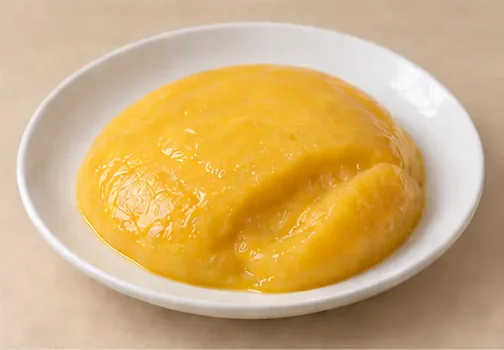
Sanbuzhan (三不沾) is a warm Chinese sweet made by patiently stirring egg yolks, sugar, starch and water in a pan, with cooking fat worked into the mixture. Beijing's Tongheju restaurant is closely associated with the dish, though accounts of its original birthplace differ. The finished sweet is glossy golden, soft and cohesive, with an egg-rich flavour and a texture that yields to a spoon without behaving like a firm cake.
Tap any red Chinese text to hear it in Mandarin.
A pan-cooked egg-yolk sweet
Sanbuzhan is a sweet course rather than a baked pastry or a set custard. Documented Beijing descriptions use egg yolks, sugar, mung-bean starch and water; a published recipe transcription also incorporates cooking fat. Recipes differ, so those ingredients describe documented versions, not a compulsory formula.
The name is commonly explained as “three non-sticks”: it should not cling to the plate, spoon or teeth. A historical Beijing restaurant profile describes a golden, glossy finish and a shape like a small, rounded mound. A contemporary 2010 account of a serving at Tongheju describes it as soft and dense, with enough cohesion to lift on a spoon.
How it is made
The egg-yolk mixture is combined with starch, sugar and water, then cooked in a pan while being stirred continuously. In the recipe transcription, fat is incorporated during cooking as the mixture thickens. The repeated motion and close control of heat produce a smooth, pliant mass rather than scrambled egg or a sliceable pudding. The specific fat, quantities and cooking time vary between documented preparations; one restaurant’s recipe should not be treated as a universal standard.
Expect a bright yellow to golden surface with a slight sheen. The texture is supple and spoonable: richer and more substantial than a loose custard, yet not firm like a cake. Egg gives it a rounded savoury-sweet depth, while sugar supplies the clear sweetness. The cooking fat adds richness, so a small serving can be satisfying. A Beijing travel feature describes it as fragrant and soft; the precise balance depends on the kitchen’s recipe.
Beijing connection and unsettled origin stories
Tongheju, a long-established Beijing restaurant, helped make Sanbuzhan a celebrated item in the city’s restaurant tradition.
The dish is also discussed in accounts from outside Beijing. A China News Service feature records competing origin stories, including claims linking it to the Qing court and to a cook in Shandong; it presents the dish’s provenance as unsettled rather than establishing one origin. It is therefore more accurate to describe Sanbuzhan as a sweet with a strong Beijing restaurant association than to claim that Beijing definitively invented it.
Serving and ordering
Sanbuzhan is best understood as a dessert or sweet course. It is commonly served warm in a rounded portion and eaten with a spoon. Because it is rich and its texture is most supple while warm, sharing a portion or ordering it after a lighter meal is a practical suggestion, not a serving rule. A 2010 Tongheju account notes that the sweet firms as it cools.
To ask for it, show the menu name 三不沾 (sān bù zhān). If ingredients matter, ask which starch and cooking fat the kitchen uses. Egg yolk is central to the dish, and some documented recipes use pork fat; do not assume a particular version is vegetarian or suitable for an allergy without asking.
Where to eat it
You can find Sanbuzhan all over Beijing, so there is no need to seek out one particular restaurant. To find one near you, search for “三不沾” in Meituan (美团) or Amap (高德地图) and check recent reviews, distance and opening hours.
More dishes to compare
Explore related local specialties and compare their names, preparation notes and ordering guidance.
Pea-flour pudding 豌豆黄 →
Pale-yellow pea cakes have a smooth texture and gentle sweetness. Enjoy small chilled squares with unsweetened tea.
Walnut cream dessert 核桃酪 →
Ground walnuts create a silky, nutty sweet preparation. Order a small warm bowl for a gentle finish to a meal.
Sources & reading
Recipes and servings vary between kitchens.