

Beiquan Wet-Milled Soft Tofu 北泉水磨豆花
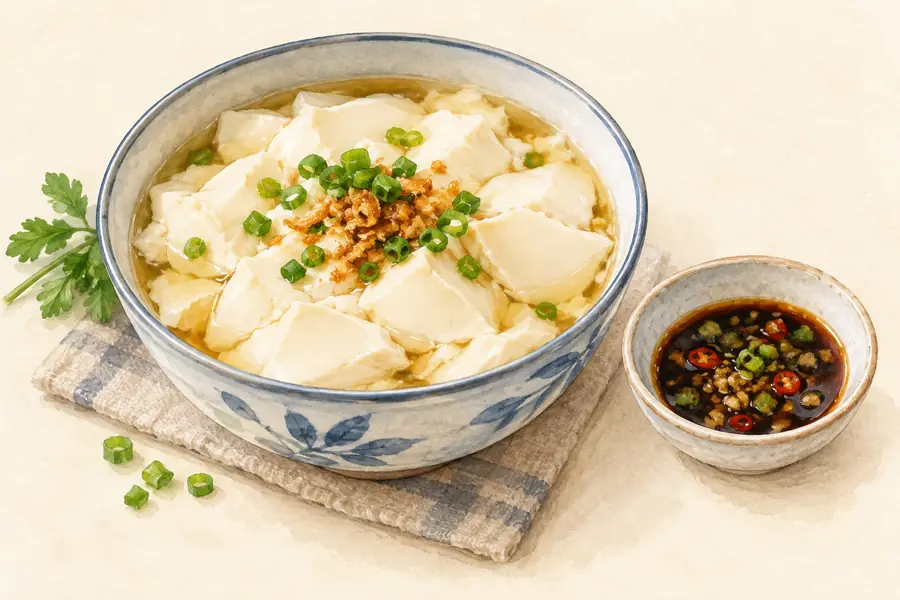
A Beibei-associated name for Chongqing tofu pudding. Expect tender, freshly set soybean curds with a savory dipping sauce, but confirm the preparation at the restaurant: the exact “Beiquan wet-milled” label is not independently documented as a standardized recipe.
Tap any red Chinese text to hear it in Mandarin.
What the name tells you
The supplied food directory places 北泉水磨豆花 in Beibei District, Chongqing. Its page does not identify a restaurant or document a recipe, and an independent source establishing this exact compound name as a distinct standardized dish was not found. Treat it as a useful menu phrase, not proof that every Beibei tofu shop makes a single “Beiquan” style or still uses a stone mill.
Beibei’s better-documented local tradition is 豆花 (douhua), also historically called river-water tofu pudding. A Beibei district gazette account describes the old practice of carrying Jialing River water uphill to tofu shops; it says that the name 河水豆花 (“river-water douhua”) persisted after piped water replaced river water. This is a local history of Beibei, not evidence that a present-day serving uses river or spring water.
How it is made and served
In the Beibei account, soaked soybeans are ground with water on a stone mill, the slurry is strained through cloth, boiled, then set with brine (salt-based coagulant). The maker adds the coagulant gradually and gently until soft white curds form. A separate 重庆地方志 account describes Beibei curds as white, tender yet cohesive, and served hot with a dipping sauce.
The contrast is the point: mild, warm soybean curds have a clean, faintly sweet bean aroma and a soft, moist, spoonable texture; a properly set portion can hold together when lifted rather than dissolving into milk. The sauce brings the more assertive aromas and flavors—chili heat, Sichuan-pepper tingle, garlic, scallion, sesame or other savory seasonings. Beibei’s gazette account describes a richly aromatic, spicy, numbing, savory and slightly sweet local sauce, but its lengthy ingredient list is one recorded style, not a mandatory recipe for every kitchen.
A common way to eat douhua is as 豆花饭 (douhua rice): a bowl of curds, plain rice and a separate dipping sauce. Lift a small piece of curd, touch it to the sauce, and eat it with rice; season bite by bite to keep the soft bean flavor distinct. Pickles or a braised pork side may accompany a more substantial meal. Across the wider Sichuan–Chongqing region, the coagulant and sauce vary by place and shop, changing the curds from delicate to slightly springy and the dip from fragrant and mild to hot, numbing or garlicky.
Ordering in Beibei
Show the name 北泉水磨豆花 Běiquán shuǐmò dòuhuā and ask whether the shop serves it, how the curds are set, and whether it comes as a meal with rice or as a standalone bowl. If you want the broader local dish, ask for 北碚豆花 Běibèi dòuhuā or 豆花饭 dòuhuā fàn. The name alone does not establish ingredients, sauce, portion or dietary suitability; ask about stock, cooking fat, and seasonings if these matter to you.
Where to eat it
You can find Beiquan Wet-Milled Soft Tofu all over Chongqing, so there is no need to seek out one particular restaurant. To find one near you, search for “北泉水磨豆花” in Meituan (美团) or Amap (高德地图) and check recent reviews, distance and opening hours.
More dishes to compare
Explore related local specialties and compare their names, preparation notes and ordering guidance.
Dianjiang stone-ground tofu pudding 垫江石磨豆花 →
Tender white tofu curds are served with a separate savory chili dip. In Dianjiang, pair the mild curds with rice and season each spoonful yourself.
Shi Mo Dou Hua 石磨豆花 →
Shi Mo Dou Hua (石磨豆花) is listed among the local specialties of Dianjiang County, Chongqing. The name includes 豆花 (soft bean curd).
Bei Bei Dou Hua 北碚豆花 →
Bei Bei Dou Hua (北碚豆花) is listed among the local specialties of Beibei District, Chongqing. The name includes 豆花 (soft bean curd).