

Jiangjin Rice Candy 江津米花糖
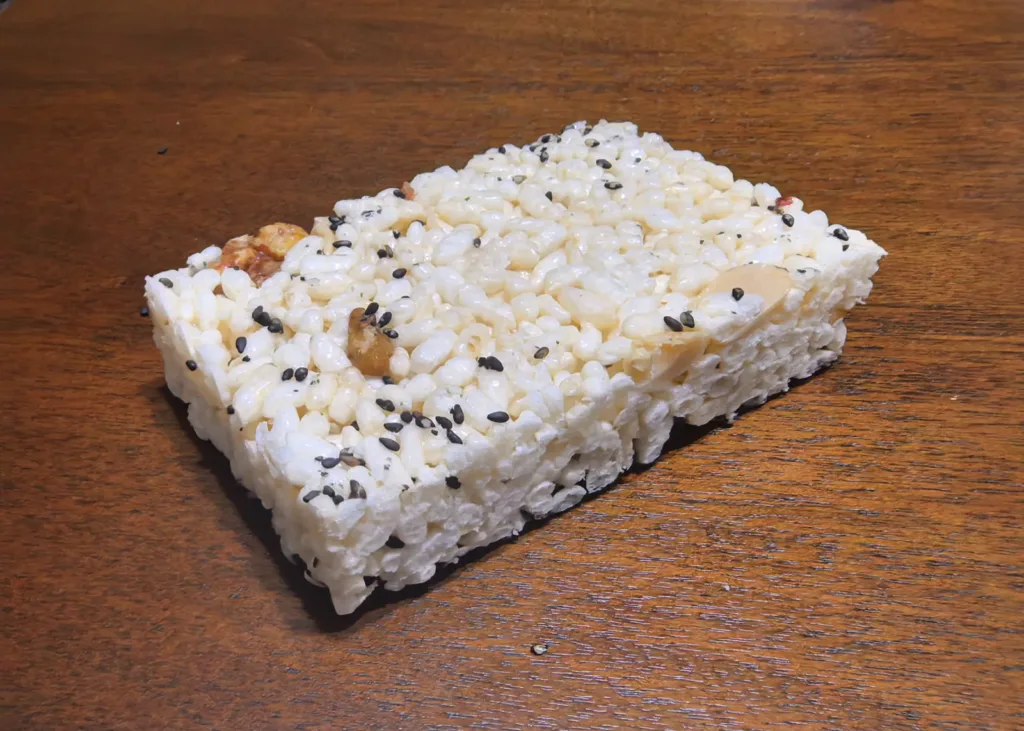
A crisp, sweet Jiangjin specialty made by puffing prepared glutinous rice in oil and binding it with syrup, often with peanuts, walnuts, or sesame.
What it is and where it comes from
Jiangjin rice candy is a confection associated specifically with Jiangjin District (江津区), in Chongqing Municipality—not a generic name for every puffed-rice sweet in the region. The early-20th-century story centers on the Taihezhai (太和斋) shop and brothers Chen Hanqing (陈汉卿) and Chen Liquan (陈丽泉), who developed the local candy from an earlier roasted-rice sweet. A Chongqing account marks 1910 as the beginning of Taihezhai and its rice candy; another describes the brothers’ improvements in the early 20th century. The date is best understood as a traditional origin marker, not as a fully documented single invention moment. The making technique is listed as Chongqing municipal intangible cultural heritage.
How it is made and tastes
The characteristic base is glutinous rice (糯米), not loose popped kernels alone. The rice is selected, rinsed, soaked, steamed, then spread to dry in the shade. Once dry, it is fried in oil over low heat until it puffs. The crisp rice is mixed with cooked sugar syrup so the syrup coats the grains and sets them into a compact slab; recipes may also include peanuts, walnut kernels, sesame, maltose, fats, and rose sugar. Ingredient lists and proportions vary by maker and brand, so check the package for allergens and animal-derived ingredients rather than assuming every version is identical.
A well-made piece is pale and glossy, with a toasted, nutty aroma and a clear sweetness. It breaks with a light crunch, then softens quickly in the mouth instead of pulling like a chewy candy. Some makers offer rose-scented or pepper-salt variations, among others; these are variations, not a single required citywide recipe.
How to eat it
Break off a piece to eat as a snack or alongside tea. A local account also describes dissolving the candy in hot water, sometimes with an egg, for a sweet warm drink; this is an alternate way to serve it, not the only customary method. The pieces are easy to carry as a packaged specialty. Jiangjin is the place association.
Where to eat it
You can find Jiangjin Rice Candy all over Chongqing, so there is no need to seek out one particular restaurant. To find one near you, search for “江津米花糖” in Meituan (美团) or Amap (高德地图) and check recent reviews, distance and opening hours.
More dishes to compare
Explore related local specialties and compare their names, preparation notes and ordering guidance.
Fuling oil-toasted sweet rice wine 涪陵油醪糟 →
Another Chongqing district sweet made from glutinous rice, but fermented into sweet rice wine rather than puffed and set into a crisp candy.
Sources & reading
Image credits & notes (1)
- A piece of Jiangjin rice candy with visible puffed rice, sesame, and nuts. Photo: 261026CQPhoto: CC BY-SA 4.0