

Fish with Pickled Mustard Greens 酸菜鱼
A Chongqing-associated fish dish built around tender slices of fish and tangy fermented greens. Jiangjin is an especially important local home for the dish, while recipes and claims about its beginnings vary.
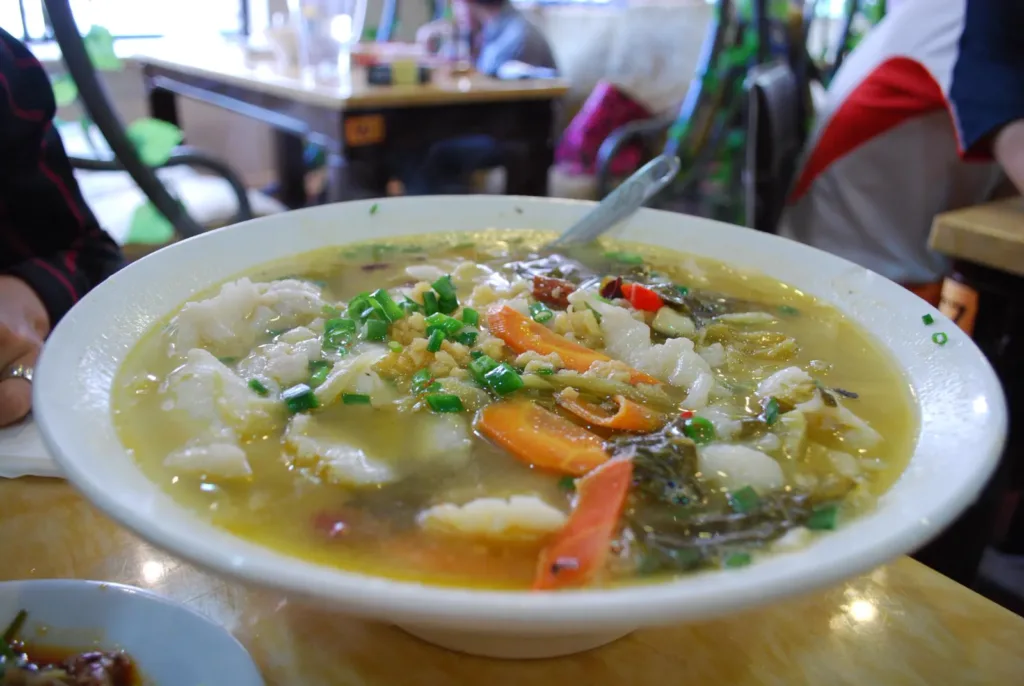
What it is and where it belongs
酸菜鱼 (suān cài yú) literally means “fish with pickled greens.” It is strongly associated with Chongqing’s Jiangjin District and with the broader Sichuan–Chongqing tradition of bold, freshly cooked river-fish dishes. Jiangjin reporting describes the dish as part of local everyday food culture, and local authorities recognize Jiangjin’s making technique as intangible cultural heritage. In 2026, “Jiangjin suan cai yu making technique” was added to Chongqing’s municipal intangible-heritage list.
That recognition establishes a meaningful Jiangjin connection, not exclusive ownership of every version of the dish. Published accounts give differing origin stories and acknowledge that the precise beginnings are hard to establish. Treat stories about a single inventor or first restaurant as local attributions rather than settled history.
How it tastes and is made
A Jiangjin account describes grass carp; contemporary kitchens also use fish such as snakehead or perch. Fermented mustard greens are the other defining ingredient. The fish is filleted and cut into slices; kitchens may briefly season or coat the slices so they stay tender. The greens are cut and fried with aromatics such as ginger, garlic, pickled chili, or dried chili to release their fragrance. Stock is added to make a hot, savory, sour broth; the fish slices are then cooked briefly in it, and some cooks finish the bowl with hot oil, chili, scallions, or Sichuan peppercorns.
The result is usually savory and sharply tangy, with a fresh fish sweetness underneath. Chili can add heat, Sichuan peppercorn can add a tingling, lightly numbing note, and fermented greens bring a salty, lactic sourness and a pleasantly crisp contrast to soft fish. The broth may be clear or richer, and spice levels, fish, oil, extra vegetables, and finishing aromatics vary from kitchen to kitchen. Some newer “golden broth” versions use yellow lantern chili; pumpkin may be used for a similar color, with a different flavor.
Ordering and eating
Look for 酸菜鱼 on a menu; the Chinese name is the clearest ordering term. It is commonly served as a hot shared dish with rice. Eat the fish and pickled greens together, and take care with heat and any small bones. If you prefer milder food, you can ask for 少辣 (“less spicy”), but the kitchen may not be able to remove all chili or peppercorn flavor.
Where to eat it
You can find Fish with Pickled Mustard Greens all over Chongqing, so there is no need to seek out one particular restaurant. To find one near you, search for “酸菜鱼” in Meituan (美团) or Amap (高德地图) and check recent reviews, distance and opening hours.
More dishes to compare
Explore related local specialties and compare their names, preparation notes and ordering guidance.
Jiang Jin Suan Cai Yu 江津酸菜鱼 →
The Jiangjin version; Jiangjin's Shuangfu Subdistrict records the Zou Kaixi eatery as the origin of Fish with Pickled Mustard Greens.
Sources & reading
- Chongqing Morning Post, Huangpu River-side search for Jiangjin suan cai yu
- Jiangjin's five techniques enter Chongqing's seventh municipal intangible-heritage list
- Chongqing food feature on competing suan cai yu origin accounts
- Unilever Food Solutions Taiwan, Chongqing-style sauerkraut fish: ingredients and method
- Local food reference
Image credits & notes (1)
- A bowl of fish with pickled mustard greens, photographed at a Melbourne restaurant; illustrative only, not a documented Jiangjin recipe. Photo: Alpha from Melbourne, Australia (avlxyz on Flickr)Photo: CC BY-SA 2.0