

Shredded Pork and Preserved Mustard Noodles 榨菜肉丝面
A flexible noodle bowl pairing tender pork strips with the salty, crisp bite of pickled zhacai—especially associated with Fuling in Chongqing.
Tap any red Chinese text to hear it in Mandarin.
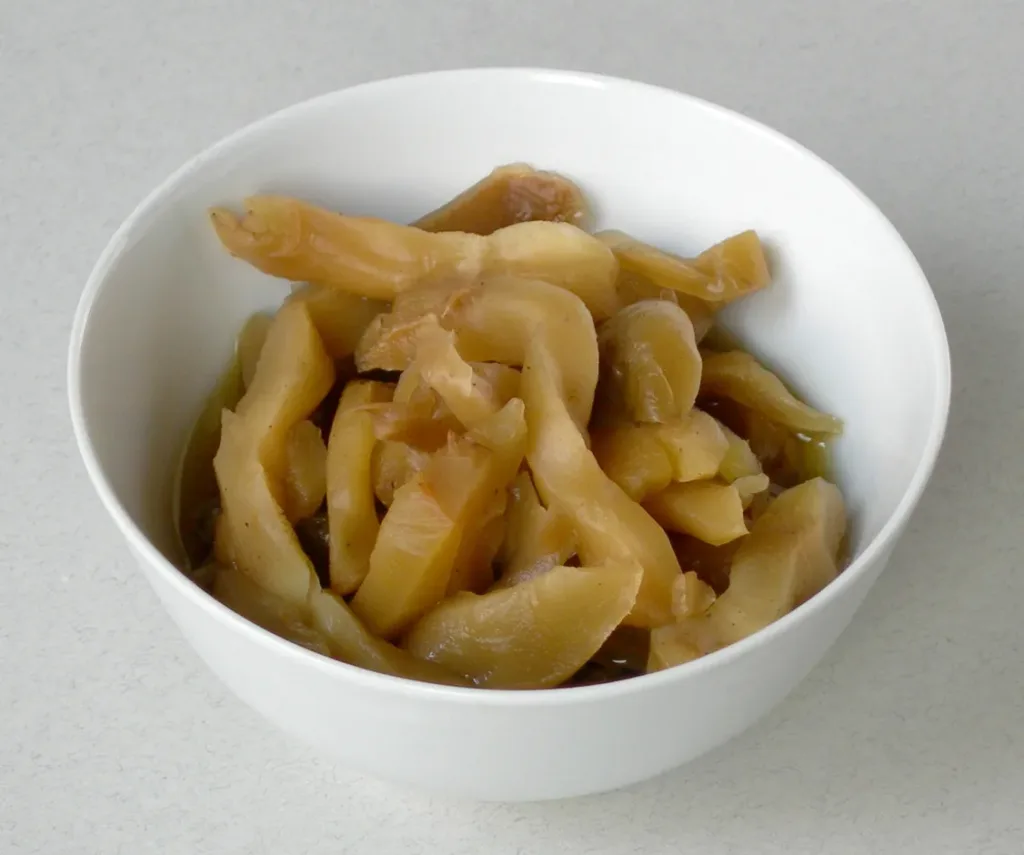
榨菜肉丝面 is a practical name to look for on a menu: wheat noodles with thin strips of pork and 榨菜, the preserved stem mustard commonly rendered as “zhacai.” Fuling, a district of Chongqing, is strongly associated with zhacai production. Local reporting traces the product to Fuling and describes 青菜头, the swollen mustard stem, as its key raw material. That establishes a meaningful Chongqing ingredient link; it does not establish one fixed, uniquely Chongqing recipe for the noodle bowl.
In a documented home-style version, pork is sliced and briefly seasoned, while the zhacai is cut into strips and soaked if it is especially salty. The pork is stirred in hot oil, the zhacai is added and briefly fried with it, and the wheat noodles are cooked separately. The topping is set over the noodles with bowl seasonings and scallion. Older, more mature zhacai may be saltier and more aromatic than tender zhacai, so soaking and added salt are adjusted rather than treated as fixed steps.
Expect a savory, salty-pickled aroma, a little tang, crisp or springy mustard against tender pork, and the soft chew of wheat noodles. Some cooks serve the pork-and-zhacai topping over drained noodles; others simmer or “braise” the noodles in the seasoned liquid so they absorb more of the flavor. These are variations, not a citywide standard. Chili, greens, broth strength, and the degree of sourness or saltiness depend on the kitchen.
To order, show or say 榨菜肉丝面 zhàcài ròusī miàn. If you have a preference, ask 汤面 tāngmiàn for soup noodles or 干拌 gānbàn for a tossed, less soupy bowl, and specify 不要辣 búyào là for no chili.
Where to eat it
You can find Shredded Pork and Preserved Mustard Noodles all over Chongqing, so there is no need to seek out one particular restaurant. To find one near you, search for “榨菜肉丝面” in Meituan (美团) or Amap (高德地图) and check recent reviews, distance and opening hours.
More dishes to compare
Explore related local specialties and compare their names, preparation notes and ordering guidance.
Chongqing xiaomian 重庆小面 →
A seasoned noodle bowl can come with or without broth. Choose the topping and discuss chili before the bowl is mixed.
Chongqing noodles with peas & minced pork 豌杂面 →
Soft peas and seasoned minced pork sit over wheat noodles in this Chongqing favourite. Mixing brings the topping into the noodles and turns the peas into part of a thick, savoury coating.
Chongqing hot-and-sour noodles 重庆酸辣粉 →
Translucent starch noodles are dressed with vinegar, chili oil and crunchy toppings. Stir the bowl well and ask which toppings contain meat before ordering.
Sources & reading
Image credits & notes (1)
- A bowl of Chinese zhacai, the pickled mustard-stem ingredient; not a finished noodle dish. Photo: Rainer Zenz (attributed on Commons; author is stated there as assumed from copyright claims)Photo: CC BY-SA 3.0