

City God Temple spiced beans 城隍庙五香豆
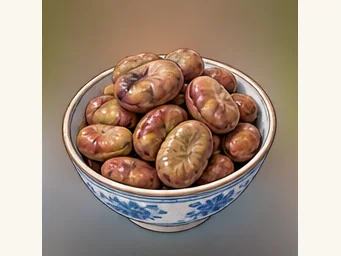
A Shanghai old-town snack of broad beans simmered with savoury-sweet seasonings. The best-known City God Temple style is associated with a pale, salty bloom on the bean skin, a lingering spice aroma and a firm, chewy centre. Recipes and textures vary; “cream” in the traditional product name does not mean the white coating is dairy cream.
Tap any red Chinese text to hear it in Mandarin.
English detail-page copy. Fact-checked 21 October 2026.
What the name means
Wǔxiāngdòu (五香豆) literally means “five-aroma beans.” In Shanghai, 城隍庙五香豆 Chénghuángmiào wǔxiāngdòu usually refers to the broad-bean snack associated with the City God Temple area, especially the old branded style also called 冰糖奶油五香豆 bīngtáng nǎiyóu wǔxiāngdòu (“rock-sugar cream-flavoured five-spice beans”). It is a cooked, seasoned bean, not the crisp deep-fried broad-bean snack sold under similar names. The number in the name is not a reliable ingredient count: accounts describe varying seasonings rather than a single five-spice formula.
The name has a history in Shanghai’s old town. The municipal tourism heritage listing attributes the branded product to Guo Yingzhou in the 1930s and records a shop called Xinglong Guoji opening at the City God Temple in 1939. The craft is listed as municipal intangible cultural heritage, with the producer named as its protecting unit. A Shanghai report likewise places the product’s rise in the 1930s and describes it as a once-famous local snack; this is a strong Shanghai association, not proof that all broad-bean snacks originated here.
What goes into the beans
Broad beans are the base. A documented traditional selection favoured plump, pale-skinned beans; the heritage description names Zhejiang’s “Nüta-bian” beans and white broad beans, while other local accounts refer to “three-white” beans. Those are descriptions of particular sourcing traditions, not a promise about every current packet.
The older City God Temple recipe accounts name anise and cinnamon with salt, and also report seasonings such as dried tangerine peel, sugar or sweetener, and cream flavouring. The precise mixture differs by account and can change with the producer or product. “Cream” is part of the traditional product name and aroma; the heritage listing explains that the pale coating is salt crystallising on the cooked bean, not a layer of dairy cream. Check the package ingredients if you need to know whether a particular product contains milk or other allergens.
How they are cooked—and what to expect
Heritage records describe a slow, seasoned cooking process rather than frying. One account sets out two stages: first cook the beans in water until done, then simmer them in a sweet-salty brine, sometimes with aged brine, before cooling. As moisture leaves the surface, a fine pale salt bloom appears. In the older method, copper cookware and open fire are mentioned; a 2023 report describes later changes including stainless-steel vessels and steam. The sources therefore document an evolving craft, not one verified recipe or factory process for every bean sold today.
Look for beans that are plump and slightly flattened, with skins ranging from brown to brown-green and, in the traditional style, a light whitish salt dusting. The seasoning is savoury first, with a restrained sweetness and a fragrant anise-cinnamon note; some versions have the creamy-sweet aroma remembered in the old brand name. The bean should give some resistance under the teeth, then soften to a tender, glutinous interior. Sources describe the traditional ideal as chewy but not hard, though the bean variety and cook can make actual packets firmer or softer.
How to eat and compare them
Eat them as a small snack, one bean at a time, letting the salty-sweet coating and spice come through before chewing the centre. The traditional texture is firm: heritage descriptions say the bean gradually softens as you chew. If one feels unusually hard, let it soften in your mouth rather than biting down at once. Start with a few, since the seasoning can be salty and the beans are dense. There is no fixed serving ritual or universal texture standard.
Do not confuse them with Shanghai’s seasonal fresh broad beans, which are often briefly braised with spring onions, or with crisp fried broad beans. Those are different preparations with different textures. City God Temple spiced beans are the slower, seasoned, chewy snack: a taste of Shanghai’s old-town food culture whose recipe and production have changed over time.
More dishes to compare
Explore related local specialties and compare their names, preparation notes and ordering guidance.
Shanghai pear-syrup candy 上海梨膏糖 →
Pear-flavored ingredients are concentrated with sugar into a firm confection, then cut or molded into pieces. Different makers add different flavorings, so the label is the best guide to the actual recipe. The candy is intensely sweet with a lingering pear or herbal aroma and a hard, slowly dissolving texture.
Qingpu flower-shaped cakes 青浦海棠糕 →
Batter is cooked in a flower-shaped mold with a sweet filling, often bean paste, before the cake is finished with its decorative topping. The metal mold creates the characteristic petal outline. The exterior is firmer and lightly caramelized, while the inside is soft and filled. Warm cakes offer the clearest contrast between the two.
Sources & reading
Recipes and servings vary between kitchens.