

Shanghai pear-syrup candy 上海梨膏糖
Shanghai pear-syrup candy is a honey-sweet confection tied to the city’s old City God Temple trade and now-recognised craft heritage. Pear juice, sugar and herbal ingredients are cooked into a slab, then worked through a distinctive “翻砂” step that gives traditional pieces a loose, short bite rather than a sticky chew. Recipes and newer flavours vary by maker; choose it as candy, not as medicine.
Tap any red Chinese text to hear it in Mandarin.
A Shanghai sweet, with a specific lineage
Ask for 上海梨膏糖 (Shànghǎi lígāotáng). The name can suggest a spoonable pear paste, but the visitor-facing product is a piece of confectionery. Shanghai’s municipal visitor site points to pear-syrup candies sold at the City God Temple as a traditional local product. The national intangible-heritage record identifies a Shanghai craft associated first with old Shanghai, Caojiadu and Zhabei, and later centred on the City God Temple area. That supports a distinctive Shanghai tradition; it does not make every pear-based herbal candy in China a Shanghai invention.
The craft was added to China’s national representative intangible cultural heritage list in 2021, under traditional techniques, with Huangpu District as the submitting area and Shanghai Pear Syrup Candy Food Factory as the listed protection unit. The heritage record dates the opening of the first City God Temple pear-candy shop to 1855. Treat that as the documented history of this Shanghai trade, not as a verified origin date for pear-syrup candy everywhere.
What goes into it
A maker’s traditional Shanghai formula combines pear juice or pear syrup with sugar and herbal ingredients. The national heritage description records a craft tradition rather than a standardized ingredient panel. A recent report quoting Shanghai Pear Syrup Candy Food Factory describes its candy as using fresh pear juice, rock sugar and several food-herb ingredients. Neither account establishes one universal ratio or a fixed recipe for all brands.
The range has also widened beyond the old herbal profile. The factory reported 22 flavours, including sesame, rose, coffee and magnolia, in 2026. That is one producer’s range at the time of reporting, not a promise that every counter carries every flavour. Read the package label if you want to know what is in the piece you buy.
Why the texture is different
The characteristic method is not simply to boil pear syrup until it sets. After the sugar is cooked, the maker works the mass through 翻砂 (fānshā), a repeated manipulation that develops a fine, sand-like structure. The mixture is poured onto a board, levelled and scored into portions; it is then brushed, turned, broken apart and wrapped. The national heritage record describes the finished candy as sweet like honey, loose and crisp, and neither sticky nor cloying. A Shanghai craft demonstration reported by China News explains that successful “翻砂” makes the candy porous enough to break easily.
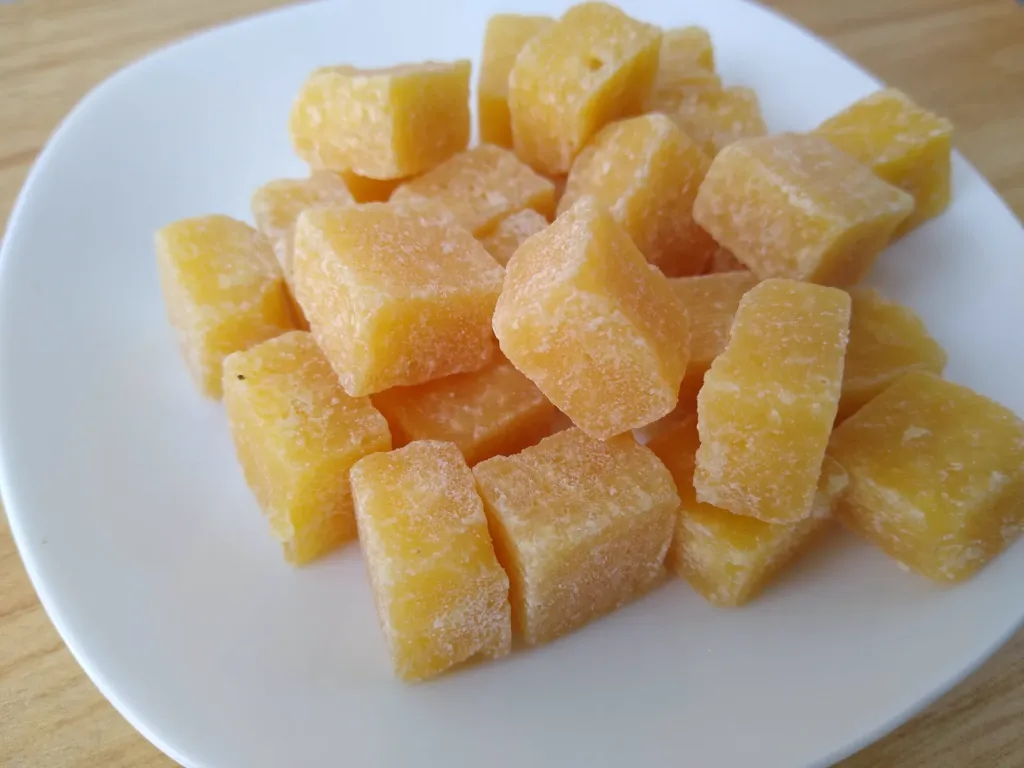
In photographs, traditional pieces often look pale gold to amber, with a matte, lightly grainy surface rather than the glassy shine of a clear hard sweet. Expect a compact piece that gives way with a short, sandy crumble; the sugar sweetness comes first, with pear and herbal notes behind it. The exact colour, aroma and firmness depend on the maker and flavour, so these are useful cues rather than a universal tasting guarantee.
How to buy and eat it
Show 上海梨膏糖 Shànghǎi lígāotáng when asking for it, and start with a small piece: the sweetness is concentrated. Traditional pieces are made to break cleanly. If the piece you buy is firm, let a small piece soften in the mouth; if it crumbles easily, break it into bites. Check the ingredient list rather than assuming every variety contains the same herbs—or that a mint, rose or sesame flavour uses the same base recipe.
For food-allergy or dietary needs, use the package’s ingredient and allergen information and ask the seller about the specific batch. “Herbal” is not a dietary or medical guarantee. The traditional historical association with cough remedies appears in heritage accounts, but this article treats packaged candy as food and makes no claim of therapeutic benefit.
Where to eat it
You can find Shanghai pear-syrup candy all over Shanghai, so there is no need to seek out one particular restaurant. To find one near you, search for “上海梨膏糖” in Meituan (美团) or Amap (高德地图) and check recent reviews, distance and opening hours.
More dishes to compare
Explore related local specialties and compare their names, preparation notes and ordering guidance.
City God Temple spiced beans 城隍庙五香豆 →
Broad beans are cooked with a sweet-salty spice mixture, then cooled for snacking. The process leaves them firm rather than turning them into a soft bean stew. The skin can be resilient, with a dense interior and a lingering aromatic sweetness. They are best eaten slowly in small quantities.
Butterfly pastry 蝴蝶酥 →
Laminated pastry is folded into a double spiral, cut into slices and baked so the layers open into a butterfly shape. Sugar on the surface caramelizes during baking. The pastry breaks into thin, crisp flakes with a buttery aroma and sweet, toasted edges. Humidity quickly softens that delicate structure.
Sources & reading
Recipes and servings vary between kitchens.
Image credits & notes (1)
- Loose, pale-gold pieces show the lightly sanded surface associated with the traditional confection. Photo: Mx. GrangerPhoto: CC0 1.0