

Coconut rice 椰子饭
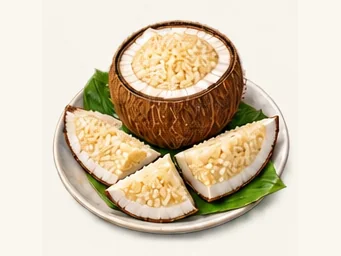
Coconut rice (椰子饭, yēzi fàn) is a Hainan sweet rice preparation steamed inside a coconut shell and cut into boat-shaped pieces. Coconut juice perfumes the rice, while softened coconut flesh adds a chewy contrast; in Haikou, treat it as a regional dish rather than a recipe owned by one named restaurant.
Tap any red Chinese text to hear it in Mandarin.
What this dish is
椰子饭 is also called 椰子船, or “coconut boat”. A Hainan provincial food reference describes it as glutinous rice steamed with coconut flesh and coconut juice, and places its clearest traditional association in Hainan, including Wenchang. The coconut is not only an ingredient: the prepared shell is the cooking vessel and the finished piece is cut into a small boat-like wedge. An English Hainan government guide likewise describes coconut rice as coconut-juice-soaked rice steamed in a shell and sliced into “boats”.
That makes the dish different from rice cooked with coconut milk in an ordinary pot. The shell and the coconut flesh remain part of the eating experience. When you see it on a Haikou menu, the useful cultural description is a Hainan coconut-and-glutinous-rice snack, not a claim that Haikou invented it.
How it is made
The documented traditional method begins with a young, tender coconut. After the outer husk and hard shell are removed, a small opening is cut at the top and the coconut water is drained. Soaked glutinous rice is packed into the coconut with coconut juice and sugar; some versions add fresh milk or hot water. The opening is covered, and the filled coconut is cooked slowly until the rice is swollen and tender. The older account records a three-to-four-hour slow cook, while also noting that earlier versions were made in a lime kiln.
This is a family of preparations rather than a single fixed formula. Rice type, sweetness, the amount of coconut flesh, and the use of milk can differ between kitchens. Do not read one vendor’s method as the only authentic recipe.
Flavour and texture
Expect a cohesive, softly chewy rice centre with a mild coconut fragrance and sweetness. The steamed coconut flesh becomes softer than raw coconut but can retain a pleasant bite. A Hainan Daily description compares the cut pieces to pale, translucent “pearls” inside a coconut skin and notes the contrast between the soft rice and the firmer coconut flesh.
The result sits closer to a sweet snack or dessert than to a plain steamed rice accompaniment. It can still be shared at a meal, especially when a table is ordering several Hainan dishes.
How to order it in Haikou
Show the Chinese name 椰子饭 Yēzi Fàn when ordering. Ask whether that kitchen’s version is sweetened and whether it contains milk if you have a dietary restriction; documented recipes use sugar and may use fresh milk. Check the current menu at the restaurant or stall you choose, and ask staff about that batch’s ingredients.
Where to eat it
You can find Coconut rice all over Hainan, so there is no need to seek out one particular restaurant. To find one near you, search for “椰子饭” in Meituan (美团) or Amap (高德地图) and check recent reviews, distance and opening hours.
More dishes to compare
Explore related local specialties and compare their names, preparation notes and ordering guidance.
Pepper soup with rice 辣汤饭 →
Pork and often offal are cooked in a broth seasoned prominently with white pepper, with rice and pickled vegetables served alongside. The rice can be eaten separately or used to balance the soup. The heat is peppery and aromatic rather than necessarily the burning sensation of chili. Tender meat and a clear savory broth make a substantial combination.
Qingbuliang 清补凉 →
A chilled sweet base, often coconut milk or coconut water, is combined with a selection of cooked beans, grains, jellies and fruit. Each stall arranges its own topping mixture. The drinkable base is sweet and cooling, while the toppings provide soft, chewy and crisp contrasts. Coconut-rich versions are more creamy than clear ones.
Sources & reading
Recipes and servings vary between kitchens.