

Eight-treasure sticky rice 八宝饭
A celebratory Shanghai and Jiangnan dessert of steamed glutinous rice, often layered around sweet red-bean paste and decorated with jewel-like dried fruits, nuts or seeds. Served warm and glossy, it is a sticky-sweet finale commonly associated with New Year and family feasts; the exact “eight treasures” vary by cook and shop.
Tap any red Chinese text to hear it in Mandarin.
What it is
Bābǎofàn (八宝饭) is a molded sweet rice dish, not a single fixed recipe. Shanghai’s municipal visitor information describes it as a New Year’s Eve dessert made with glutinous rice and ingredients such as red dates, lotus seeds, longan and preserved fruit, often shaped into a dome and finished with light syrup. In Shanghai, it commonly follows the savory dishes at a reunion dinner.
The “eight treasures” are a festive idea, not a count you can rely on. A basic Shanghai version often combines sticky rice and red-bean paste with a changing pattern of fruit, nuts or seeds. A Shanghai report lists red dates, lotus seeds, raisins, walnuts, melon seeds and goji berries among one familiar set; household and shop recipes add or replace items. The number and arrangement are not a city-wide standard.
Eight-treasure rice belongs to a broader Jiangnan and Chinese celebratory repertoire, rather than being demonstrably a Shanghai invention. Shanghai is a particularly strong home for it: local reporting describes it as a familiar Shanghai holiday dish and documents its place at family gatherings and banquet meals.
How it is made and what to expect
The foundation is glutinous rice, soaked and steamed until tender and cohesive. In one documented Shanghai home method, cooks mix the hot rice with sugar and pork fat, line a bowl with preserved fruits and nuts, add a layer of rice, spread sweet red-bean paste inside, cover it with more rice, steam it again and turn the bowl out onto a plate. Other recipes use different fats, skip the bean paste, or finish with syrup, so this is an example rather than a mandatory formula.
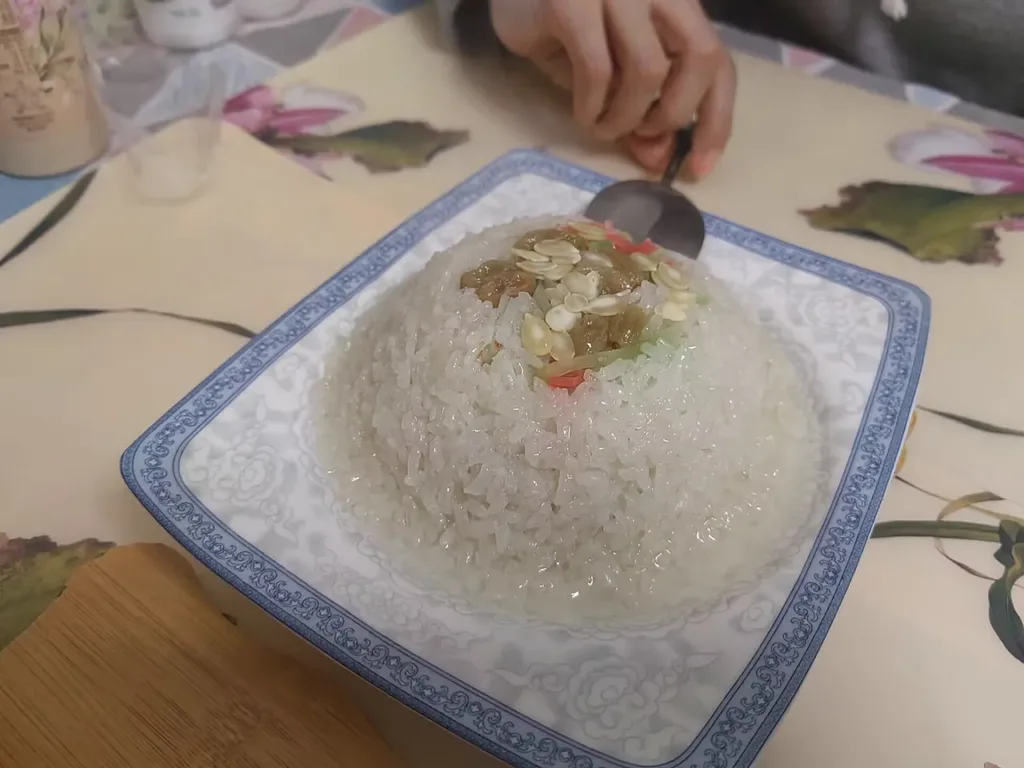
The result is usually a compact, glossy mound. The rice looks pearly white; dates, raisins, candied citrus or other preserved fruit add red, amber and green accents. A thin syrup can make the surface shine. Warm rice smells faintly sweet and rich, while a traditional pork-fat version has a fuller, savory richness beneath the sugar. Its defining bite is sticky and soft, with dense bean paste at the center and small chewy, crunchy or nutty contrasts from the toppings.
How it is served
At a New Year’s meal, eight-treasure rice often arrives after richer savory dishes as a shared sweet finale. Spoon it while warm, taking a little of the rice, filling and decorated surface together. A large molded rice serving is substantial, so at a restaurant it is practical to ask whether a small portion is available or to share one.
If a particular topping matters, ask what is in that day’s version: the ingredients change, and the word “eight” does not guarantee a particular list. 八宝饭 (bābǎofàn) is the useful name to show when ordering. Traditional recipes may use pork fat, and toppings can include nuts; ask the restaurant about the actual preparation if avoiding either.
The dish is a seasonal favorite, but availability is shop-specific.
Where to eat it
You can find Eight-treasure sticky rice all over Shanghai, so there is no need to seek out one particular restaurant. To find one near you, search for “八宝饭” in Meituan (美团) or Amap (高德地图) and check recent reviews, distance and opening hours.
More dishes to compare
Explore related local specialties and compare their names, preparation notes and ordering guidance.
Qibao glutinous-rice dumplings 七宝汤圆 →
Glutinous-rice dough is wrapped around a sweet or savory filling and boiled until the dumplings float and soften. Qibao versions are often large enough to require several careful bites. The wrapper is smooth and stretchy; the center may be fluid, creamy or meaty depending on the filling.
Bar-shaped rice cakes 条头糕 →
Glutinous-rice dough is shaped into slender bars, commonly around sweet bean paste, and cooked until soft. Some versions carry a light osmanthus fragrance or finishing syrup. The wrapper is chewy and supple, contrasting with the smoother, denser filling. Its sweetness and sticky texture make a small piece quite satisfying.
Sources & reading
Recipes and servings vary between kitchens.
Image credits & notes (1)
- A Shanghai-style eight-treasure rice mound decorated with preserved fruit and nuts. The garnish shown is one version, not a fixed ingredient list. Photo: Jason2016426Photo: CC0 1.0