

Fried beef-and-potato slices 炸松肉
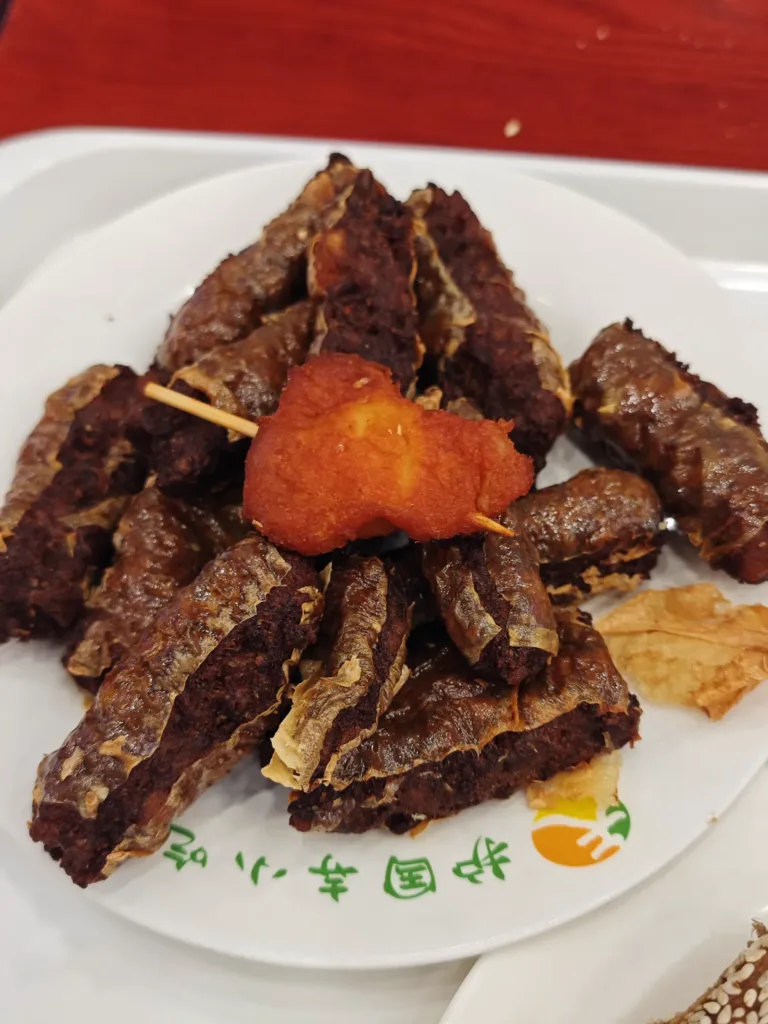
炸松肉 (zhá sōng ròu) is a Beijing-associated Hui Muslim snack of seasoned minced beef enclosed in thin wrappers and fried until browned. One documented Niujie-style preparation adds crushed gāozhi for a distinct crisp layer; the exact filling and wrapper vary, so potatoes are not part of a fixed definition.
Tap any red Chinese text to hear it in Mandarin.
What the name means
Show 炸松肉 Zhá sōngròu when ordering. “Fried beef-and-potato slices” is misleading: this is usually a minced-beef parcel, and potatoes are one possible household variation rather than a defining ingredient. It is strongly associated with Beijing’s Hui Muslim food culture, including the Niujie area of Xicheng District. A recent Beijing Daily report documents a local maker’s beef version, while the municipal government describes songrou among Niujie’s halal snacks.
Filling, wrapper and frying
There is no single formula. In a recent Niujie example, minced beef is seasoned with chopped scallion and ginger, soy sauce, five-spice and starch, then mixed with crushed gāozhi. The filling is spread over thin yóupí (油皮), brushed with starch slurry so the layers hold together, covered with a second sheet, cut into small pieces and fried in peanut oil. The report specifically distinguishes the wrapper used there from bean-curd skin; this is a description of that cook’s method, not a rule that every shop must follow.
A home recipe offers a different version: mashed steamed potato and starch are mixed with beef, and thin oil-bean-curd sheets wrap the filling. Its author describes potato as a substitute for gāozhi, which that kitchen did not make. This variation helps explain why potato appears in some descriptions, but it should not be built into the dish’s English name or treated as a required ingredient.
What it tastes and feels like
The Niujie report describes a golden, crisp exterior around a tender beef centre, with the aromas of meat, frying oil and gāozhi. That combination is the point: a browned, brittle outside gives way to a soft, savoury filling, while the crisp crumbs add another bite. The specific seasoning and whether the filling includes gāozhi, potato or another binder depend on the maker.
It is most appealing freshly fried and hot. In home cooking, songrou may also be eaten after cooling or added to a braise; those are serving options, not a guarantee about how any particular shop sells it.
How to order
Look for 炸松肉 Zhá sōngròu on the menu. You can ask 这是牛肉馅的吗? Zhè shì niúròu xiàn de ma? (“Is the filling beef?”) or 里面有土豆吗? Lǐmiàn yǒu tǔdòu ma? (“Does it contain potato?”). Recipes differ, so check the particular batch if you are avoiding a specific ingredient. The name refers to the dish, not to one standardized recipe.
Where to eat it
You can find Fried beef-and-potato slices all over Beijing, so there is no need to seek out one particular restaurant. To find one near you, search for “炸松肉” in Meituan (美团) or Amap (高德地图) and check recent reviews, distance and opening hours.
More dishes to compare
Explore related local specialties and compare their names, preparation notes and ordering guidance.
Fried starch sausage slices 炸灌肠 →
A firm, starch-based roll is cooled, sliced and fried until the exposed surfaces brown. The slices are finished with a garlicky, salty dressing rather than enclosed in a conventional meat-sausage casing at serving time. The browned edges can be crisp while the center remains resilient and slightly sticky. Raw garlic gives the mild starch its strongest flavor.
Mending beef pies 门钉肉饼 →
The filled dough is shaped into a tall, compact round and pan-fried. Its relatively thick sides hold the meat juices while its two flat faces brown. Expect a crisp base, a chewy wrapper and a juicy, savoury centre. The filling can remain much hotter than the crust.
Sources & reading
Recipes and servings vary between kitchens.
Image credits & notes (1)
- Fried songrou attributed to Huguosi Snacks in the source-file title. Photo: Lan Zhiyi (蓝芷怡)Photo: CC BY 4.0