

Fuzhou fine-vermicelli soup 捞化
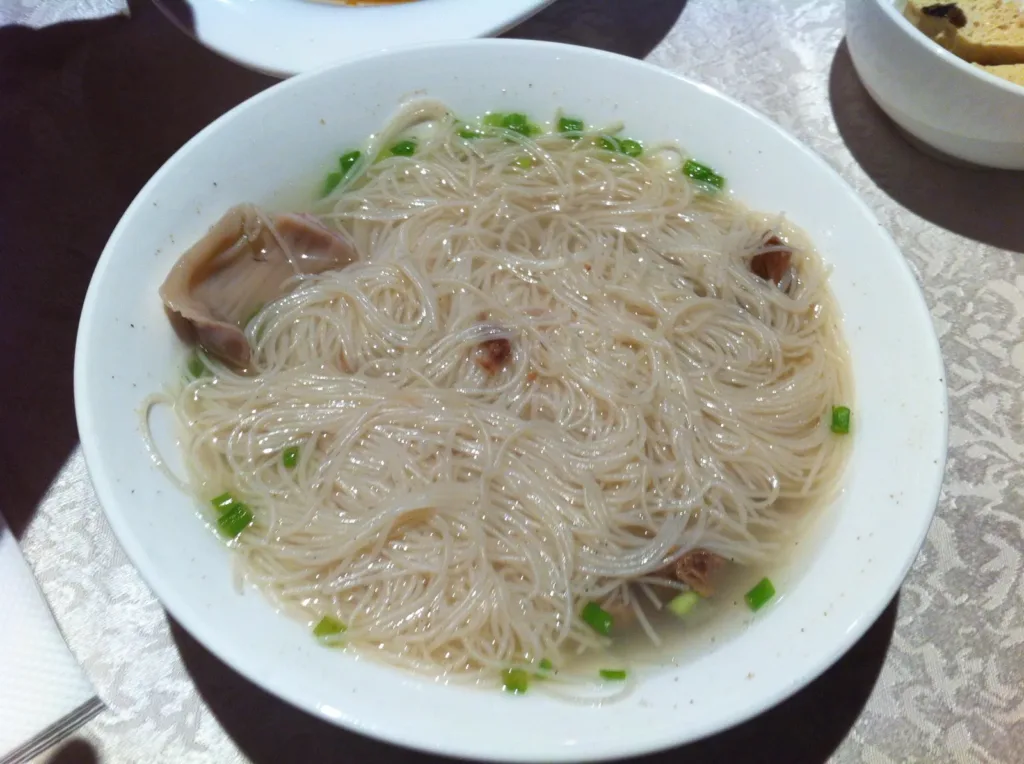
Laohua (捞化), also called 捞兴化粉, is Fuzhou’s quick-blanched Xinghua rice-vermicelli bowl. Fine strands are lifted through boiling water, then served with broth and a choice of meat, seafood, offal, or vegetables. Its identity lies in the flexible assembly rather than a single fixed recipe: soft, absorbent noodles meet either a clear broth or a darker pig-blood broth and toppings chosen to order.
Tap any red Chinese text to hear it in Mandarin.
What you are eating
The name is a useful clue. Local accounts connect 捞化 with 捞兴化粉: the fine Xinghua vermicelli is associated with Putian’s historic Xinghua area and cooks quickly when “lifted” through boiling water. A typical bowl is assembled by briefly blanching the vermicelli, lifting it into a bowl, adding prepared broth, and choosing toppings.
Look for the assembly rather than one canonical recipe. Depending on the kitchen, the toppings may include pork, beef, offal, seafood, leafy vegetables, mushrooms, or other fresh ingredients. Some shops also offer 粉干 or other noodles; if you want the fine, quick-cooking strands associated with laohua, show the Chinese name 捞化 and ask which noodle is being used.
Two broad styles are useful for comparison, not as a rigid rule. Clear-soup laohua may use a long-cooked bone broth, duck broth, or a herbal-style broth. Pig-blood laohua is darker and fuller, with pork bones, pig blood, braised pork offal, and bean paste used in the broth. Kitchens differ, so the same order can range from clean and light to savoury and dense. Shrimp oil (虾油), and sometimes garlic oil, may be added at the table or during assembly. Shrimp oil has a pronounced salty, marine flavour; ask before adding it if you avoid seafood, and never assume a bowl is vegetarian or free of allergens.
The noodles themselves should be soft and delicate after their brief blanching. The selected toppings supply most of the chew, while the broth carries their combined savouriness. Try a bite of the noodles with the broth first, then taste a topping with a little shrimp oil only if you want that stronger seafood note. There is no reliable universal topping set, price, or seasoning level: recipes and servings vary between kitchens.
How to order and find it
Show 捞化 Lāohuà when ordering; 捞兴化粉 Lāo Xīnghuà Fěn is a useful variant to recognise. Choose two or three toppings first, then check whether the bill is calculated by ingredient before adding a large assortment. For a current nearby search, enter 捞化 Lāohuà or 捞兴化粉 福州 Lāo Xīnghuà Fěn Fúzhōu in Meituan (美团) or Amap / Gaode Maps (高德地图). Treat the results as a way to locate open kitchens, not as a ranking or an endorsement. Check the menu, recent reviews, opening information, today’s availability, and allergen questions at the selected venue.
Arrival and return
Laohua is a distributed city food rather than a fixed attraction, so it has no single entrance, station, outlet, or return route. If you arrive through Fuzhou Station (福州站), the China Railway public station page lists local services including K1, K3, 2, and 10 at “火车站”; use the live map from your actual stop to choose a nearby laohua result rather than treating any one stop as the dish’s address. The final walk, opening status, and return route depend on the venue you select. Save that venue’s map pin and reverse the live route to your accommodation or Fuzhou Station; no outlet-specific exit number or journey time is asserted here.
More dishes to compare
Explore related local specialties and compare their names, preparation notes and ordering guidance.
Shacha noodles 沙茶面 →
A shacha paste is blended into broth, then noodles and individually chosen toppings are added. The sauce commonly draws on nuts, spices and dried seafood, with recipes differing between makers. The bowl is thickly aromatic, nutty and savory, sometimes gently sweet or spicy rather than simply chili-hot.
Stir-fried Xinghua vermicelli 炒兴化粉 →
Very fine Xinghua rice vermicelli is softened and quickly stir-fried with a savory mixture that may include vegetables, pork, seafood or mushrooms. Small additions of liquid keep the strands from drying out. The noodles are delicate but absorbent, carrying flavor throughout rather than relying on a large sauce pool.
Sources & reading
Recipes and servings vary between kitchens.
Image credits & notes (1)
- A bowl of laohua (捞化), also called Xinghua rice noodles, photographed at the Fuzhou Association of Beijing; used here as a dish illustration rather than a photograph of a Fuzhou venue. Photo: N509FZPhoto: CC BY-SA 4.0