

Thick Broth with Fried Dough Twists 糊饽
Thick Broth with Fried Dough Twists (糊饽), also written 糊粕 in a Zhangye municipal history page, is a Zhangye breakfast soup built around meat broth, starch sheets and softened fried dough twists. Its thick, smooth texture may be combined with sliced meat, cabbage and sometimes gluten or tofu, while beef and lamb versions both appear in local descriptions.
Tap any red Chinese text to hear it in Mandarin.
Hu bo is a local breakfast, not a single standardised recipe. The Zhangye municipal history office lists 糊粕 among the city’s traditional snacks and describes local food as wheat-led. A Zhangye food guide uses 糊饽 and places it among everyday breakfast dishes. Keep both Chinese forms in mind when reading menus: the sources use them for this Zhangye breakfast, rather than establishing two separate dishes.
What is in the bowl?
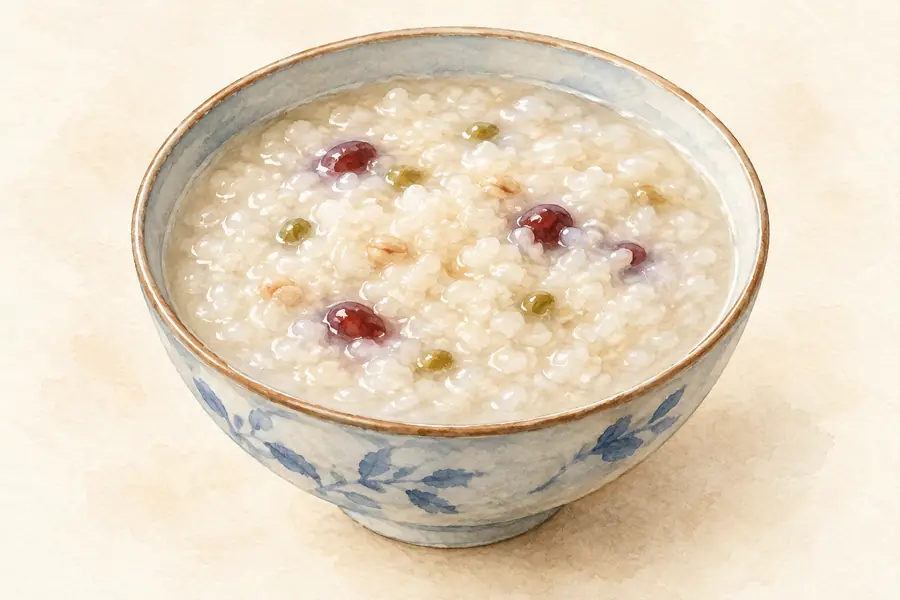
Recent reporting from Gansu describes versions made with beef or lamb broth. A bowl may include thin slices of meat, cabbage, tofu, gluten and 粉皮 (fenpi, starch sheets). Starch water is cooked until thick or used to thicken the soup, then fried dough twists—麻花 (mahua)—are broken into the bowl. Another local description gives a shorter core list: meat broth, mahua, fenpi, sliced meat and cabbage, with green onion, garlic sprouts, Sichuan pepper, caoguo and black pepper for seasoning. These accounts describe a family of preparations, not a fixed formula.
The reason to order it is texture. The soup is spoon-thick rather than clear; fenpi feels smooth, while soaked mahua becomes tender and chewy without necessarily disappearing. Meat and cabbage break up the starchiness. Eat the mahua and fenpi early if you want more contrast, or let them sit longer for a softer bowl.
How to order
Keep the Chinese name on your phone and ask: 有糊饽吗? Yǒu hú bō ma? (“Do you have hu bo?”) If a menu uses the other spelling, look for 糊粕 Hú Pò. Ask 这碗是什么肉? Zhè wǎn shì shénme ròu? (“What meat is in this bowl?”) and 里面有麻花和面筋吗? Lǐ miàn yǒu má huā huómiàn jīn ma? (“Does it contain fried dough twists and gluten?”). Local descriptions include both beef and lamb broth, and some versions include gluten or tofu, so do not infer the ingredients from the pale, thick appearance.
Anyone avoiding meat, wheat-based dough, gluten or possible cross-contact should ask before ordering. The sources do not establish a standard vegetarian, gluten-free or allergy-safe version. The bowl may look like a simple porridge, but the broth and the added dough and starch products matter.
Practical tips
糊饽 is described as a Zhangye breakfast served in ordinary local food shops and stalls, not as a dish tied to the Rainbow Mountains or another attraction.
For a first taste, order one bowl and pay attention to the broth, the slippery fenpi and the way the mahua changes as it soaks. If the shop offers a choice of beef or lamb, use the Chinese question above instead of assuming that “糊饽” fixes the meat. Zhangye food sources present the dish as part of a broader wheat-and-breakfast culture, not as a single inventor’s recipe.
Where to eat it
You can find Thick Broth with Fried Dough Twists all over Gansu, so there is no need to seek out one particular restaurant. To find one near you, search for “糊饽” in Meituan (美团) or Amap (高德地图) and check recent reviews, distance and opening hours.
More dishes to compare
Explore related local specialties and compare their names, preparation notes and ordering guidance.
Shandan chaobola 山丹炒拨拉 →
山丹炒拨拉 comes from 山丹县 in 张掖 and stir-fries chopped liver, lung, tripe, intestine and heart on a broad iron griddle with scallion, garlic sprouts and spice, best eaten hot in winter. 糊饽 is a broth-and-starch breakfast bowl made with meat broth, fried dough twists, starch sheets, sliced meat and cabbage, seasoned with pepper and cardamom instead of chilli. One is dry, fast and offal-heavy; the other is thick, slow and gentle enough for breakfast. 糊饽 is the easier starting point.