

Jingchuan Jar-Shaped Steamed Bread 泾川罐罐蒸馍
Jingchuan Jar-Shaped Steamed Bread is featured among the local specialties of Gansu.
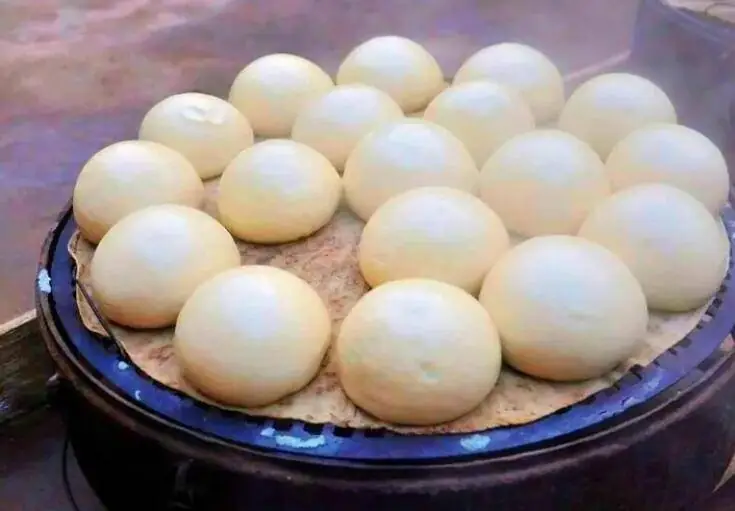
Image notes
Resized for the web; the photo itself has not been edited.
Jingchuan Jar-Shaped Steamed Bread (泾川罐罐蒸馍) is a steamed wheat bun from Jingchuan (泾川) in Pingliang (平凉), Gansu. Also called Qianceng Zhengmo (千层蒸馍), 'thousand-layer steamed bread', it is wider at the top than at the base, like a small jar, which gives it its name.
How it is made
The Pingliang culture and tourism bureau describes a dough of locally grown winter wheat flour, raised with a starter made from the lees of yellow wine (黄酒糟) and no food additives. It counts eleven steps from fermenting the dough to lifting the buns out of the steamer, among them mixing in fresh flour, kneading, letting the dough rest, pinching off portions and shaping each bun. Dry flour is worked in to make a stiff dough that is kneaded again and again before it is divided.
The steaming needs a fire of hard firewood and a very hot steamer, and the bureau notes that the fire has to be fiercer once the buns go in for them to set in their jar shape. In the past, women washed and pounded red wheat, known as 'qimai' (齐麦), left it covered for a day, then rose at cockcrow to grind it on a donkey-drawn mill and sift the flour.
Flavour and texture
Each bun weighs about two liang, roughly 100 grams. The skin is thin, glossy and translucent, and when the bun is torn open the crumb separates into layer upon layer, like a bud about to open. It is soft when hot and crisp when cold. Soaked in boiling water, even a dried bun opens out 'like a white lotus first blooming' without losing its wheat aroma.
The buns keep for a long time without going mouldy, spoiling or losing their flavour, and the bureau calls them a travel essential and a good gift for family and friends. In the 1930s an American living in Jingchuan, named in Chinese as Ge Liubian (葛留编), took batches home on journeys of more than forty days and found them unchanged.
Where it comes from
According to the bureau, the bun is made only in Jingchuan, and traditionally only by hereditary families in a few villages on the edge of the county town: Shuiquansi (水泉寺), Yangpo (阳坡), Lanjiashan (兰家山), Hougou (后沟) and Tianjiagoumen (田家沟门). Two to three hundred households made and sold it in the Republican period; by the 1970s only the state-run restaurant and a few farming families did. Demanding ingredients, slow work and low market prices brought the craft close to dying out from the late 1980s, until Liu Wenmin (刘文敏) of the Jingchuan Guangsheng Food Company (泾川县广胜食品有限责任公司) sought out folk practitioners and mastered the traditional method.
The making technique is on the third batch of Pingliang's municipal intangible cultural heritage list. Local legend holds that the Kangxi Emperor tasted the buns when passing through old Jingzhou (泾州) and made them a yearly tribute.
Sources & reading
Written from the linked sources and fact-checked against them on 2026-09-23. Recipes and servings vary between kitchens.