

Beef and Lamb Offal Soup 牛羊杂割
Beef and Lamb Offal Soup is featured among the local specialties of Gansu.
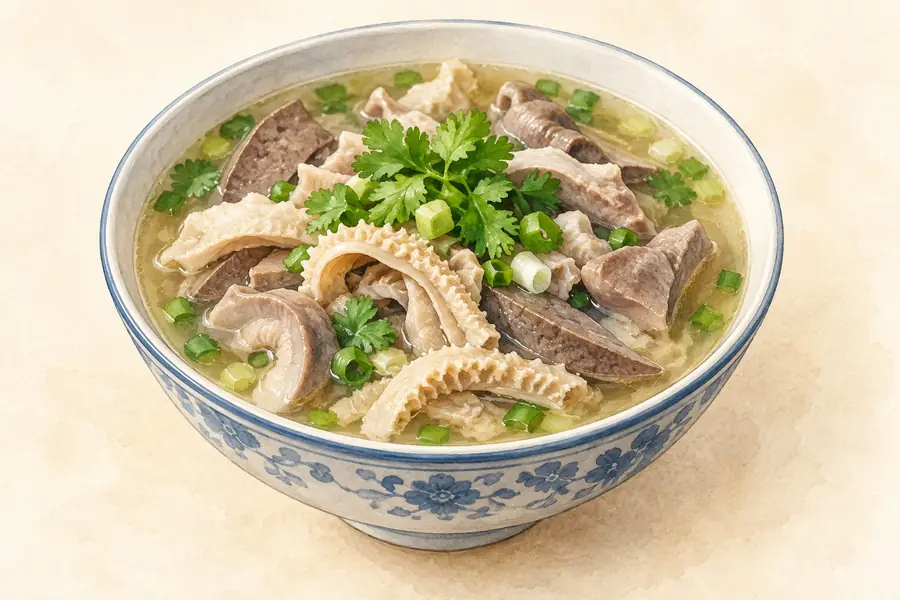
Beef and Lamb Offal Soup (牛羊杂割) is a traditional Hui snack of cattle and sheep offal served in hot broth, and one of the best-loved dishes of Linxia Hui Autonomous Prefecture (临夏回族自治州), Gansu. Minzu Daily (民族日报) names Hezhou beef zage (河州牛杂割) among Linxia's "ten snacks". In Linxia, going out for zage means the beef version; the sheep version is usually called yang zasui (羊杂碎), and the two are eaten differently.
How it is made
The ge (割) in the name means to cut, and the cutting happens at the counter. In a zage shop the broth simmers in a pot while the owner slices ox tongue, cheek meat, tripe, hoof tendon, heart and liver into the bowl with quick, practised knife strokes. Regulars may get extra tendon or tongue without asking. A thin slice of youhulu (油葫芦) goes on top, the broth is ladled over, and chopped garlic shoots and coriander are scattered on to finish.
How it is eaten
Beef zage is eaten as a breakfast, and Gansu Daily (甘肃日报) notes that it carries more meat than a clear mutton soup or yangrou paomo (羊肉泡馍), mutton soup with crumbled bread, which makes it a small luxury at that hour. Diners blow the greens aside and sip the broth first. Many soak flatbread or mahua (麻花), fried dough twists, in the soup; the twists hold together and stay chewy. Others take a bite of bread, then a spoonful of broth, and some go on to a second bowl of broth. Many visitors new to Linxia used to shy away from it, but beef zage has been winning over travellers in recent years.
Where it comes from
China Linxia Net (中国临夏网), the prefecture's news site, says Hui cooks had already mastered zage by the Ming dynasty. It cites the travel writer Xu Xiake (徐霞客): in 1638, while exploring around Kunming (昆明) in Yunnan, he was kept as a guest by the Hui poet Ma Yunke (马云客). Each day Ma killed a chicken for him and served dishes that were mostly beef and mutton zage and dried meat, which Xu noted were very clean and finely prepared.
Sources & reading
Written from the linked sources and checked sentence by sentence against quoted extracts by a separate reviewer on 2026-09-23. Recipes and servings vary between kitchens.